Lamium maculatum
Spotted dead nettle
Every Lamium maculatum on HortOS in one place: the plain species and 5 varieties. Pick a size to see it across all of them.
Part of Lamium: see them all
6 growers · 3 sizes · from $1.00 ex tax
- Type
- Semi-evergreen perennial
- Height
- 0.08 m to 0.5 m
- Spread
- 0.3 m to 1 m
- Growth
- Fast
- Flowers
- Pink, late spring to summer, sometimes on into autumn; summer by HortFlora and the RHS
- Sun
- Part shade to full shade
- Hardiness
- Canadian zones 2b to 8a (Natural Resources Canada)
- In Canada
- Naturalised
Growing spotted dead-nettle
In Canada. VASCAN lists spotted dead-nettle as introduced in Alberta, Ontario, Quebec and Newfoundland, and as ephemeral in British Columbia.
Hardiness. Natural Resources Canada's records show it growing in zones 2b to 8a in Canada. The KPU Plant Database rates it zone 4, which it gives as -34 to -29 C without naming the scale. NC State Extension gives USDA zones 3 to 8, and the RHS rates it H7. The Wisconsin extension says it dies back in cold climates and can stay evergreen in mild ones.
Light and soil. KPU gives part sun to deep shade, full sun only if the soil is kept moist, well-drained soil and moderate water use. NC State Extension grows it in shade, heavy shade included, in average, evenly moist but well-drained soil; it says the plant will tolerate dry soil but does poorly in compacted or wet soil and in high heat and humidity, and that leaf scorch can follow if the soil dries out or the plant is grown in too much sun.
Care and pests. The RHS suggests cutting back after flowering to encourage fresh foliage, and NC State Extension says bare patches in hot, humid summers can be cut back to stimulate new growth. KPU lists slugs and snails and marks it deer and rabbit resistant; NC State Extension calls aphids and slugs occasional problems.
Using spotted dead-nettle
Spotted dead-nettle is a groundcover for shade. KPU lists it for groundcover, bedding, container planting, hanging baskets and the perennial border, for summer interest. NC State Extension calls it a good groundcover for moist, shady areas, suggests starter plants 0.15 to 0.25 m apart for quick cover, and advises siting it where there is little foot traffic.
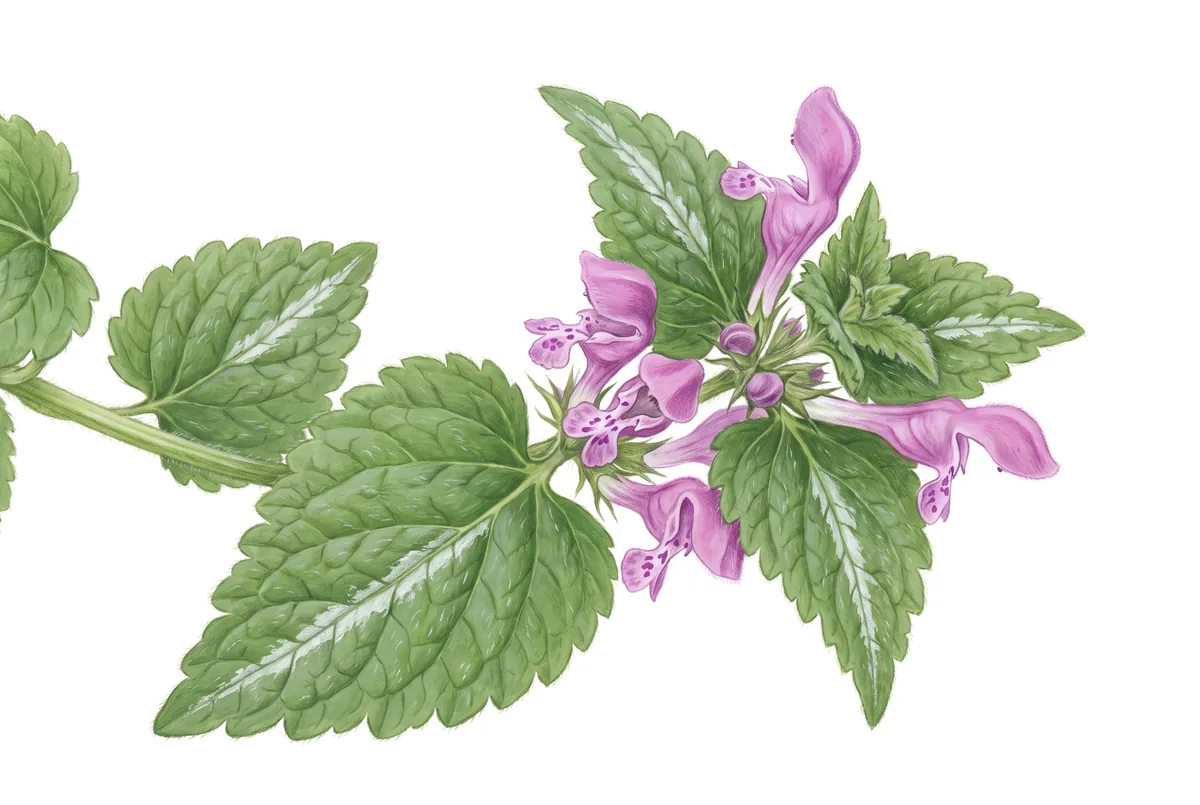
The flowers are two-lipped, the upper lip a hood, in whorls on the upper part of the stem; KPU gives them about 2 cm long, in colours from white and pink to violet, magenta and red. Most lines are named forms that differ in leaf marking and flower colour: Red Nancy has its own page, and KPU names 'Ghost', 'Golden Anniversary', 'Hermann's Pride' and 'Purple Dragon' among the cultivars it may show.
What to check before you buy
The KPU Plant Database classes spotted dead-nettle as an invasive plant and a horticultural weed, calls it an invasive, stoloniferous perennial and says it is best kept in containers to control its spread. NC State Extension says it spreads indefinitely by stems that root in the ground, though it calls it easy to control and not considered aggressive. Canadian growers list it mostly by cultivar, among them Red Nancy, White Nancy, Ghost, Purple Dragon and Pink Pewter, so read the full name on each line. Canadian growers name containers by class, as the guide to plant grades and container sizes explains, and the guide to nursery plant quality sets out the root and pest checks. The table above shows the sizes growers list.
Prices are set by each grower and shown ex tax. Availability is confirmed by the grower at order.
Common questions
- Who grows Lamium maculatum wholesale in Canada?
- 6 wholesale growers list Lamium maculatum on HortOS right now, each with their own pot sizes and trade prices. They are in Alberta, Ontario, Quebec and British Columbia. The growers are named on this page.
- What pot sizes does Lamium maculatum come in?
- Growers on HortOS list Lamium maculatum in 100mm, 110mm and 1G.
- How do I order Lamium maculatum from these growers?
- HortOS is for the trade. Add the lines you want to a list and send it: each grower gets their part of the order by email, confirms what they have and quotes freight, and nothing is bought until you approve it. Listing, searching and ordering are free.
- Is spotted dead-nettle native to Canada?
- No. VASCAN records it as introduced in Alberta, Ontario, Quebec and Newfoundland and as ephemeral in British Columbia. NC State Extension and the Missouri Botanical Garden give its home range as Europe and North Africa to West Asia.
- Is spotted dead-nettle invasive?
- The KPU Plant Database of Kwantlen Polytechnic University's School of Horticulture classes it as an invasive plant and a horticultural weed and suggests keeping it in containers. NC State Extension calls it vigorous but easy to control and not considered aggressive.
- How hardy is spotted dead-nettle in Canada?
- Natural Resources Canada's records show it growing in zones 2b to 8a in Canada, and the KPU Plant Database rates it zone 4 (-34 to -29 C; its page names no scale). The Wisconsin extension says it dies back in cold climates.
- Will spotted dead-nettle grow in deep shade?
- Yes, by the references read. KPU lists deep and filtered shade among its exposures, and NC State Extension says it does best in shade, heavy shade included. KPU allows full sun only where the soil is kept moist.
- How far apart is spotted dead-nettle planted as a groundcover?
- NC State Extension suggests starter plants 0.15 to 0.25 m apart for quick cover. From there the plant spreads by sprawling stems that root where they touch the ground.
- Do deer eat spotted dead-nettle?
- The KPU Plant Database marks it deer and rabbit resistant, and NC State Extension lists deer among the challenges it resists.
Sources
- GBIF species match API
- VASCAN, the Database of Vascular Plants of Canada (Canadensys): Lamium maculatum
- Royal Horticultural Society, RHS Plants: Lamium maculatum (spotted deadnettle)
- North Carolina State Extension Gardener Plant Toolbox: Lamium maculatum
- Missouri Botanical Garden Plant Finder: Lamium maculatum 'White Nancy' (with its note on the species)
- University of Wisconsin-Madison Division of Extension, Wisconsin Horticulture: Spotted deadnettle, Lamium maculatum
- Natural Resources Canada, Canada's Plant Hardiness Site: Lamium maculatum
- Kwantlen Polytechnic University, School of Horticulture, KPU Plant Database: Lamium maculatum (spotted deadnettle)
- The HortOS catalogue for Canada: the listing rows for Lamium maculatum
- The HortOS guides for Canada: plant grades and container sizes by market; nursery plant quality
The growers, sizes and prices above are live and change as lists arrive. Cite this page: HortOS, Spotted dead-nettle (Lamium maculatum), https://ca.hortosapp.com/plants/lamium-maculatum.
Found a fact that is wrong? Tell us and it is checked against its source.