Carex oshimensis
sedge
Every Carex oshimensis on HortOS in one place: the plain species and 9 varieties. Pick a size to see it across all of them.
Part of Carex: see them all
12 growers · 7 sizes · from $2.05 ex tax
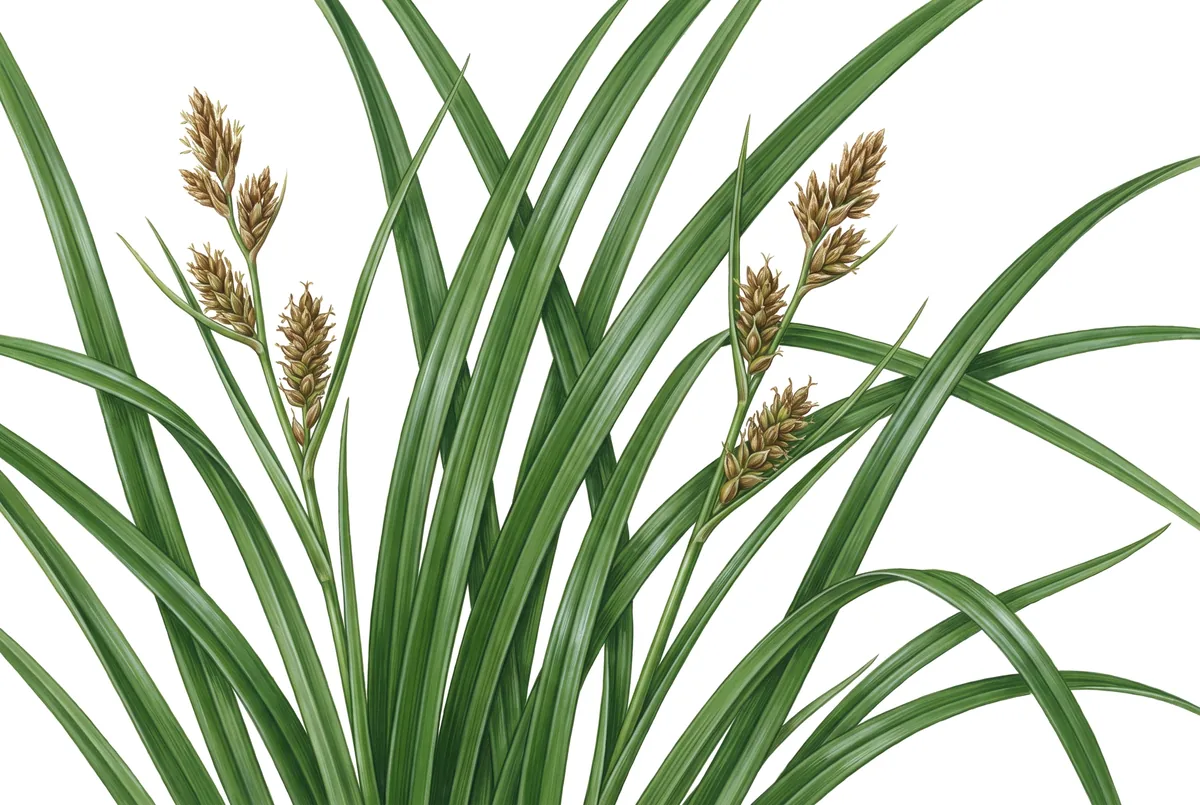
- Type
- Evergreen perennial
- Height
- 0.25 m to 0.46 m
- Spread
- 0.25 m to 0.43 m
- Growth
- Moderate
- Flowers
- Brown, spring to summer
- Sun
- Full sun to part shade (North Carolina State Extension); part shade (the Missouri Botanical Garden, for 'Evergold')
- In Canada
- Not native
Growing japanese sedge
Climate. No Canadian reference read gives a hardiness zone for the species: Natural Resources Canada's plant hardiness site holds a page for it under the name variegated Japanese sedge, with no zone range. North Carolina State Extension rates it for USDA zones 5a to 9b. The Missouri Botanical Garden, writing of the species on its Evergold page, says it is evergreen in the deep South of the United States but not fully evergreen around St. Louis, though some leaf colour lasts through mild winters.
Light and soil. North Carolina State Extension gives full sun to partial shade and rich, moist to wet soil, kept especially moist in full sun. It says the plant takes some temporary flooding but not drought, while Missouri, writing of Evergold, finds it more tolerant of dry spells than most sedges.
Growth and care. North Carolina State Extension says the plant does not spread, but the clump slowly grows larger over the years, and it can be lifted and divided in autumn or spring. Missouri says Evergold spreads slowly by short rhizomes and, where it is not evergreen, is cut to the ground in late winter.
Pests. American references report no serious problems, though North Carolina State Extension says aphids are sometimes troublesome.
Using japanese sedge
North Carolina State Extension suggests mass planting as a groundcover, use as an accent or specimen, the front of a border and the shade of woodland plantings, and calls it ideal for riparian areas, rain gardens and pond margins and good in containers. Missouri, on its Evergold page, suggests grouping or massing it as a groundcover in part shade, as an edging for paths, and for moist low spots and the margins of streams and ponds. No reference read gives planting centres.
What to check before you buy
Canadian growers list this sedge almost wholly by its named forms, Evergold, Everest, Everillo, Everlime, Evercream, Eversheen, Lunar Falls and Moon Falls among them, and some lines use the shortened name Carex oshi. or Carex hachijoensis; check the cultivar name on the line, since North Carolina State Extension gives Everest green leaves with white margins and Everillo lime-green leaves. The table above shows the sizes growers list; Canadian growers name containers by class, #1, #2, #3, #5 and #10, as the guide to plant grades and container sizes explains, and the guide to nursery plant quality sets out the root checks before stock leaves the grower.
Used forgroundcovermass plantingpots and courtyardswetland and riparian
Prices are set by each grower and shown ex tax. Availability is confirmed by the grower at order.
Common questions
- Who grows Carex oshimensis wholesale in Canada?
- 12 wholesale growers list Carex oshimensis on HortOS right now, each with their own pot sizes and trade prices. They are in British Columbia and Ontario. The growers are named on this page.
- What pot sizes does Carex oshimensis come in?
- Growers on HortOS list Carex oshimensis in 50 cell plug, 72 cell plug, 32 plug tray, 72 plug tray, 1G, 2G and 50G.
- How do I order Carex oshimensis from these growers?
- HortOS is for the trade. Add the lines you want to a list and send it: each grower gets their part of the order by email, confirms what they have and quotes freight, and nothing is bought until you approve it. Listing, searching and ordering are free.
- Is Japanese sedge native to Canada?
- No. Hokkaido University gives Carex oshimensis as endemic to the Izu Islands of central Japan, on forest floors, volcanic deserts and roadsides; North Carolina State Extension gives Oshima Island, and the Missouri Botanical Garden dry woods and rocky slopes throughout Honshu.
- How big does Carex oshimensis grow?
- Hokkaido University gives about 30 to 40 cm tall. The Missouri Botanical Garden gives a low mounded clump 0.25 to 0.4 m tall and as wide, and North Carolina State Extension about 0.3 to 0.46 m tall and 0.3 to 0.43 m wide.
- Is Carex oshimensis the same as Carex hachijoensis?
- Some Canadian listings of these sedges, Evergold among them, give Carex hachijoensis among their common names. The RHS, on its Evergold page, gives Carex hachijoensis 'Evergold' as a synonym of Carex oshimensis 'Evergold'.
- Does Japanese sedge stay green in winter?
- Hokkaido University calls the species evergreen. Missouri, writing of the species on its Evergold page, says it is evergreen in the deep South of the United States but not fully evergreen around St. Louis, and that it is cut to the ground in late winter where it is not evergreen.
Sources
- GBIF species match API
- VASCAN, the Database of Vascular Plants of Canada: name search, Carex oshimensis
- Hokkaido University, Graduate School of Environmental Science, plant list (Cyperaceae, Carex): Carex oshimensis Nakai
- North Carolina State Extension Gardener Plant Toolbox: Carex oshimensis
- Missouri Botanical Garden Plant Finder: Carex oshimensis 'Evergold', with its notes on the species
- Natural Resources Canada, Canada's Plant Hardiness Site: Carex oshimensis
- RHS (Royal Horticultural Society) plant profile: Carex oshimensis 'Evergold' (v), with its synonyms
- The HortOS guides for Canada (plant grades and container sizes; nursery plant quality)
- The HortOS catalogue for Canada (the names growers list Carex oshimensis and its forms under on ca.hortosapp.com)
The growers, sizes and prices above are live and change as lists arrive. Cite this page: HortOS, Japanese sedge (Carex oshimensis), https://ca.hortosapp.com/plants/carex-oshimensis.
Found a fact that is wrong? Tell us and it is checked against its source.