Artemisia stelleriana
sagebrush / wormwood
Part of Artemisia: see them all
Grown by 1 nursery · no sizes or prices listed
- Type
- Semi-evergreen perennial
- Height
- 0.3 m
- Growth
- Moderate
- Flowers
- Yellow, summer
- Sun
- Full sun (the RHS, North Carolina State Extension, the Chicago Botanic Garden)
- Hardiness
- Canadian zones 2b to 7b (Natural Resources Canada)
- In Canada
- Naturalised
Also grown by 1 nursery (no sizes or prices listed)
Enquire with them for sizes and prices.
- Ground Effects Wholesale Nurseries Ltd.Langley, British Columbia
Growing beach wormwood
In Canada. VASCAN, the Database of Vascular Plants of Canada, records it as introduced in British Columbia, Ontario, Quebec, New Brunswick, Nova Scotia, Prince Edward Island and the island of Newfoundland. E-Flora BC treats it as not established in British Columbia: first collected at Victoria in 1948, it has not been reported since. Natural Resources Canada maps its observations in Canada from zone 2b to 7b, an observed range, not a rating, with most of its records outside the country.
Position and soil. North Carolina State Extension gives loam, sand or shallow rocky soil, acid to alkaline, and says it does not tolerate wet soils or shade; the RHS says it will suffer in heavy, poorly drained soil. In a four-year trial, the Chicago Botanic Garden found that too much soil moisture over winter, rather than cold, caused the decline and death of its plants, recorded melt-out, the rotting of part of the crown, after heavy rain and high humidity, and suggested that lighter soils with sharp drainage may reduce winter losses.
Cold. American references give USDA zones, a different scale from Canada's: 3 to 9 by North Carolina State Extension, 4 to 7 by the Chicago Botanic Garden. The RHS rates it H5, hardy in most places in the United Kingdom even in severe winters.
Upkeep. The RHS trims it in spring if it needs tidying and calls it generally pest-free, though it may be susceptible to honey fungus. North Carolina State Extension, an American reference, calls it easy to grow, with a medium growth rate, and lists heat, drought, dry and poor soil, salt and deer among the challenges it resists.
Using beach wormwood
North Carolina State Extension describes a creeping groundcover and edging plant for dry areas, common in coastal gardens of the American South, and suggests it for rock gardens, containers, borders and coastal sites; it says the flowers draw butterflies and bees. The RHS suggests it for ground cover, garden edging, gravel and coastal gardens, cottage gardens and city and courtyard gardens, and the Chicago Botanic Garden lists it for beds, borders and groundcover. Its yellow flower heads are small, 6 to 7 mm across by Go Botany, and the Chicago trial found that the flowers of nearly every artemisia it grew ended up detracting from the display. The genus page covers the other artemisias; its low form 'Silver Brocade' has its own page.
What to check before you buy
The HortOS catalogue for Canada lists it as Artemisia stelleriana and as the form 'Silver Brocade', also spelt 'Silver Brochade'. The RHS files 'Silver Brocade' as a synonym of its 'Boughton Silver', so check which form a line names. The table above shows the sizes growers list, and the guide to plant grades and container sizes explains the Canadian container classes, from the #1 up. For roots and pests, see the guide to nursery plant quality. The drawback to weigh is wet ground in winter, set out above.
Used forgroundcoverpots and courtyards
Prices are set by each grower and shown ex tax. Availability is confirmed by the grower at order.
Common questions
- Is beach wormwood native to Canada?
- VASCAN records it only as introduced in Canada, from British Columbia to Newfoundland. North Carolina State Extension gives its home as China, Japan, Korea, the Russian Far East and Alaska's Aleutian Islands, and also names western Canada.
- How big does beach wormwood grow?
- The RHS puts it in its 0.1 to 0.5 m height class and its 0.5 to 1 m spread class; the Chicago Botanic Garden gives about 0.3 m tall. It creeps by rhizomes, by North Carolina State Extension (Go Botany notes the rhizome), into what the RHS calls a mat.
- What kills beach wormwood over winter?
- In the Chicago Botanic Garden's trial it was too much soil moisture in winter, not cold, that caused the decline and death of its plants. The garden suggests lighter soils with sharp drainage.
- Does beach wormwood flower?
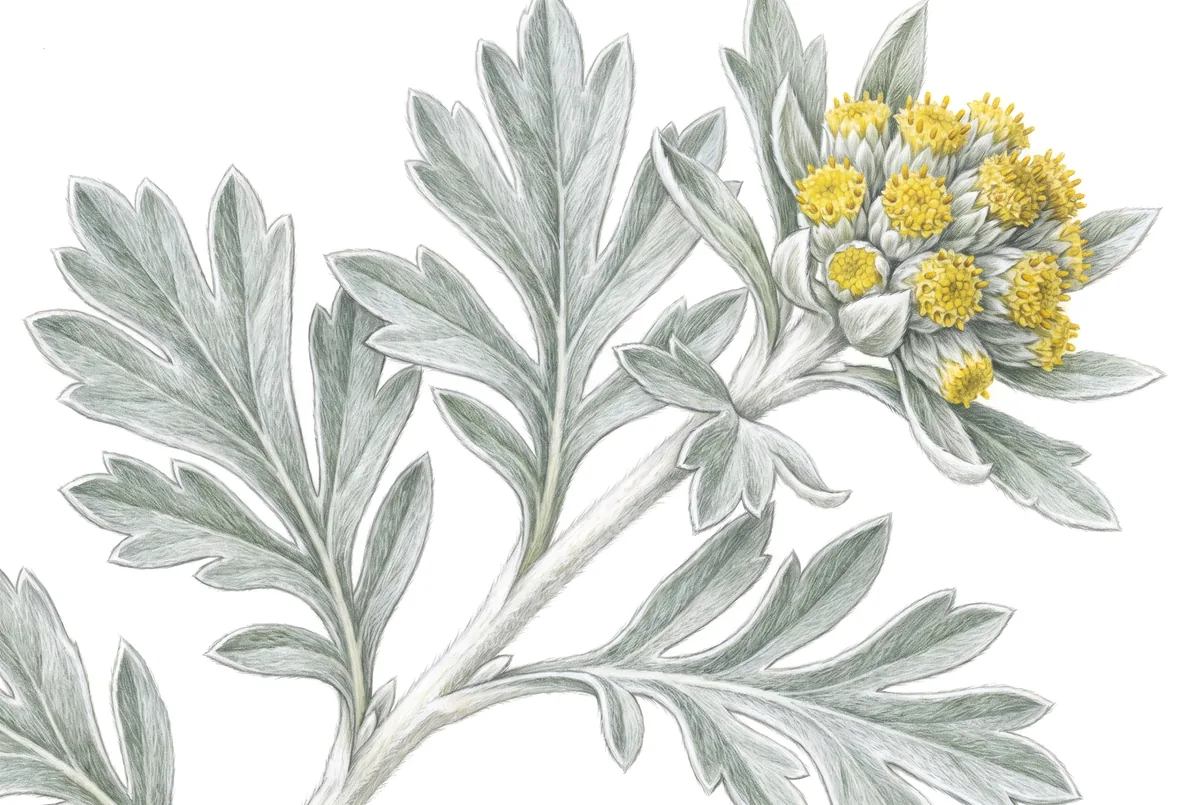
- Yes. The RHS describes small yellow flowers held above the leaves in summer, and the Chicago Botanic Garden gives July to August. Go Botany says each head is made of disc flowers only, with no ray flowers.
- Is beach wormwood evergreen?
- The RHS says it often stays evergreen but may lose its leaves in very cold winters. North Carolina State Extension says it keeps its leaves year round.
Sources
- GBIF species match API
- VASCAN, the Database of Vascular Plants of Canada: Artemisia stelleriana
- Natural Resources Canada, Canada's Plant Hardiness Site: Artemisia stelleriana
- E-Flora BC, the Electronic Atlas of the Flora of British Columbia (University of British Columbia): Artemisia stelleriana
- Go Botany (Native Plant Trust): Artemisia stelleriana
- North Carolina State Extension Gardener Plant Toolbox: Artemisia stelleriana
- RHS Plants (Royal Horticultural Society): Artemisia stelleriana
- Chicago Botanic Garden, Plant Finder: Artemisia stelleriana
- Chicago Botanic Garden, Plant Evaluation Notes: An Evaluation Report of Artemisias
- RHS Plants (Royal Horticultural Society): Artemisia stelleriana 'Boughton Silver', with its synonyms
- The HortOS catalogue for Canada (the listing names)
- The HortOS guides for Canada (plant grades and container sizes by market; nursery plant quality)
The growers, sizes and prices above are live and change as lists arrive. Cite this page: HortOS, beach wormwood (Artemisia stelleriana), https://ca.hortosapp.com/plants/artemisia-stelleriana.
Found a fact that is wrong? Tell us and it is checked against its source.