Stormwater Fee Credits and Rain Garden Rebates in Canadian Cities
For stewardship groups, property managers and homeowners in Canada: what nine utilities from Victoria to Halifax credit or rebate for holding stormwater on site, who can apply, what each program says about planting and trees, and how many Canadian nurseries grow the rain garden plants that STEP rates for Ontario and the City of Victoria lists. Counts only.
Updated October 9, 2026. Counts are what the live ca.hortosapp.com plant pages printed; medians are not published yet.
On this page
A stewardship group helping a homeowner in Kitchener or Victoria plan a rain garden gets asked the same thing each time: how much comes off the stormwater bill, and does the planting change the answer. In the Canadian programs read for this page, the credit or rebate is measured in water held or area treated, and one program alone sets a rule about which plants go in.
The page draws on the program pages of nine utilities, three municipal by-laws, the City of Victoria's 2015 rainwater standards and the Ontario planting guidance of the Sustainable Technologies Evaluation Program (STEP). HortOS, a free directory of Canadian wholesale plant growers with their published availability and trade prices, adds how many nurseries grow each plant that STEP and the City of Victoria name. It is a dated summary, not a ruling on any application.
Quick facts
| Kitchener | The City of Kitchener, Ontario, says in 2026 that a property can earn a credit of up to 45 per cent of its monthly stormwater utility fee, and the top level needs more than 3,200 litres captured. |
|---|---|
| Waterloo | The City of Waterloo, Ontario, sets residential credits of 9 to 45 per cent in By-law 2026-053, last passed by council on 22 June 2026, and the same by-law ends credits for tree planting, canopy and preservation. |
| Guelph | The City of Guelph, Ontario, pays up to $2,000 for a rain garden installed in 2026, based on the litres it holds and the cost of installation, against receipts. |
| Victoria | The City of Victoria, British Columbia, lists a 2026 rebate of $15 a square metre for a rain garden, bioswale or infiltration chamber, from a minimum of $375 to a maximum of $1,000. |
| Thunder Bay | EcoSuperior, which delivers the rebate the City of Thunder Bay, Ontario, funds, says in 2026 that it returns up to $625 on plants and landscaping materials, and at least 50 per cent of the plants must be native species or cultivars. |
| Hamilton | The City of Hamilton, Ontario, said on its page read on 5 October 2026 that it will bring in a stormwater fee in 2027, and that its rebate for residents has a lower tier capped at $1,500 and a higher one capped at $5,000. |
What each program credits or rebates
The table sets nine utilities side by side, with Victoria's credit and its rebate in separate rows. Each row is what the city, its utility or its delivery body printed on the day it was read, with the authority and the year in the last column. It is a selection of Canadian programs, not a full register of them.
| City | Credit or rebate | Who can apply | What the program says about planting | Authority and year |
|---|---|---|---|---|
| Kitchener, Ontario | A credit of up to 45 per cent on the monthly stormwater fee; the top level needs more than 3,200 litres captured | Detached and semi-detached homes, townhomes, condominiums and buildings of two to five units | Rain gardens are one of five measures the page names for homes | City of Kitchener, 2026 |
| Waterloo, Ontario | For residential property, a credit of 9 to 45 per cent in five bands set by litres stored; 3,361 litres or more earns the top band | Owners of a single home or duplex, and owners of multi-residential or non-residential property | Rain gardens and bioretention areas are named as eligible; under the 2026 by-law tree planting, canopy and preservation earn no credit | City of Waterloo By-law 2026-053, passed June 2026 |
| Guelph, Ontario | A rebate of up to $2,000 for a rain garden installed in 2026, worked out from the litres it holds and what it cost to install | Residents, once the program's advisor has helped with a plan and a pre-approval form has gone in | The advisor's visit includes a garden design and recommended plants | City of Guelph, 2026 |
| Hamilton, Ontario | A rebate for new low impact development projects at a home, in two tiers: one to $1,500 and one to $5,000 | Residents for the rebate; industrial, commercial and institutional properties, and multi-residential ones, for credits on the fee | Rain gardens and permeable surfaces are the examples given of projects the rebate funds | City of Hamilton, 2026; the fee itself is due to start in 2027 |
| Mississauga, Ontario | A credit capped at 50 per cent of the stormwater charge for any one property | Businesses and multi-residential properties | Bioretention is named as green infrastructure that can count toward the runoff volume credit | City of Mississauga, 2026 |
| Thunder Bay, Ontario | Up to $625 back on plants and other supplies for a rain garden | Owners of residential property inside the city | At least half of the plants claimed have to be native species or cultivars | EcoSuperior for the City of Thunder Bay, 2026 |
| Victoria, British Columbia (credit) | A yearly credit capped at 10 per cent of the stormwater user fee on low density residential property; on other classes the cap is 40 per cent, or 50 with an education credit | Any owner whose property pays the stormwater user fee, by application to the City | The by-law defines a rain garden as a shallow landscaped depression with bioretention soil and vegetation | City of Victoria Bylaw No. 14-071, consolidated January 2026 |
| Victoria, British Columbia (rebate) | A rebate of $15 a square metre for a rain garden, bioswale or infiltration chamber, from a minimum of $375 to a maximum of $1,000 | People who own and live in a home of one to four units | The City's 2015 professional standards carry a plant list for rain gardens: trees, edge species and bottom species | City of Victoria, 2026 |
| Halifax, Nova Scotia | A credit of 30 to 50 per cent on the site related flow charge, rising with the size of storm the site detains | Non-residential stormwater customers; a residential customer can ask to be billed as non-residential and file the same documents | Green infrastructure and engineered wetlands are listed design components; the test is peak flow held to the pre-development rate for at least the 1-in-5-year storm | Halifax Water, 2026 |
| Saskatoon, Saskatchewan | Credits that together cannot pass 50 per cent of the storm water management charge | Owners of commercial, industrial, institutional or multi-residential property with an onsite practice in place | Rain gardens are named among the low impact development works that can earn the onsite retention credit | City of Saskatoon Bylaw No. 9545, codified to December 2025 |
Some rows need a line more than a cell can hold. The five bands in Waterloo's row are the residential ones, from the residential schedule of By-law 2026-053 (Waterloo, Ontario, 2026): 200 to 500 litres of storage earns 9 per cent, and 3,361 litres or more earns 45 per cent. The City of Kitchener, Ontario, describes three residential levels in 2026: 20 per cent for 200 to 800 litres captured, 30 per cent for 801 to 3,200 litres, and 45 per cent above that.
Guelph's rebate works differently from a credit. The City of Guelph, Ontario, gives a 2026 example of a 4,000 litre rain garden, about 13 square metres, that could bring $2,000 back at $0.50 a litre. In its second 2026 example, a garden that pre-qualified for $2,000 and cost $1,500 to install is rebated $1,500. In Hamilton, Ontario, By-law No. 25-100 received Council's approval on 7 May 2025, as the City's June 2025 update to Council records. The City of Hamilton, Ontario, says on its page in 2026 that the rebate is for new projects, that Green Venture will administer it, and that a residential property of 6 or fewer units cannot get a fee credit.
What the programs measure, and what they say about trees
None of the credits in the table is set by a species list. Kitchener, Waterloo and Guelph count litres, Victoria's rebate counts square metres, and Halifax Water tests peak flow. Saskatoon's Bylaw No. 9545 (Saskatchewan, codified to December 2025) bases its onsite retention credit on 2 per cent for each millimetre of storm water retained, up to 25 millimetres. Halifax Water, Nova Scotia, says in 2026 that it gives no credit for private works installed to manage stormwater quality.
Conditions on the garden itself differ by document. The City of Waterloo, Ontario, says in 2026 that a rain garden earning its credit must hold a measurable volume, take runoff straight from a hard surface and soak away within 72 hours of rain. STEP's rain garden page (Ontario, 2026) says such a garden is not a constructed wetland and is designed to drain fully within 48 hours.
On trees, the clearest statement is in Waterloo, Ontario, where By-law 2026-053 (2026) says in its residential schedule that "tree related credits are removed". It issues no credit for planting a tree, for canopy or for preserving a tree, and a tree credit granted earlier runs to the end of its term and is not renewed. The City of Kitchener, Ontario, mentions tree planting in 2026 under a separate project that helps homeowners lower flood risk, not under a credit level. The City of Victoria's 2015 professional standards (British Columbia) do not allow trees in a rain garden built over a rock reservoir.
The plants two authorities list, and the nurseries growing them
STEP and the City of Victoria each publish rain garden plants with ratings a designer can use. STEP's cover low impact development in Ontario and are shared under a Creative Commons licence. STEP (Ontario, 2026) rates soil moisture as 1 for dry, 2 for moist and 3 for wet, and a rating written as a range means the plant tolerates a range. Its guide points plants rated 3 to the low zone that floods in rain, plants rated 2 to the middle zone and plants rated 1 to the high, driest zone. STEP (Ontario, 2026) also says a plant with low salt tolerance should not go where runoff arrives from salted roads and parking lots.
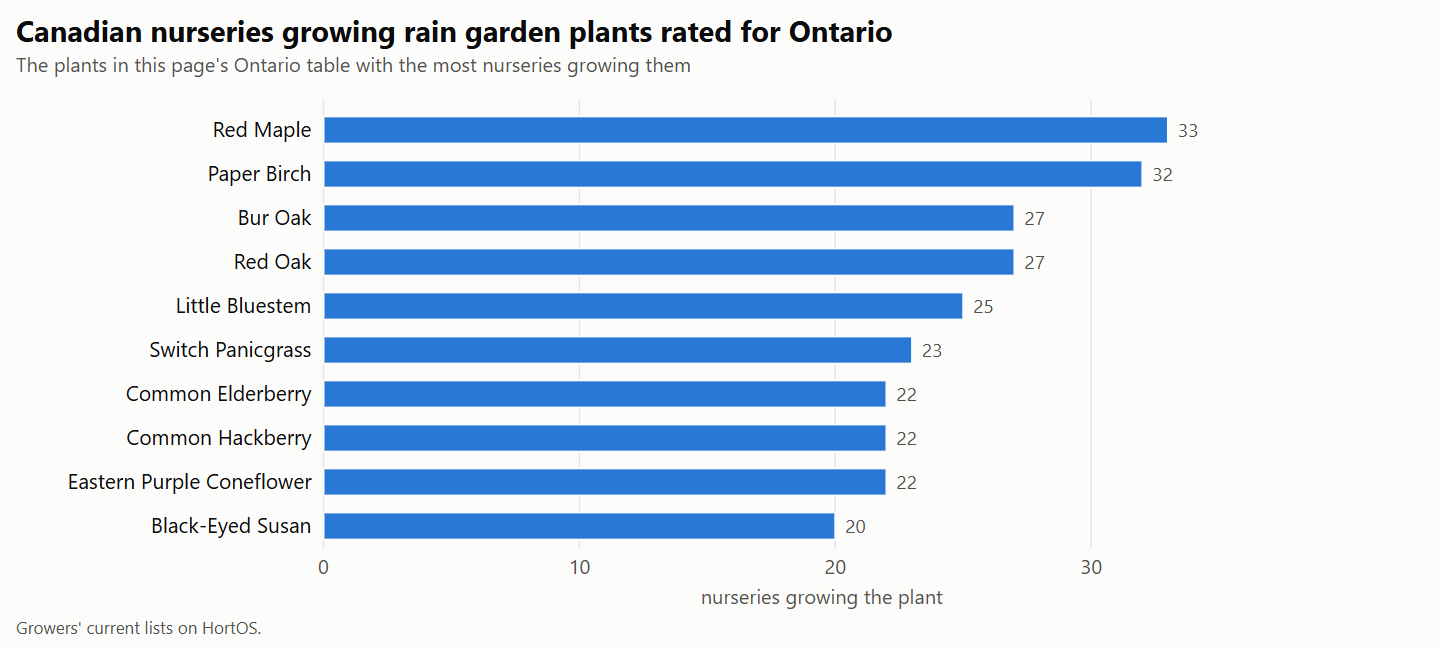
The table below is a selection from STEP's pages: the plants STEP marks with a star, which it gives to species that did well in projects it designed, installed and monitored (STEP, Ontario, 2024). It shows the starred species that have a plant page on HortOS, with the one cultivar STEP starred by name, and two of STEP's rating columns. That is 38 plants, and 203 other rated plants on STEP's pages are not shown. Counts are the nurseries each plant's page on HortOS showed as growing it. A count here is growers listing the plant, not how many plants exist or how well it suits a site. Median trade prices are not published for Canada yet.
Counts are the nurseries each plant page shows as growing the plant, with or without sizes listed.
Three names differ from STEP's. Common elderberry and grey dogwood sit under the species names that the Database of Vascular Plants of Canada (VASCAN, Canada, 2026) accepts, where STEP writes them as subspecies. Bayberry is STEP's Morella pensylvanica, which VASCAN (Canada, 2026) gives as the accepted name with Myrica pensylvanica as its synonym. Red Maple heads the table with 33 nurseries growing it, and Blue Flag Iris, one of the plants STEP rates 3 for soil moisture alone, has 16.
The second list is the rain garden plant list in the City of Victoria's Rainwater Management Standards, Professional Edition, of June 2015 (British Columbia). The City groups its plants as trees, edge species and bottom species, and a footnote marks the species native to the Pacific Northwest coast. The table shows the species on that list that have a plant page on HortOS, in the City's three groups; the entries the City lists as named cultivars are left out, and 6 entries in all are not shown. "Not marked" means the 2015 list prints no native mark beside the name, and nothing more.
| Plant | Place in the rain garden (City of Victoria, B.C., 2015) | Marked native to the Pacific Northwest coast (City of Victoria, B.C., 2015) | Nurseries growing it |
|---|---|---|---|
| Vine Maple (Acer circinatum) | Tree, at the bottom or the edge | Yes | 8 |
| Red Maple (Acer rubrum) | Tree, at the bottom or the edge | Not marked | 33 |
| Katsura (Cercidiphyllum japonicum) | Tree, at the bottom or the edge | Not marked | 19 |
| Eastern Redbud (Cercis canadensis) | Tree, at the bottom or the edge | Not marked | 26 |
| Tupelo (Nyssa sylvatica) | Tree, at the bottom or the edge | Not marked | 8 |
| Salal (Gaultheria shallon) | Edge | Yes | 15 |
| Box-leaf Honeysuckle (Lonicera pileata) | Edge | Not marked | 9 |
| Oregon Grape (Mahonia aquifolium) | Edge | Yes | 16 |
| Pacific Wax Myrtle (Myrica californica) | Edge | Yes | 7 |
| Nootka Rose (Rosa nutkana) | Edge | Yes | 6 |
| Sword Fern (Polystichum munitum) | Edge | Yes | 15 |
| Snowberry (Symphoricarpos albus) | Edge | Yes | 18 |
| Evergreen Huckleberry (Vaccinium ovatum) | Edge | Yes | 17 |
| David's Viburnum (Viburnum davidii) | Edge | Not marked | 11 |
| Slough Sedge (Carex obnupta) | Bottom | Yes | 6 |
| Awl Fruited Sedge (Carex stipata) | Bottom | Yes | 12 |
| Dwarf Arctic Iris (Iris setosa) | Bottom | Yes | 2 |
| Bog Myrtle (Myrica gale) | Bottom | Yes | 7 |
Counts are the nurseries each plant page shows as growing the plant, with or without sizes listed.
In the Victoria table, Salal is an edge plant with 15 nurseries growing it, and Awl Fruited Sedge, the bottom species with the most nurseries, has 12.
What these tables do not show
A nursery count is national. It is not a count for Ontario or for British Columbia, and the nurseries of each province are on their own pages, for Ontario and for British Columbia. A count does not show where a nursery's seed came from, whether its plants are the straight species or a cultivar, or which sizes it lists. A low count is a count and no more.
STEP speaks to those gaps in its own guidance. Its guide (Ontario, 2026) says to refer to the scientific name when buying native plants from commercial nurseries and garden centres. It also says the origin of plant material, and how it was collected and propagated, should be confirmed with the grower or nursery (STEP, Ontario, 2026). The Toronto and Region Conservation Authority's 2018 guide (Ontario) says rain garden plants have to cope with wet conditions and with dry ones. For a group that has not bought from a trade nursery before, the guide to buying from a wholesale grower explains how growers set their terms.
The tables also say nothing about what a program's advisor would specify for one yard. The City of Guelph, Ontario, says in 2026 that its advisor's home visit includes a garden design and plant recommendations. For the size of the trade behind the counts, the nursery industry statistics guide gives the national picture.
What to watch for
- Reading the top percentage as what one garden earns. Waterloo's By-law 2026-053 (Ontario, 2026) grants 9 per cent for 200 to 500 litres of storage and 45 per cent only from 3,361 litres.
- Treating a rebate ceiling as a payment. The City of Guelph, Ontario, says in 2026 that receipts for installation expenses must be submitted to get the rebate.
- Assuming every property class can apply. Halifax Water, Nova Scotia, describes its 2026 credits as being for non-residential stormwater customers, and the City of Saskatoon's program page (Saskatchewan, 2026) speaks of commercial and multi-residential properties.
- Carrying one city's cap to another property class. Victoria's Bylaw No. 14-071, consolidated in January 2026 (British Columbia), caps the credit at 10 per cent of the stormwater user fee on low density residential property. On the other classes the same 2026 by-law of Victoria, British Columbia, caps it at 40 per cent, or 50 per cent with an education credit.
- Reading a plant table as a list of what a program accepts. Thunder Bay's rule on native plants and Victoria's 2015 list are the planting terms found in the programs read; the Ontario table is design guidance from STEP.
Getting it right
- Find out who runs the program for the property: the city, the water utility or a delivery body such as EcoSuperior in Thunder Bay or Green Venture in Hamilton. Ask them whether the property's class can apply.
- Ask the program what it measures and what proof it wants: litres stored, square metres built or peak flow held. The program decides how the figure is worked out.
- Where a program wants a plan and a form filed before the work starts, as Guelph's does, ask what has to be filed first and when.
- Ask the program's advisor or the garden's designer for the plant list by botanical name, then ask each nursery about seed origin, propagation and the sizes it lists.
- Check the by-law or program page again on the day of applying. Each figure here is dated, and the city or utility decides every application.
A word of caution
Every credit, rebate, band and cap on this page is what a city, a utility or its delivery body printed in the year shown, and councils change them. The city or the utility decides who gets a credit or a rebate and how much. STEP's ratings and the City of Victoria's list are design guidance for Ontario and for Victoria, and a qualified designer or the program's advisor is the one to ask about a particular site.
Sources
- City of Kitchener, Stormwater credits: residential and non-residential credit levels.
- City of Guelph, Rain Garden Rebate Program: rain garden rebate rules, 2026.
- City of Waterloo, Apply for a stormwater credit: credit program and rain garden conditions.
- City of Hamilton, Stormwater Fee: fee start, rebate tiers, credits.
- City of Hamilton, Stormwater Fee and Stormwater Incentive Program Update (HW2503), communication update to Council, 12 June 2025: date Council approved the by-law.
- City of Mississauga, Stormwater charge credit program: credit program and its cap.
- EcoSuperior, Rain Garden Rebate Program (funded by the City of Thunder Bay): rebate amount and eligible plants.
- City of Victoria, Rainwater Rewards Program: rebates by method, residential credit.
- City of Victoria Stormwater Utility, Rainwater Management Standards, Professional Edition, June 2015: rain garden plant list, Victoria.
- Halifax Water, Stormwater Credits: non-residential detention credits.
- City of Saskatoon, Storm Water Management Credit Program: credit program and who applies.
- Sustainable Technologies Evaluation Program (STEP), LID SWM Planning and Design Guide, Plant lists: planting zones and rating scales (CC BY 4.0).
- Sustainable Technologies Evaluation Program (STEP), LID SWM Planning and Design Guide, Shrubs: List: rated shrubs, starred species (CC BY 4.0).
- Sustainable Technologies Evaluation Program (STEP), LID SWM Planning and Design Guide, Trees: List: rated trees, starred species (CC BY 4.0).
- Sustainable Technologies Evaluation Program (STEP), LID SWM Planning and Design Guide, Graminoids: List: rated grasses and sedges (CC BY 4.0).
- Sustainable Technologies Evaluation Program (STEP), LID SWM Planning and Design Guide, Perennials: List: rated perennials, starred species (CC BY 4.0).
- Sustainable Technologies Evaluation Program (STEP), LID SWM Planning and Design Guide, Rain gardens: rain garden design, drain time (CC BY 4.0).
- Toronto and Region Conservation Authority, A complete guide to building and maintaining a rain garden: what rain garden plants tolerate.
- Database of Vascular Plants of Canada (VASCAN), Sambucus canadensis: accepted name and synonyms.
- Database of Vascular Plants of Canada (VASCAN), Cornus racemosa: accepted name and synonyms.
- Database of Vascular Plants of Canada (VASCAN), Morella pensylvanica: accepted name and synonyms.
- City of Waterloo, Stormwater Utility and Credit Program Bylaw, Bylaw 2026-053 (consolidated digital version): residential credit bands, tree credits.
- City of Saskatoon, Bylaw No. 9545, The Storm Water Management Utility Bylaw, 2019 (codified to Bylaw No. 10144, 17 December 2025): credit caps and eligible works.
- City of Victoria, Sanitary Sewer and Stormwater Utilities Bylaw, Bylaw No. 14-071 (consolidated 22 January 2026 up to Bylaw No. 26-005): credit caps by property class.
More guides

Buying From a Wholesale Grower When You Are Not in the Trade
Naturalist clubs, conservation authorities, schools, land trusts and municipalities can buy from Canadian wholesale growers when they order like the trade: in quantity, ahead of the season, on the grower's terms. This page explains who sells to whom, business numbers and tax, minimums and pooling, how the Canadian Nursery Stock Standard sizes stock, provenance, lead times and shipping.
Nursery Industry Statistics 2026, and How to Cite HortOS
The two kinds of nursery industry number, the official survey and the live supply picture, for Canada: Statistics Canada's 2024 nursery sales, area and expenses, the number of nurseries over time, growers listed on HortOS by province and town, why no medians are published yet, and how to cite HortOS now and the Index when it publishes.
Box tree moth in Canada: boxwood rules and the plants named beside it
For landscape designers, garden clubs and stewardship groups in Canada: the provinces regulated for box tree moth, what the federal Order and directive say about moving boxwood, what Canadian bodies have published on keeping or replacing it, and how many Canadian nurseries grow boxwood and the plants two Ontario Master Gardener groups name beside it. Counts only.