Buying From a Wholesale Grower When You Are Not in the Trade
Naturalist clubs, conservation authorities, schools, land trusts and municipalities can buy from Canadian wholesale growers when they order like the trade: in quantity, ahead of the season, on the grower's terms. This page explains who sells to whom, business numbers and tax, minimums and pooling, how the Canadian Nursery Stock Standard sizes stock, provenance, lead times and shipping.
Updated October 24, 2026. Figures from the live ca.hortosapp.com provincial hubs on 24 September 2026; medians will follow with the first Canadian edition of the HortOS Plant Price Index.

On this page
- Quick facts
- Who sells to whom, and how to tell
- The business number, tax and what a trade account changes
- Minimum orders, trays and pooling an order
- How Canadian stock is sized and described
- Provenance: asking for local stock
- Lead times, shipping and provincial lines
- What to watch for
- Getting it right
- A word of caution
- Sources
A naturalist club planning its spring plant sale, a conservation authority with a shoreline to plant, a school with a bare fence line, a land trust restoring a field edge, a municipality's tree giveaway: each finds a wholesale grower's availability list, sees a #1 container priced at a few dollars and a #2 at a few more, and asks the same question. Can we buy from these people, and how? The answer that matters most is that a wholesale grower sells to whoever behaves like the trade: orders in quantity, orders ahead of the season, picks up or arranges freight, and pays on the grower's terms. Whether you hold a business number matters less than whether your order is worth a grower's morning.
This page gathers what the Canadian Nursery Landscape Association's Canadian Nursery Stock Standard says about how stock is sized and described, what the Canadian Food Inspection Agency says about certifying nursery stock that moves between provinces or to the United States, what the Province of British Columbia says about the nursery sector, what the North American Native Plant Society, the Ontario Invasive Plant Council, the Alberta Native Plant Council, the Native Plant Society of Saskatchewan and Halton Region Master Gardeners say about where to buy native plants, and what Natural Resources Canada's plant hardiness site says about matching plants to climate. It adds what is printed on HortOS, a free directory of Canadian wholesale plant growers with their published availability and trade prices. It summarizes that advice and is not a substitute for asking the grower or your accountant.
Quick facts
| Who can buy | Each grower sets its own terms. The North American Native Plant Society's growers list shows nurseries that wholesale and retail by appointment and offer custom growing; Halton Region Master Gardeners' Ontario list marks others wholesale and retail and warns that many are open by appointment only. Ask. |
|---|---|
| The business number | Needed to sign up and order on HortOS. Most conservation authorities, naturalist clubs, school boards and land trusts already hold one. |
| Tax | Trade list prices are ex tax. GST or HST is added at the rate for the grower's province unless your organization is registered and recovers it; a registered charity may have its own rebate. Ask your treasurer which applies. |
| The sizes to buy | Plugs and liners for a large restoration; #1 and #2 containers for a volunteer planting; larger pots and calliper trees where a plant must look planted on day one. The Canadian Nursery Stock Standard sets how each is described (CNLA). |
| Provenance | Native on a label means native somewhere in Canada. Ask for the seed source; the native plant societies' lists mark growers that collect seed themselves and grow local stock. |
| Lead time | Spring stock was sown the year before. Order the season ahead, and for stock grown to order from your own seed source, a year. |
Who sells to whom, and how to tell
The Canadian Nursery Landscape Association describes itself as a national not-for-profit federation of provincial horticulture associations representing growers, retailers and landscape professionals, and the Province of British Columbia's nursery page points new entrants to a business plan for a wholesale nursery: the trade thinks of growers and retailers as different businesses. The native plant lists show how blurred the line is in practice. The North American Native Plant Society's commercial growers list includes an Alberta grower that wholesales and retails by appointment and offers custom growing and seed collection, and a British Columbia grower described as wholesale, retail, by appointment. Halton Region Master Gardeners' 2026 list of native plant nurseries in southern Ontario marks several as wholesale and retail and opens with a warning to contact the nursery in advance because many are open by appointment only. The Native Plant Society of Saskatchewan and the Alberta Native Plant Council each keep a searchable list of native plant sources for their province.
On HortOS, three places tell you where a grower stands.
- The grower's page. Every grower in the directory has a page with its contact details and its current list, and a grower that has set a minimum order shows it there.
- The list itself. A line can be priced or price on application, and the grower's own wording beside a line tells you the unit and the grade.
- The provincial hubs. The hubs for Ontario, Quebec, British Columbia, Alberta, Saskatchewan, Manitoba, Nova Scotia and New Brunswick list every grower by town, with the number of lines each has published. On 24 September 2026 the Ontario hub listed 816 growers, Quebec 469, British Columbia 446 and Alberta 202.
If a grower's page says nothing about who it sells to, email and ask three things: whether it sells outside the trade, what the minimum is, and whether you can pick up. HortOS itself is a trade platform. Reading the directory and the prices needs no account; ordering through it needs a trade sign-up with a business number, and every order goes to the grower to confirm. The terms are each grower's own, and HortOS never answers about stock or terms on a grower's behalf.
The business number, tax and what a trade account changes
A trade account with a grower is usually a short application with the organization's business number, delivery address and a contact, followed by the grower's terms: payment before shipping for a new account, an invoice on terms once you are known, and the minimum. Signing up on HortOS asks for the business number. Neither costs anything, and neither changes the list price; what changes is the grower's willingness to hold stock and invoice you.
Tax is the part that changes the arithmetic. Trade lists and the HortOS pages quote prices ex tax, and the grower adds GST or HST at its province's rate on the invoice. A registered organization recovers it on its return; a charity may have a rebate; an unregistered club pays it and keeps the receipt. Which of those applies is a question for the treasurer and the Canada Revenue Agency, not for a grower, and the difference between a five per cent and a fifteen per cent line on a thousand-plant order is worth asking before the quote.
Minimum orders, trays and pooling an order
A grower's minimum is not a snub. Plugs and liners are grown as a batch in a tray, and pulling six out of a tray for one buyer costs more in handling than they earn. Containers are less rigid, but a delivery run has a floor too, and that floor becomes the minimum on the grower's page. The answer for a small buyer is to pool: a naturalist club orders for its plant sale, a conservation authority for a season of landowner plantings, a school as part of a municipality's tree giveaway, and the growers on the native plant lists that offer custom growing will grow a pooled order to a group's own seed source given the time.
How Canadian stock is sized and described
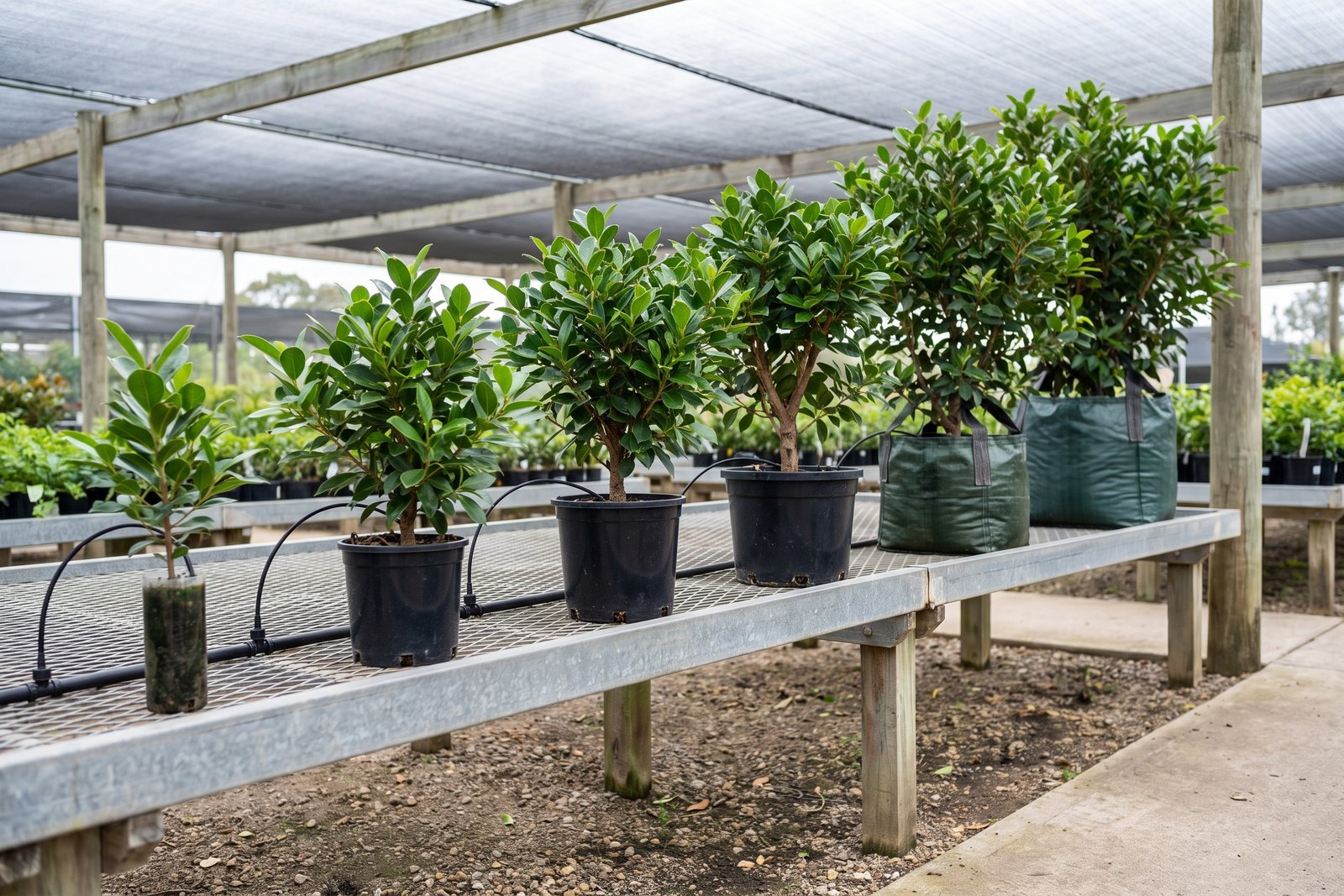
The Canadian Nursery Landscape Association's Canadian Nursery Stock Standard, in its ninth edition, has standardized how nursery stock is sized and described since 1967. The association says it gives growers, distributors, specifiers and buyers minimum specifications for plant size, the relationships between height, width and calliper, and the appropriate root ball or container sizes, that it aligns closely with the American standard ANSI Z60.1 with metric units used in Canada, and that catalogues and contract documents should follow it. Landscape Ontario notes that the standard replaced the container-grown plants section of the Canadian Landscape Standard. In practice a list names a container class such as #1, #2, #3, #5 or #10, a plug or liner by tray, a shrub by height in centimetres and a tree by calliper in millimetres or centimetres; the number is the container or the stem, not the plant's height, so ask for height and potting date. The Canadian classes match the American ladder, and plant grades and container sizes, market by market sets the two side by side with the Australian and New Zealand grades.
HortOS does not yet publish Canadian medians, because a median needs several growers pricing the same size on trade lists and the first Canadian edition of the HortOS Plant Price Index is still being prepared. Each grower's own published price sits beside its line on the plant pages, and the price check will test a quote against the medians once they exist.
Provenance: asking for local stock
A native plant is not necessarily a local plant, and in a country as wide as Canada it is not necessarily a hardy one either. Natural Resources Canada's plant hardiness site publishes the zone maps gardeners use to select species for their area and species-specific climate models for thousands of North American plants; a species native to the Carolinian zone of southern Ontario is not native to the Prairies, and a seed lot from Georgia is not the same plant as one from Grey County. The native plant societies' lists are where the market shows its hand: the Ontario Invasive Plant Council points its Grow Me Instead readers to the North American Native Plant Society's list of growers who specialize in native plants and do not sell invasive species, and that list notes which growers collect their own seed and offer custom growing.
For a buyer that means three questions to the grower: is this the straight species or a cultivar, where did the seed or cutting come from, and can you grow to order from seed we collect or specify. A native specialist will usually answer all three; a production nursery growing a national range may buy liners in and cannot always say.
Lead times, shipping and provincial lines
- Order ahead. Spring stock was sown the previous year, and stock grown to order from your own seed source needs a year. A grower's list on HortOS shows what it holds today, with the date it was updated: useful for a top-up order and no guide to next spring.
- Pick up where you can. Trade prices never include freight, and plugs travel best in their own trays over a short distance. The Ontario hub lists 33 growers in Hamilton, 29 in Lincoln, 24 in Norfolk and 24 in Toronto, so one trip with a trailer can collect from several.
- Mind the border. The Canadian Food Inspection Agency's Canadian Nursery Certification Program is a phytosanitary certification program for nurseries and greenhouses that ship nursery stock to the United States or within Canada, and its directive says an interfacility stamp does not replace a CFIA domestic movement certificate where one is required. A grower already certified ships across a provincial line as routine; one that is not may decline, and stock from a regulated area for a pest moves only on the agency's terms.
What to watch for
- Treating the list price as the delivered price. Add GST or HST unless the organization recovers it, then freight, then stakes, guards and mulch; the plants can be the smaller half of a planting budget.
- Ordering in the planting season. Spring plugs were sown the previous year. An order placed in May buys what is left.
- Reading native as local. A #1 from a national grower may carry seed from another province or from the United States. Ask, and specify, if provenance matters to the site or the funder.
- Asking a grower for six plants. Below the minimum you are asking for retail service from a business that does not offer it. Pool, or buy the six from a nursery on your society's list.
- Taking the size on trust. A container class or a calliper is not a height. Ask for height and potting date, and check a sample before the order leaves.
Getting it right
- Settle the species list against your province's native plant society list and the hardiness zone for the site, and set quantities from the spacing.
- Shortlist growers on the provincial hub and the plant pages: in your province, listing the sizes you need, with a list updated recently.
- Ask the treasurer how GST or HST applies to the organization, then sign up on HortOS or apply for the grower's own account.
- Email three growers with species, quantities, seed source, planting date and whether you will pick up, and ask each for a written quote ex tax with a ship date.
- Order the season ahead, a year for stock grown to order, and order stakes and guards at the same time.
- Confirm the count and the date a week before pickup, and check the trays before they leave.
A word of caution
The grower counts on this page are what the HortOS hubs printed on one date; the live pages change as lists arrive, so a figure there may differ from the ones quoted here. Tax rules are the Canada Revenue Agency's and each province's, and the organization's accountant or treasurer should confirm how they apply. Plant movement rules are the Canadian Food Inspection Agency's to set. On stock, terms and provenance, the grower's word is the one that counts.
Sources
- Canadian Nursery Landscape Association, Canadian Nursery Stock Standard: how stock is sized and described.
- Canadian Nursery Landscape Association: the national federation.
- Landscape Ontario, new Canadian Nursery Stock Standard released: the ninth edition.
- Canadian Food Inspection Agency, directive D-04-01, Canadian Nursery Certification Program: certification and domestic movement.
- Province of British Columbia, nursery plants: the nursery sector and starting a nursery.
- North American Native Plant Society, commercial growers: native growers by region.
- Ontario Invasive Plant Council, Grow Me Instead: alternatives and where to buy them.
- Halton Region Master Gardeners, native plant nurseries in southern Ontario: wholesale and retail, by appointment.
- Alberta Native Plant Council: native plant source list.
- Native Plant Society of Saskatchewan: native plant sources.
- Natural Resources Canada, plant hardiness of Canada: zones and species models.
More guides
Plant Grades and Container Sizes, Market by Market
A #3 in Florida, a 200 mm pot in Sydney, a PB5 in Hamilton and a #2 in Ontario are roughly the same plant. This page sets the four markets' size ladders side by side from plug to field grown tree, explains what each grade is and how old, and names the standard each market specifies against.
Buying Plants in Bulk for a Community Group
Garden clubs, community gardens, schools and friends groups can buy plants by the tray and the cart from wholesale growers when they order like the trade. This page explains what bulk means to a grower, the three ways a group buys, how to turn a plan into quantities, what a quote request needs and how collection day works.
Reading a Grower's Price List and Trade Terms
A grower's price list is an offer written in shorthand, and the terms are part of the price. This page reads a trade list column by column and term by term, from the tax and freight basis to minimums, price on application, holds, substitutions, payment and claims, and turns two quotes into landed costs.