Box tree moth in Canada: boxwood rules and the plants named beside it
For landscape designers, garden clubs and stewardship groups in Canada: the provinces regulated for box tree moth, what the federal Order and directive say about moving boxwood, what Canadian bodies have published on keeping or replacing it, and how many Canadian nurseries grow boxwood and the plants two Ontario Master Gardener groups name beside it. Counts only.
Updated October 19, 2026. Counts are what the live ca.hortosapp.com plant pages printed; medians are not published yet.
On this page
- Quick facts
- Six regulated provinces, and how each came to be regulated
- What the directive and the Order say about moving boxwood
- Treat, keep or replace: each published position under its own name
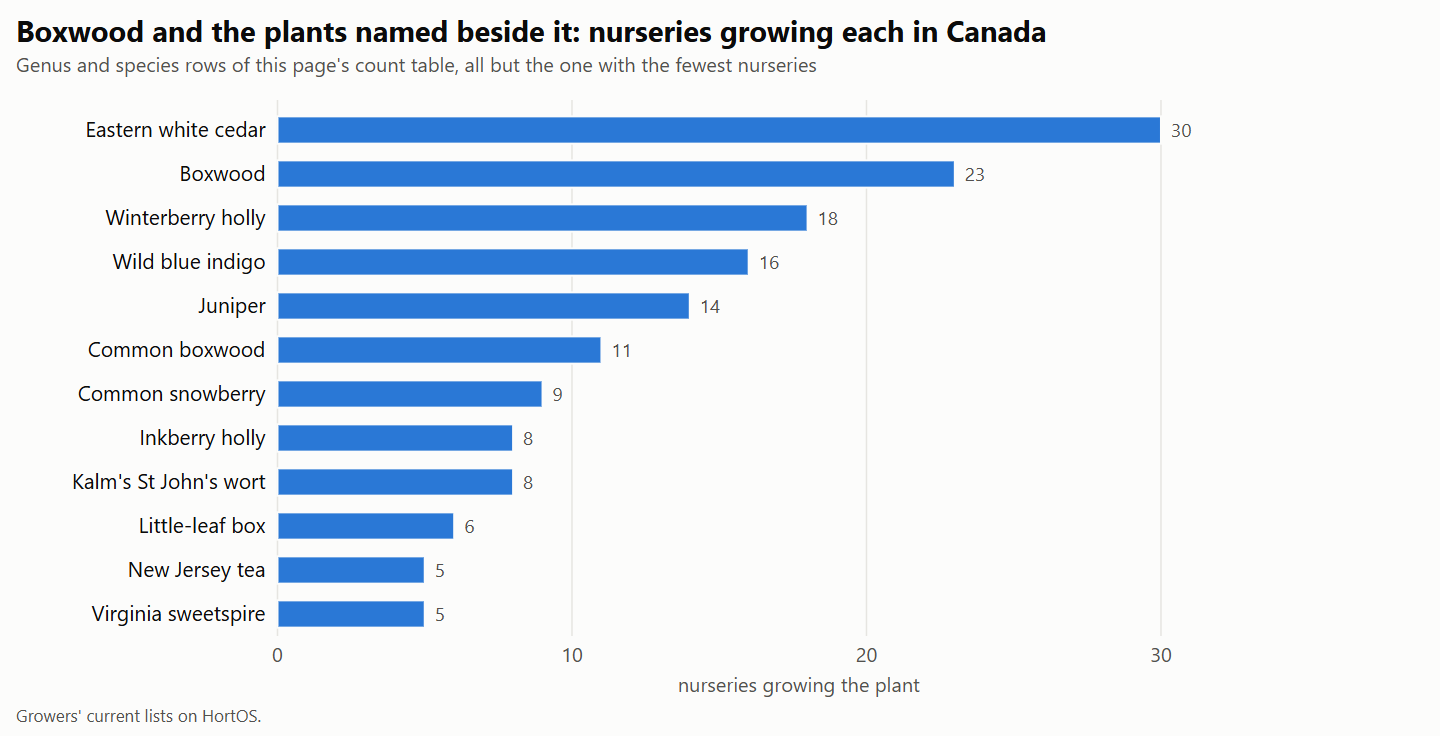
- Boxwood and the plants two Ontario groups name, by nurseries growing each
- What a plant page and these two tables cannot tell a buyer
- What to watch for
- Getting it right
- A word of caution
- Sources
A garden centre buyer in Manitoba wants boxwood from an Ontario nursery, and asks what the federal rules require before it ships. Canada's Box Tree Moth Order of 12 December 2024 restricts movement: subject to one exception, boxwood plants for planting may leave the infested place, six provinces together, only with an inspector's prior authorization under a movement certificate. Canadian bodies differ on keeping or replacing boxwood, and each view appears here under its own name.
This page reports what that Order, the Canadian Food Inspection Agency's directive D-22-04 and the Agency's pages say. It also reports what Landscape Ontario, the Invasive Species Centre, two provincial councils and two Ontario Master Gardener groups have published. It adds, from HortOS, a free directory of Canadian wholesale plant growers with their published availability and trade prices, how many nurseries grow boxwood and the plants the two Master Gardener groups name. It is not legal text, does not rate any plant against the moth, and gives no advice.
Quick facts
| The regulated provinces | Ontario, Quebec, New Brunswick, Prince Edward Island, Nova Scotia, and Newfoundland and Labrador make up the area Canada regulates for the moth, on the Canadian Food Inspection Agency's page modified 19 June 2025 and read on 5 October 2026. The Box Tree Moth Order of 12 December 2024 declares the same six infested. |
|---|---|
| The directive in force | Directive D-22-04, second revision, took effect on 22 October 2024 (Canadian Food Inspection Agency, Canada), and was the version on the Agency's site on 5 October 2026. The Agency's page for the directive was last modified on 5 June 2026. It regulates boxwood (Buxus) plants for planting, with rooted and unrooted cuttings counted in. |
| Boxwood leaving a regulated province | Directive D-22-04 (Canada, 2024) requires a domestic movement certificate for boxwood plants for planting that go from a regulated province to a non-regulated part of Canada other than British Columbia. The same 2024 directive's table of requirements marks that movement into British Columbia as prohibited. |
| What the moth feeds on | In Canada the moth is found on boxwood shrubs alone, the Canadian Food Inspection Agency's page says (2025). The Agency's 2019 fact sheet records two spindle species, one holly species and orange jasmine as hosts in Asia. |
| How it spreads | The Canadian Food Inspection Agency (Canada, 2025) estimates that the moth flies 5 to 10 km a year, and says it also spreads when infested boxwood shrubs are moved. |
| Keeping or replacing boxwood | Halton Region Master Gardeners (Ontario, 2023) say growing boxwood is no longer considered sustainable. Landscape Ontario (Ontario, 2020) says most boxwood stripped by the caterpillars comes back into leaf when it is monitored, treated, fertilized and pruned. |
Six regulated provinces, and how each came to be regulated
Three federal documents, read on 5 October 2026, name the same six provinces. The Box Tree Moth Order of 12 December 2024, a ministerial order published by the Canadian Food Inspection Agency, declares them infested with the moth. Appendix 1 of the Agency's directive D-22-04 (second revision, effective 22 October 2024) names them as the regulated areas, and so does the Agency's page modified on 19 June 2025.
The directive (Canada, 2024) dates the first North American detection to 2018, in the Toronto area, and says the moth went onto Canada's list of regulated pests in November 2022. The same 2024 directive records a ministerial order of 11 July 2023 that declared Ontario infested. In June 2023 the moth was intercepted at garden centres and other stores in Quebec and in each Atlantic province, on plants the Agency's decision document RMD-23-05 (Canada, 2024) traces to nursery shipments from Ontario. The decision in RMD-23-05, effective 9 May 2024, widened the regulated area to the provinces east of Ontario other than Prince Edward Island.
The table sets the ten provinces in eight rows; Alberta, Saskatchewan and Manitoba share one because directive D-22-04 (2024) puts them in one class, neither regulated nor British Columbia.
| Province | Status under the federal rules (Canadian Food Inspection Agency, 2024 to 2025) | Boxwood plants for planting arriving from a regulated province (directive D-22-04, 2024) | What an authority reports (authority, year) |
|---|---|---|---|
| Ontario | Regulated; declared infested by the Order of 12 December 2024 | No requirement | First found in the Toronto area in 2018 (Canadian Food Inspection Agency, 2024) |
| Quebec | Regulated; declared infested by the Order of 12 December 2024 | No requirement | Trap detections in 2023 between Montreal and Rivière-du-Loup (Canadian Food Inspection Agency, 2024) |
| New Brunswick | Regulated; declared infested by the Order of 12 December 2024 | No requirement | Trap detections in 2023 around Saint John, Quispamsis and Fredericton (Canadian Food Inspection Agency, 2024) |
| Nova Scotia | Regulated; declared infested by the Order of 12 December 2024 | No requirement | One positive trap site in the 2023 survey, near Windsor (Canadian Food Inspection Agency, 2024) |
| Prince Edward Island | Regulated; added after a find at a residence in August 2024 | No requirement | Moth first detected on the island in 2023 (PEI Invasive Species Council, 2024) |
| Newfoundland and Labrador | Regulated; declared infested by the Order of 12 December 2024 | No requirement | All 10 survey traps were negative in 2023 (Canadian Food Inspection Agency, 2024) |
| British Columbia | Treated as a pest-free area, on yearly surveys from 2021 to 2023 | Prohibited | Not found in the province as of May 2024 (Invasive Species Council of British Columbia, 2024) |
| Alberta, Saskatchewan and Manitoba | Not on the directive's list of regulated provinces | A domestic movement certificate, from a nursery working under an accepted systems approach or a preventive control plan | The moth had not been reported there (Canadian Food Inspection Agency, 2024) |
Newfoundland and Labrador is declared infested by the Order of 12 December 2024, although the Agency's 2024 decision document shows all of its 2023 survey traps as negative. The June 2023 interceptions at stores reached the province, and the Agency's decision effective 9 May 2024 brought it into the regulated area. The PEI Invasive Species Council's 2024 guide says the moth was first detected on the island in 2023. The Agency's decision effective 9 May 2024 left the island out, because the moth was not yet confirmed as established there and stakeholders in the province objected. The Agency's page (2025) says the island was added after a find at a home in August 2024.
What the directive and the Order say about moving boxwood
Section 3 of the federal Order of 12 December 2024 says no person other than an inspector may move boxwood plants for planting out of the infested place without an inspector's prior authorization under a movement certificate. The Order's one exception to section 3 (2024) covers boxwood that began outside the infested place, enters and leaves it between 1 November and 15 May, and is kept apart from boxwood that began inside.
Directive D-22-04 (Canada, second revision, 2024) sets requirements by where boxwood plants for planting start and where they go. Within and between the six regulated provinces the 2024 directive's entry is no requirement. For a regulated province to a non-regulated part of Canada other than British Columbia, the 2024 directive requires a domestic movement certificate. Under the same directive (2024) a nursery asking for one needs a box tree moth pest module, inside either a systems approach the Agency accepts or a preventive control plan. As accepted systems approaches the 2024 directive names three programs: the Greenhouse-Grown Plant Certification Program, the Canadian Nursery Certification Program and the Clean Plants Program. For a regulated province to British Columbia the 2024 directive's entry is prohibited. For boxwood that starts in a non-regulated area and moves within Canada, its entry (2024) is no requirement.
The 2024 directive leaves cut boxwood branches for decoration, boxwood seed and boxwood in tissue culture outside its scope. It adds (D-22-04, 2024) that any material leaving a regulated area for one that is not regulated must be free of every life stage of the moth, and that the person moving it is responsible. A violation, the 2024 directive says, may draw a penalty under the Agriculture and Agri-Food Administrative Monetary Penalties Act.
Directive D-22-04 (2024) and the Agency's 2024 decision document also describe a United States federal order of 19 December 2023. By their 2024 account that order recognized British Columbia as free of the moth, left boxwood grown elsewhere in Canada barred from the United States, and lifted that country's restrictions on spindle (Euonymus) and holly (Ilex) plants.
Treat, keep or replace: each published position under its own name
The Canadian Food Inspection Agency's page (Canada, 2025) asks owners to inspect boxwood from May to September. The Agency's 2025 page says a biological pesticide containing Bacillus thuringiensis subspecies kurstaki can control larvae that are feeding, and that several treatments may be needed. Landscape Ontario says on its 2020 pages that most boxwood stripped by the caterpillars keeps sound stems and roots. Those 2020 pages say it comes back into leaf when it is monitored, treated, fertilized and pruned, and give three inspection windows: 15 May to 15 June, 15 July to 15 August, and 1 to 20 September.
The Invasive Species Centre's page (read in 2026) says the bacterial spray controls the moth very well in Ontario, and that some defoliated hedges have been seen to recover after treatment. The same page, read in 2026, says that where the moth is confirmed, homeowners are encouraged to remove or treat it, or to take boxwood out and plant a shrub that is not a host.
Halton Region Master Gardeners (Ontario, 2023) say growing boxwood is no longer considered sustainable, given its pests and diseases. The group recommends (2023) replacing infested boxwood over time without treating or replanting it. The same 2023 article says boxwood treated early may survive but will need treatment for as long as it is kept. The Halton group's 2023 article cautions that the bacterial spray kills the caterpillars of all butterflies and moths, not the box tree moth alone. Landscape Ontario (2024) says boxwood plants rarely host other caterpillars. Toronto Master Gardeners (Ontario, 2022) say boxwood has few one-for-one substitutes.
This page takes neither side and advises none of these courses.
Boxwood and the plants two Ontario groups name, by nurseries growing each
The next table starts with five boxwood rows: the genus page, two species pages and two named selections. The other rows are plants that Halton Region Master Gardeners (2023) or the Toronto Master Gardeners' hedging guide (2021) name beside or in place of boxwood, each at the level the group names it. The Toronto group's 2022 box tree moth guide points to that hedging guide. Each row is a HortOS plant page for Canada, and the table does not carry every plant the two groups name. Counts are the nurseries each plant's page on HortOS showed as growing it. Median trade prices are not published for Canada yet.
| Plant | What the named authority says of it (authority, year) | Nurseries growing it |
|---|---|---|
| Boxwood (Buxus) | Boxwood itself: hardy to Zone 4, for a small hedge (Toronto Master Gardeners, 2021) | 23 |
| Common boxwood (Buxus sempervirens) | A boxwood species on the Centre's list of recorded hosts (Invasive Species Centre, read 2026) | 11 |
| Little-leaf box (Buxus microphylla) | A boxwood species on the Centre's list of recorded hosts (Invasive Species Centre, read 2026) | 6 |
| Boxwood (Buxus 'Green Mountain') | Upright boxwood cultivar, 1.5 m high (Toronto Master Gardeners, 2021) | 4 |
| Boxwood (Buxus 'Green Velvet') | Boxwood cultivar, 1 m high, that keeps its green in winter (Toronto Master Gardeners, 2021) | 6 |
| Inkberry holly (Ilex glabra) | Evergreen; a holly from eastern North America (Halton Region Master Gardeners, 2023) | 8 |
| Inkberry holly (Ilex glabra 'Shamrock') | Evergreen cultivar, 80 to 100 cm high (Halton Region Master Gardeners, 2023) | 4 |
| Inkberry holly (Ilex glabra 'Compacta') | Evergreen cultivar, 80 to 100 cm high (Halton Region Master Gardeners, 2023) | 1 |
| Eastern white cedar (Thuja occidentalis) | Evergreen; a tree from eastern North America (Halton Region Master Gardeners, 2023) | 30 |
| Eastern white cedar (Thuja occidentalis 'Danica') | Evergreen, classed as a native cultivar; 0.5 to 1 m high (Halton Region Master Gardeners, 2023) | 11 |
| Eastern white cedar (Thuja occidentalis 'Little Giant') | Evergreen, classed as a native cultivar; 0.5 to 1 m high (Halton Region Master Gardeners, 2023) | 9 |
| Eastern white cedar (Thuja occidentalis 'Nigra') | Quick hedging cultivar that reaches 5 m (Toronto Master Gardeners, 2021) | 9 |
| Juniper (Juniperus) | Hardy to Zone 4 (Toronto Master Gardeners, 2021) | 14 |
| Juniper (Juniperus chinensis 'Spartan') | Reaches 4 m; for sun or part shade (Toronto Master Gardeners, 2021) | 10 |
| Juniper (Juniperus chinensis 'Mountbatten') | Reaches 6 m; quick, for sun (Toronto Master Gardeners, 2021) | 2 |
| Spruce (Picea glauca 'Conica') | Cone shaped, 4 m high; named for a formal hedge (Toronto Master Gardeners, 2021) | 10 |
| Winterberry holly (Ilex verticillata) | Deciduous; a holly from the eastern half of North America (Halton Region Master Gardeners, 2023) | 18 |
| New Jersey tea (Ceanothus americanus) | Deciduous native, about 1 m high and wide (Halton Region Master Gardeners, 2023) | 5 |
| Common snowberry (Symphoricarpos albus) | Deciduous native, 125 to 150 cm high (Halton Region Master Gardeners, 2023) | 9 |
| Kalm's St John's wort (Hypericum kalmianum) | Deciduous native, 60 to 100 cm high (Halton Region Master Gardeners, 2023) | 8 |
| Virginia sweetspire (Itea virginica) | Deciduous, classed as near native; 1 to 2 m as a species (Halton Region Master Gardeners, 2023) | 5 |
| Aromatic aster (Symphyotrichum oblongifolium) | Herbaceous perennial, classed as near native; 30 to 100 cm high (Halton Region Master Gardeners, 2023) | 1 |
| Wild blue indigo (Baptisia australis) | Herbaceous perennial, 1.2 m high and wide (Halton Region Master Gardeners, 2023) | 16 |
Counts are the nurseries each plant page shows as growing the plant, with or without sizes listed.
Each of the 23 rows is one plant page, counted on its own. Boxwood has five rows, eastern white cedar four, juniper three and inkberry three, and no count can be added to another or read as part of another. The boxwood and juniper genus rows do not show which kind a nursery grows; the 'Green Mountain' and 'Green Velvet' rows count only nurseries that name those selections. The heights in the Halton cells for named selections are the group's range for selections it names together, not the measure of one.
The Toronto rows come from a guide to evergreens for hedging, not a set of boxwood replacements. In that guide (Toronto Master Gardeners, 2021) the 'Nigra' cedar reaches 5 m, the two junipers 4 m and 6 m and the 'Conica' spruce 4 m. This page does not present them as stand-ins for a low boxwood edging. The zone numbers are that guide's own (Toronto Master Gardeners, 2021), and it names no zone map. On replacing boxwood, the same 2021 guide names inkberry as a native alternative to consider, and the Halton table (2023) classes inkberry as near native. The group's 2022 guide says inkberry recovers from an occasional hard pruning, but that it is not settled whether it suits every clipped form boxwood takes.
The Halton rows come from an article of ten plants, yew among them, that the group wrote for its own region, and the other guides are a Toronto group's. Neither speaks for another province's climate. The Halton group (Ontario, 2023) urges gardeners who have chosen to replace boxwood to look at native species. The 2023 article says boxwood suits a broad range of conditions and that its substitutes may be more particular about where they grow.
Four rows are hollies (Ilex): the three inkberry rows and winterberry. The Agency's 2019 fact sheet records one holly species, Ilex purpurea, and two spindle species as hosts of the moth in Asia. Its page (Canada, 2025) and its 2024 decision document both say that in Canada the moth has been found on boxwood alone. The Invasive Species Centre (read in 2026) notes that Canada has native species in both genera and that no native host has been confirmed so far. It adds that they could be affected if the moth finds them suitable. This page rates no row as a host or as resistant.
Every count is for the whole country, and some are small. Eastern white cedar also has a row in the hemlock woolly adelgid guide.
What a plant page and these two tables cannot tell a buyer
- Where a boxwood was produced. A count does not say which province a nursery is in, or where a boxwood was propagated and grown. Under directive D-22-04 (Canada, 2024) the requirement is set by a plant's origin and its destination.
- Certificates and programs. No count shows whether a nursery holds a domestic movement certificate, has a pest module, or works under a program the directive names. Outside the regulated area the 2024 directive recommends a pest module to boxwood producers but does not require one.
- Inspection. No count shows that a plant was inspected or is free of the moth. The best management practices for box tree moth dated 5 July 2024 (Canada), on Landscape Ontario's site, say a nursery's records for boxwood it receives should show the supplier and the moth program the plants were grown under.
- Species, selection and seed source. A species row does not tell a buyer if the plants are a named selection or the species itself, where their seed or cuttings came from, or how they were raised. Each is a question to put to the grower.
- Size and price. A count is not a size, a quantity or a price. The guide to buying from a wholesale grower covers who a grower sells to and how to ask one.
What to watch for
- Reading the table's "No requirement" as no rule. It is the directive's entry (Canada, 2024) for boxwood moving between regulated provinces; the Order of 12 December 2024 still restricts movement out of the infested place.
- Reading "Prohibited" as a rule about planting. It is the directive's entry (Canada, 2024) for one movement: boxwood plants for planting going from a regulated province to British Columbia.
- Treating the regulated area as settled. The Agency widened it in May 2024 and again after the August 2024 find, so an older document may show a smaller area.
- Taking the last column as a map of the moth today. The Quebec, Nova Scotia, New Brunswick and Newfoundland and Labrador entries are the Agency's 2023 trapping as its 2024 decision document reports it. The others are dated statements of 2024, and none says where the moth is today.
Getting it right
- Open the Canadian Food Inspection Agency's box tree moth page and the Order on the day, and note the provinces each names and its date.
- Ask the grower which province the boxwood ships from and where it was grown, and set its origin and its destination against the table of requirements in directive D-22-04 (2024).
- For boxwood going from a regulated province to Manitoba, Saskatchewan or Alberta, ask the grower whether it ships under the domestic movement certificate that directive D-22-04 (2024) requires. The Agency is who to ask about a shipment.
- In British Columbia, Alberta, Saskatchewan or Manitoba, report a suspected moth or its damage on boxwood at once, as the Agency's page (2025) asks.
A word of caution
The infested place is set by the Box Tree Moth Order of 12 December 2024, a ministerial order. The movement requirements are in directive D-22-04 (2024) of the Canadian Food Inspection Agency, which is who to ask about a shipment. Both are given as read on 5 October 2026, and the regulated area has been widened twice since 2023. The positions on boxwood and the plant names belong to the bodies named, and the counts are one day's reading of the HortOS plant pages.
Sources
- Canadian Food Inspection Agency, Box tree moth: regulated provinces, inspection, treatment.
- Canadian Food Inspection Agency, directive D-22-04: movement requirements for boxwood.
- Canadian Food Inspection Agency, Box Tree Moth Order of 12 December 2024: infested place, movement out of it.
- Canadian Food Inspection Agency, RMD-23-05: the 2024 expansion decision.
- Canadian Food Inspection Agency, box tree moth fact sheet: hosts recorded in Asia.
- Invasive Species Centre, Box Tree Moth: hosts, control, removal.
- Landscape Ontario, Box tree moth: A growing concern for Ontario gardens: boxwood and other caterpillars.
- Landscape Ontario, Rejuvenating boxwood plants damaged by box tree moth: regrowth of stripped boxwood.
- Landscape Ontario, Safe removal of boxwood affected by box tree moth: the three inspection windows.
- Halton Region Master Gardeners, Sustainable Solutions for the Boxwood Blues, Part 2: the plants it names.
- Halton Region Master Gardeners, Time to Re-Think Boxwood, Part 1: the group's position on boxwood.
- Toronto Master Gardeners, Box Tree Moth guide: substitutes, inkberry and pruning.
- Toronto Master Gardeners, Evergreens Suitable for Hedging: hedging evergreens and zones.
- Invasive Species Council of British Columbia, Be a box tree moth detective: the province's status in 2024.
- PEI Invasive Species Council, A Guide to Invasive Insect Identification and Management on PEI: first detection on the island.
- Box Tree Moth, Best Management Practices of 5 July 2024, in a copy on Landscape Ontario's site: what a nursery's records show.
More guides
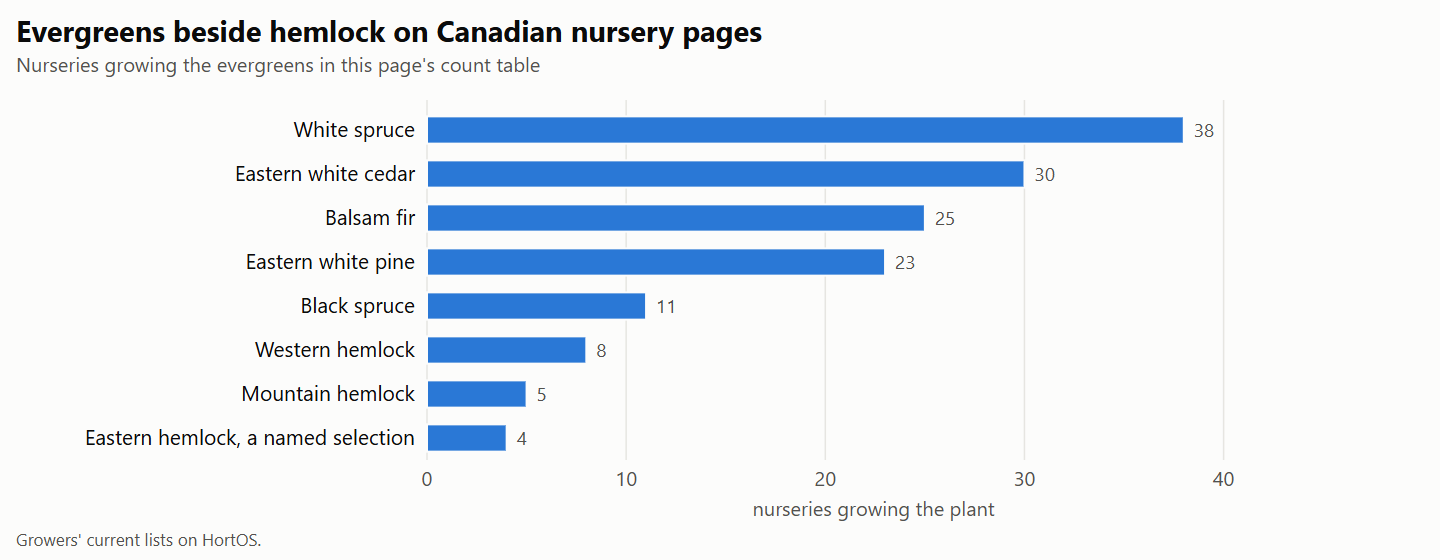
Hemlock woolly adelgid in Canada: rules and stand-in evergreens
For stewardship groups, conservation authorities and arborists in Canada: the areas the federal Order regulates for hemlock woolly adelgid, the recent detections outside them, what moving hemlock requires, how the authorities describe treatment, and the conifers Ontario names for restoring some of hemlock's functions, with how many Canadian nurseries grow each. Counts only.

Buying From a Wholesale Grower When You Are Not in the Trade
Naturalist clubs, conservation authorities, schools, land trusts and municipalities can buy from Canadian wholesale growers when they order like the trade: in quantity, ahead of the season, on the grower's terms. This page explains who sells to whom, business numbers and tax, minimums and pooling, how the Canadian Nursery Stock Standard sizes stock, provenance, lead times and shipping.
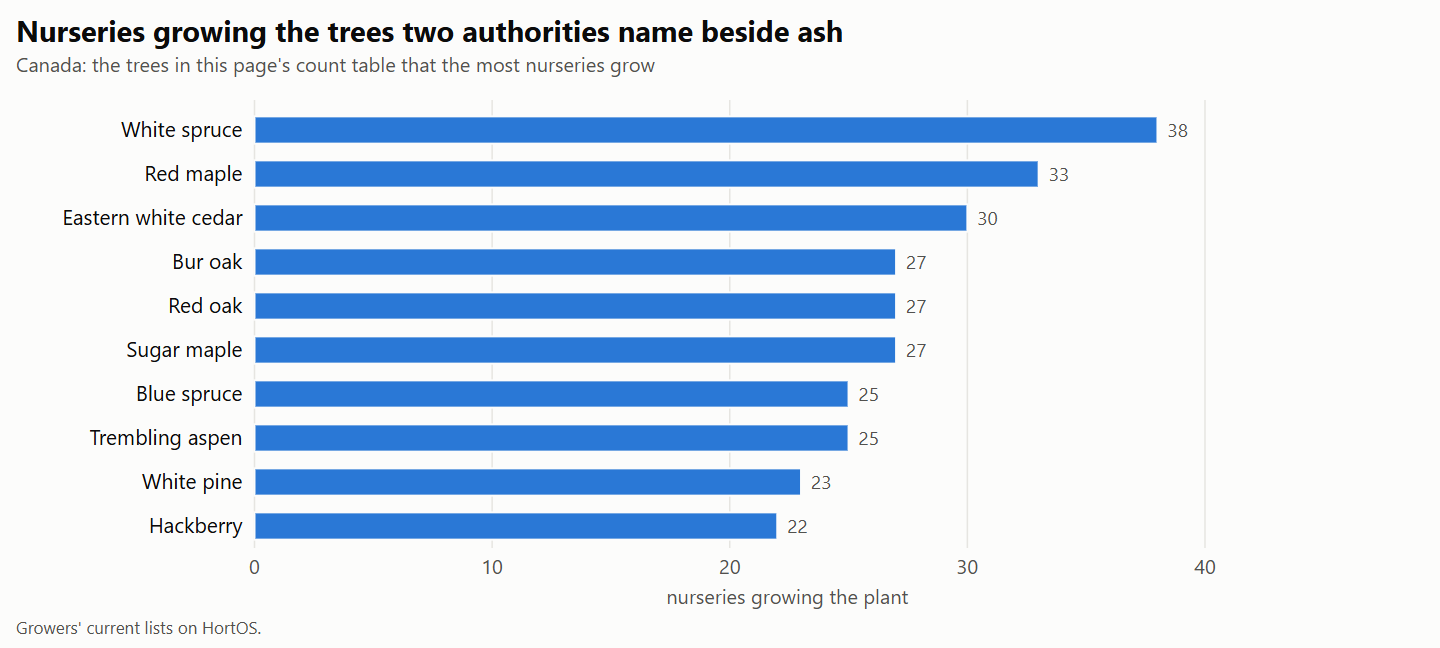
Replacing ash trees lost to emerald ash borer in Canada
For tree boards, municipal foresters and stewardship groups in Canada: what the Canadian Food Inspection Agency's pages say of regulated areas in eight provinces, the federal rule on moving ash nursery plants, what municipalities say about treating and replanting, and how many Canadian nurseries grow each tree two authorities name. Counts only, no prices.