Hemlock woolly adelgid in Canada: rules and stand-in evergreens
For stewardship groups, conservation authorities and arborists in Canada: the areas the federal Order regulates for hemlock woolly adelgid, the recent detections outside them, what moving hemlock requires, how the authorities describe treatment, and the conifers Ontario names for restoring some of hemlock's functions, with how many Canadian nurseries grow each. Counts only.
Updated October 6, 2026. Counts are what the live ca.hortosapp.com plant pages printed; medians are not published yet.
On this page
- Quick facts
- The regulated areas, and the recent detections outside them
- Treating a hemlock, as the authorities describe it
- Evergreens with a count, and the nurseries growing them
- Shade, moisture and height, set beside hemlock
- What the counts and the tables leave out
- What to watch for
- Getting it right
- A word of caution
- Sources
A stewardship group in Ontario or Nova Scotia has a hemlock screen with hemlock woolly adelgid and asks which evergreen could go in its place. A 2023 technical note from the Ontario Ministry of Natural Resources and Forestry names five conifers that can restore part of hemlock's ecological work in a stand: white spruce, red spruce, white pine, white cedar and balsam fir. That note is about forest stands, not garden hedges. No Canadian authority read for this page names a like-for-like replacement for a hemlock hedge.
This page reports what the 2025 Infested Place Order, the Canadian Food Inspection Agency's Directive D-07-05, Natural Resources Canada, Ontario's technical note and Tree Atlas, the Invasive Species Centre, the Niagara Peninsula Conservation Authority and Halifax Regional Municipality say. It adds one thing from HortOS, a free directory of Canadian wholesale plant growers with their published availability and trade prices: how many nurseries grow each evergreen. It is not advice on treating a tree, moving plant material or choosing a replacement.
Quick facts
| The regulated areas | The infested place in Schedule 1 of the Hemlock Woolly Adelgid Infested Place Order, 2025, is all of British Columbia, seven Nova Scotia counties and four Ontario areas. The counties are Kings, Lunenburg, Digby, Queens, Shelburne, Yarmouth and Annapolis. The Ontario areas are the Regional Municipality of Niagara, Haldimand County, the City of Hamilton and the Township of Alnwick/Haldimand. The Order is a ministerial order dated 21 August 2025 and published by the Canadian Food Inspection Agency, whose regulated areas page showed the same areas when read on 4 October 2026. |
|---|---|
| What may not leave them | All firewood, whatever the species, and any hemlock, Yeddo spruce or tiger-tail spruce plant or part that carries bark or foliage, plants for planting included. Moving one out needs an inspector's written authorization under a movement certificate first, subject to the Order's own exceptions (Infested Place Order, 2025, a ministerial order published by the Canadian Food Inspection Agency). |
| Hemlock from elsewhere in Canada | Hemlock material moving from a non-regulated area of Canada needs no Movement Certificate (Canadian Food Inspection Agency, Directive D-07-05, sixth revision, effective 8 August 2025). |
| Detections outside the Order | The Agency's detections list records Norfolk County and the Greater Toronto Area, Ontario, in 2025, Halifax Regional Municipality, Nova Scotia, in 2025 and 2026, and Hants County, Nova Scotia, in 2026. The 2025 Order names none of the four (Canadian Food Inspection Agency page, modified 15 June 2026, read 4 October 2026). |
| The conifers Ontario names | White spruce, red spruce, white pine, white cedar and balsam fir, for restoring some of hemlock's ecological functions to a forest stand (Ontario Ministry of Natural Resources and Forestry, Technical Note TN-09, 2023). |
| Halifax's treatment plan | Halifax Regional Municipality, Nova Scotia, says on its page (2026) that it expects chemical treatment two or three times in 10 to 15 years, by injection or basal bark spray. |
The regulated areas, and the recent detections outside them
The movement rules this page reports are federal: the Infested Place Order, a ministerial order dated 21 August 2025 and published by the Canadian Food Inspection Agency, and the Agency's Directive D-07-05 (2025). No provincial or municipal rule on moving hemlock was read. The Order's recital says paragraph 15(3)(b) of the Plant Protection Act gives the Minister the power to set and vary a place declared infested. The same Order added four Ontario areas to the place declared infested on 3 June 2022.
The table sets the three provinces side by side: the area Schedule 1 of the Order names, the 2025 and 2026 entries on the Agency's detections list for places the Order does not name, and one authority's report. The Agency's regulated areas page, modified on 15 June 2026 and read on 4 October 2026, showed the same areas.
| Province | Regulated area (Infested Place Order, August 2025) | Detections on the Agency's list in places the Order does not name, 2025 to 2026 | What an authority reports (authority, year) |
|---|---|---|---|
| British Columbia | The entire province | Not applicable: the Order names the whole province | Damage to western and mountain hemlock is usually minor (Canadian Food Inspection Agency, 2025) |
| Nova Scotia | The counties of Kings, Lunenburg, Digby, Queens, Shelburne, Yarmouth and Annapolis | Hants County (2026) and Halifax Regional Municipality (2025 and 2026) | Halifax approved a treatment and management plan on 4 September 2025 (Halifax Regional Municipality, 2026) |
| Ontario | The Regional Municipality of Niagara, Haldimand County, the City of Hamilton and the Township of Alnwick/Haldimand | Norfolk County and the Greater Toronto Area (2025) | Detected and increasing across Ontario, including several of its own conservation areas (Niagara Peninsula Conservation Authority, 2026) |
The four places in the detections column are on the Agency's detections list and are not in Schedule 1 of the Order of 21 August 2025. The column holds recent entries, not first finds: Halifax Regional Municipality says in 2026 that the insect was first found there in 2023. The Canadian Food Inspection Agency says in 2026 that a find on a property brings a Movement Prohibition Notice, which stops affected materials leaving that location.
For British Columbia this page reports two statements and draws no conclusion. The federal Order of 2025 names the entire province. Directive D-07-05 (Canadian Food Inspection Agency, 2025) says the insect was first reported there in 1919, and that damage to its native western and mountain hemlock is usually minor.
The 2025 Order's regulated things are all firewood, whatever the species, and any hemlock, Yeddo spruce or tiger-tail spruce plant or part that carries bark or foliage, plants for planting included. Under the 2025 Order nobody except an inspector may move one out without an inspector's written authorization under a movement certificate, subject to the Order's own exceptions. As read on 4 October 2026, every prohibition in the 2025 Order is on movement out of the infested place, and it has no section on growing, selling or planting hemlock.
Directive D-07-05, in its sixth revision effective 8 August 2025, says how hemlock nursery plants move. Hemlock plants for planting that leave a regulated area need a Movement Certificate with each shipment (Canadian Food Inspection Agency, D-07-05, 2025). Under the 2025 Directive the certificate attests to an insecticide treatment, or to plants that are free of the insect and were grown in an approved block registered in the Hemlock Woolly Adelgid Nursery Program. From a non-regulated area of Canada no certificate is needed, the same 2025 Directive says.
The Invasive Species Centre's 2025 guide for Ontario calls the transport of nursery plants a major pathway for the insect, because hemlocks are commonly grown for landscape use, hedges included. The Agency's 2026 page tells anyone who needs to move regulated materials out of a regulated area to contact its local office, and says moving them without approval can bring a fine or legal consequences.
Treating a hemlock, as the authorities describe it
The Canadian Food Inspection Agency (2025) describes the adelgid as an aphid-like insect that kills hemlock, and lists the death of the tree within 4 to 15 years among the signs.
Natural Resources Canada (2025) says foliar insecticides can cut numbers on small nursery trees but do not suit large trees or natural forest. The same 2025 fact sheet says systemic insecticides, injected or sprayed onto the trunk, are in wide use in the United States, and that cost and environmental tolerance for the active ingredient can limit their use. Ontario's 2023 technical note says chemical control works, costs a good deal of money and time, and reduces damage only for a while.
No product is named on this page. Natural Resources Canada (2025) says the pesticides registered against the insect may change from year to year, and points readers to Health Canada's Pesticide Product Information Database. The same 2025 fact sheet says some jurisdictions and situations allow only a licensed professional to apply a pesticide. As read on 4 October 2026, the Niagara Peninsula Conservation Authority in Ontario says it will begin treating infested hemlocks at three of its conservation areas with an injected pesticide, in a fall its page does not date. That is the authority's own action on its own land.
The Invasive Species Centre's 2025 guide for Ontario says land managers and landowners should avoid removing hemlock pre-emptively. Natural Resources Canada (2025) says that once hemlock is gone it often does not return by itself, and is commonly followed by hardwoods that do not do the same ecological work. For stands where the insect is endemic, the stage table in Ontario's 2023 technical note sets planting hemlock, or resistant hemlock, beside planting other climate adapted evergreen conifers.
Evergreens with a count, and the nurseries growing them
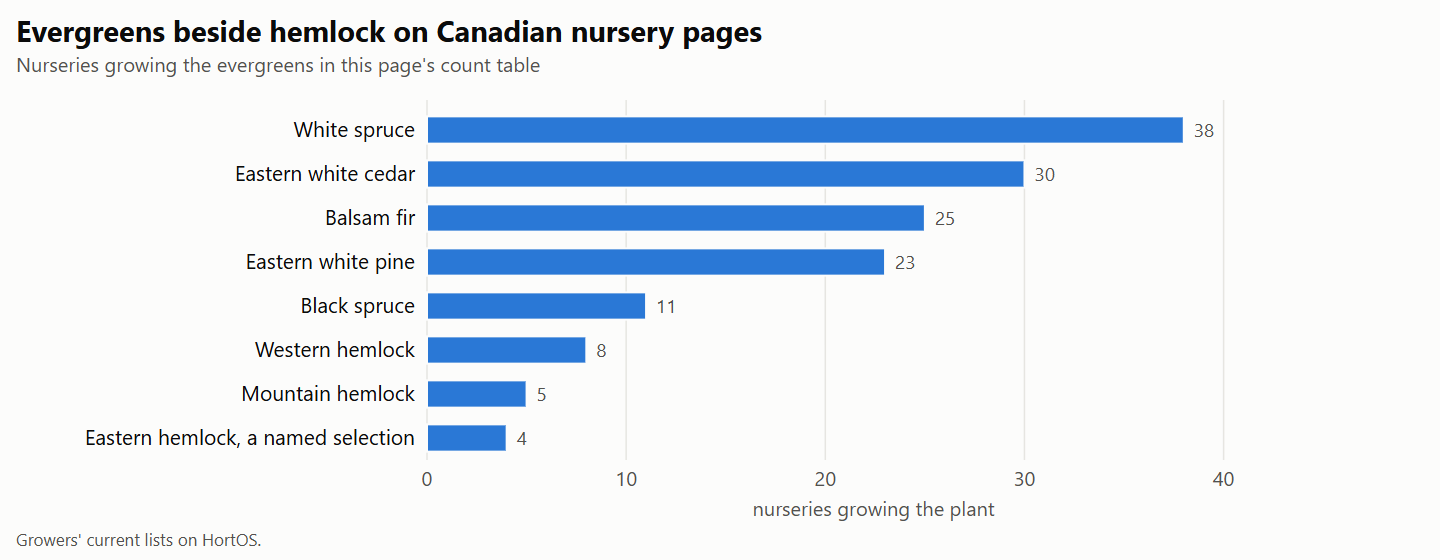
The first four rows of the next table are conifers that Ontario's 2023 technical note names. Black spruce is a native evergreen conifer on Ontario's Tree Atlas list. The last three rows are hemlocks, because the federal Order of 2025 regulates hemlock plants for planting. Besides eastern hemlock itself, 5 native evergreen conifers on Ontario's list have no row, red spruce and eastern redcedar among them. Counts are the nurseries each plant's page on HortOS showed as growing it. Median trade prices are not published for Canada yet. In the table, MNRF is Ontario's Ministry of Natural Resources and Forestry, CFIA Order is the 2025 Order that the Canadian Food Inspection Agency publishes, and a regulated item is the Order's regulated thing.
| Plant | Why it is in this table (authority, year) | Nurseries growing it |
|---|---|---|
| Eastern white cedar (Thuja occidentalis) | Named for restoring some of hemlock's functions (Ontario MNRF, 2023) | 30 |
| White spruce (Picea glauca) | Named for restoring some of hemlock's functions (Ontario MNRF, 2023) | 38 |
| Eastern white pine (Pinus strobus) | Named for restoring some of hemlock's functions (Ontario MNRF, 2023) | 23 |
| Balsam fir (Abies balsamea) | Named for restoring some of hemlock's functions (Ontario MNRF, 2023) | 25 |
| Black spruce (Picea mariana) | On Ontario's list of native trees; grows across Canada (Ontario Tree Atlas, 2024) | 11 |
| Eastern hemlock, a named selection (Tsuga canadensis 'Pendula') | A hemlock: a regulated item (CFIA Order, 2025) | 4 |
| Western hemlock (Tsuga heterophylla) | A hemlock: a regulated item (CFIA Order, 2025) | 8 |
| Mountain hemlock (Tsuga mertensiana) | A hemlock: a regulated item (CFIA Order, 2025) | 5 |
Counts are the nurseries each plant page shows as growing the plant, with or without sizes listed.
The table has no row for eastern hemlock, the species: its page showed 20 nurseries growing it on the same date. The 'Pendula' row is one named selection, which no source read for this page describes. For red spruce (Picea rubens), the fifth conifer in Ontario's note, the count was 3. The counts are for Canada as a whole, several are small, and none says where the nurseries are. The province pages for Ontario, Nova Scotia and British Columbia show the growers in each, and the directory holds a page for every grower.
The Ontario Ministry of Natural Resources and Forestry (2023) gives the first four conifers as examples to keep and regenerate in forest stands, not as hedge plants. The Tree Atlas page for eastern white cedar (Ontario, 2023) says the tree's small size makes it a very good choice for a landscaping hedge. The Atlas page for eastern white pine (Ontario, 2023) says the tree grows quickly and suits blocking a view, and can become lopsided where wind exposure is high.
No authority read for this page names black spruce as a stand-in for hemlock. It has a row only as a native evergreen conifer that Ontario's Tree Atlas (2024) says grows across Canada and throughout Ontario.
The three hemlock rows are not a warning against the plants. The 2025 Order's definition of a regulated thing, given in the section on the regulated areas, covers hemlock of every species. Western and mountain hemlock are native to British Columbia (Canadian Food Inspection Agency, D-07-05, 2025). No authority read for this page offers either as a replacement for eastern hemlock.
The Canadian Food Inspection Agency's fact sheet (2025) names eight hemlock species, Yeddo spruce and tiger-tail spruce as the trees known to be attacked. White cedar, white pine, balsam fir and the native spruces are not among them. That describes the Agency's list as read, and is not a promise about any tree.
Shade, moisture and height, set beside hemlock
The last table sets eastern hemlock beside the five conifers in Ontario's 2023 technical note, plus black spruce and eastern redcedar from Ontario's Tree Atlas list. Three other native pines on that list are not shown. The height, shade and moisture cells are what the Government of Ontario's Tree Atlas page for each tree says, on pages dated 2023 to 2025. The last column is the light tolerance line of the Natural Resources Canada fact sheet for the tree (2024). The table holds no HortOS figure. Two cells read "Not stated", because the fact sheets for eastern white-cedar and balsam fir carry no light tolerance line.
| Evergreen | Height (Ontario Tree Atlas, 2023 to 2025) | Shade (Ontario Tree Atlas) | Moisture (Ontario Tree Atlas) | Light tolerance (Natural Resources Canada, 2024) |
|---|---|---|---|---|
| Eastern hemlock (Tsuga canadensis), the tree being replaced | 30 m | Very shade tolerant | Best on very moist sites | Very shade-tolerant |
| Eastern white cedar (Thuja occidentalis) | 15 m | Tolerates some shade | Best in moist soil | Not stated |
| White spruce (Picea glauca) | Usually 24 m | Tolerates shade | A range of moisture levels | Shade-tolerant |
| Balsam fir (Abies balsamea) | 30 m | Sun or shade | All soil moisture levels | Not stated |
| Red spruce (Picea rubens) | 26 m | Shade tolerant | Best in well-drained soils | Very shade-tolerant |
| Black spruce (Picea mariana) | 20 to 30 m | Tolerates partial shade | Many moisture levels | Moderately shade-tolerant |
| Eastern white pine (Pinus strobus) | 20 to 40 m | Best in full sun; young trees tolerate some shade | Different moisture levels | Full sunlight; seedlings moderately shade-tolerant |
| Eastern redcedar (Juniperus virginiana) | 10 m | Intolerant of shade | Dry to average moisture | Full sun |
The heights are what Ontario's Tree Atlas says each tree reaches as a tree, not the height of a clipped hedge. No source read for this page gives a growth rate in figures, a spacing or a clipped height, so none is stated.
Natural Resources Canada (2024) says eastern hemlock needs a cool moist site and is very shade-tolerant. Ontario's 2023 technical note describes it as shallow rooted and very intolerant of drought.
Ontario's Tree Atlas (2023) says eastern white cedar does not tolerate road salt, and that white-tailed deer browse its twigs in winter. The Atlas page for balsam fir (Ontario, 2024) says the roots are shallow, so the tree can blow down in extreme wind. Ontario's Tree Atlas (2023) says red spruce is now relatively rare in Ontario, with a natural range that runs into the Maritime provinces.
The Tree Atlas describes Ontario. For Nova Scotia this page rests on the national fact sheets, the Canadian Food Inspection Agency and Halifax Regional Municipality. No Nova Scotia government page was read, so nothing here describes how these trees behave on a Nova Scotia site.
What the counts and the tables leave out
A count is not a number of plants, and it does not say a tree suits a site. Four more things are missing, each a question for the grower.
- Where the plants were grown. A grower's page does not say whether the nursery sits inside a regulated area (the reader sets its location against the Agency's page), is registered in the Hemlock Woolly Adelgid Nursery Program, or has treated its hemlock. For hemlock leaving a regulated area, the buyer asks for the Movement Certificate that Directive D-07-05 (Canadian Food Inspection Agency, 2025) says must accompany each shipment.
- Seed source. Ontario's Tree Atlas (2026) advises planting locally sourced trees. The directory does not show provenance, so the buyer asks where the seed or cuttings were collected.
- Species or named selection. A species and its named selections have separate pages and counts. For eastern white cedar, the page for 'Smaragd' showed 19 nurseries growing it and the page for 'Nigra' showed 9. No source read for this page describes either selection.
- Size at sale. The counts include nurseries with no sizes listed, so the buyer asks which sizes the grower lists.
How growers set minimums and terms for a group outside the trade is in the guide to buying from a wholesale grower. How to cite a count from HortOS is in the guide to nursery industry statistics. HortOS does not answer for a grower.
What to watch for
- Reading a detection as a regulated area. The provinces table holds four places with detections that the 2025 Order does not name.
- Reading the Order as a ban on hemlock, or as a rule about hemlock alone. The 2025 Order restricts movement out of the infested place, and all firewood is a regulated thing under it.
- Taking a forest list for a hedge list. Ontario's 2023 technical note is about forest stands. The hedge and screen remarks this page reports are the Tree Atlas's (Ontario, 2023), on eastern white cedar and eastern white pine.
- Relying on a description written before the 2025 Order. The Order of 21 August 2025 added four Ontario areas, so an earlier description does not show the regulated areas as they now stand.
Getting it right
- Find the property's municipality or county on the Canadian Food Inspection Agency's regulated areas page and its detections list, and note the page's modified date.
- Before a hemlock plant, a branch or any firewood leaves a regulated area, contact the local Canadian Food Inspection Agency office, as its page (2026) says to. Under the 2025 Order an inspector authorizes the movement.
- Before a treatment, look up what is registered in Health Canada's Pesticide Product Information Database, and ask the local authorities who may apply it, as Natural Resources Canada (2025) says to.
- Before a tree is cut, ask the municipality what it requires, as the Niagara Peninsula Conservation Authority (Ontario, read 4 October 2026) tells landowners in its watershed.
- Set the site's shade and moisture against the comparison table, then read both authorities' pages for each tree on the shortlist.
- Ask each grower in writing where the plants were grown, whether the plant is the species or a named selection, where the seed was collected, and which sizes it lists.
A word of caution
The infested place is set and varied by ministerial order under the Plant Protection Act, as the 2025 Order's recital says. This page gives the regulated areas as the Order of 21 August 2025 and the Canadian Food Inspection Agency's page stood on 4 October 2026. What is registered against the insect is in Health Canada's Pesticide Product Information Database, and Natural Resources Canada (2025) says to ask local authorities who may apply it. The counts are what the HortOS plant pages showed, and the live pages change.
Sources
- Canadian Food Inspection Agency, Infested Place Order, 2025: the Order's schedule.
- Canadian Food Inspection Agency, Regulated areas and items: regulated areas, detections list.
- Canadian Food Inspection Agency, Directive D-07-05: movement requirements for hemlock.
- Canadian Food Inspection Agency, Hemlock woolly adelgid: the insect and its signs.
- Canadian Food Inspection Agency, Scientific fact sheet: Adelges tsugae: the host trees.
- Natural Resources Canada, Hemlock woolly adelgid: damage, options, pesticide caution.
- Invasive Species Centre, Guide for Managing Hemlock Woolly Adelgid: management by stage.
- Ontario Ministry of Natural Resources and Forestry, Technical Note TN-09: guidelines, conifers named.
- Niagara Peninsula Conservation Authority, Invasive Species Management: treatment on its lands.
- Halifax Regional Municipality, Hemlock woolly adelgid: finds, plan, treatment forms.
- Government of Ontario, The Tree Atlas: native tree list, planting tips.
- Ontario Tree Atlas, Eastern hemlock: height, shade, moisture.
- Ontario Tree Atlas, Eastern white cedar: traits and hedge remark.
- Ontario Tree Atlas, Eastern white pine: traits and wind caution.
- Ontario Tree Atlas, White spruce: height, shade, moisture.
- Ontario Tree Atlas, Balsam fir: traits, shallow roots.
- Ontario Tree Atlas, Black spruce: height, shade, moisture.
- Ontario Tree Atlas, Red spruce: traits and Ontario rarity.
- Ontario Tree Atlas, Eastern redcedar: height, shade, moisture.
- Natural Resources Canada, eastern hemlock: site needs, light tolerance.
- Natural Resources Canada, eastern white-cedar: form and habitat.
- Natural Resources Canada, eastern white pine: light tolerance line.
- Natural Resources Canada, white spruce: light tolerance line.
- Natural Resources Canada, balsam fir: habitat and range.
- Natural Resources Canada, black spruce: light tolerance line.
- Natural Resources Canada, red spruce: light tolerance line.
- Natural Resources Canada, eastern redcedar: light tolerance line.
More guides

Buying From a Wholesale Grower When You Are Not in the Trade
Naturalist clubs, conservation authorities, schools, land trusts and municipalities can buy from Canadian wholesale growers when they order like the trade: in quantity, ahead of the season, on the grower's terms. This page explains who sells to whom, business numbers and tax, minimums and pooling, how the Canadian Nursery Stock Standard sizes stock, provenance, lead times and shipping.
Nursery Industry Statistics 2026, and How to Cite HortOS
The two kinds of nursery industry number, the official survey and the live supply picture, for Canada: Statistics Canada's 2024 nursery sales, area and expenses, the number of nurseries over time, growers listed on HortOS by province and town, why no medians are published yet, and how to cite HortOS now and the Index when it publishes.
Beech leaf disease in Ontario and native trees compared with beech
For conservation authorities, naturalist clubs and land trusts in Canada: the dated record of beech leaf disease in Ontario, what the authorities say of the disease and of a diseased beech, and a comparison of American beech with native trees from Ontario's Tree Atlas on height, shade and wildlife food, with how many Canadian nurseries grow each. Counts only.