Nursery Industry Statistics 2026, and How to Cite HortOS
The two kinds of nursery industry number, the official survey and the live supply picture, for Canada: Statistics Canada's 2024 nursery sales, area and expenses, the number of nurseries over time, growers listed on HortOS by province and town, why no medians are published yet, and how to cite HortOS now and the Index when it publishes.
Updated September 25, 2026. Figures from the live ca.hortosapp.com pages on 24 September 2026 and Statistics Canada's release of 24 April 2025; refreshed with the first Canadian edition of the HortOS Plant Price Index.

On this page
Anyone who searches for nursery industry statistics in Canada finds two kinds of number and rarely knows which is which. The first is Statistics Canada's annual survey: what the country's nurseries sold, on how many hectares, at what cost. The second is the live supply picture: which growers publish an availability list this month, where they are, and what is on it. The idea that matters most is that the two answer different questions, that both are citable, and that a writer, a student or a library guide should say which one a figure comes from.
This page gives both for Canada. The official figures are Statistics Canada's, from its release on the greenhouse, sod and nursery industries for 2024, with Landscape Ontario's reading of the earlier series on the number of nurseries. The supply figures are what HortOS, a free directory of Canadian wholesale plant growers with their published availability and trade prices, printed on 24 September 2026: growers listed by province and the towns where they cluster. It ends with how to cite those figures now and what the first Canadian edition of the HortOS Plant Price Index will add.
Quick facts
| Nursery sales | Nursery sales and resales of $796.1 million in 2024, up 3.9 per cent, on 15,209 hectares, down 0.8 per cent; nursery operating expenses $695 million, up 4.1 per cent (Statistics Canada). |
|---|---|
| The wider sector | Total sales of the greenhouse, nursery, field-grown cut flower and sod industries rose to $6.0 billion in 2024 from $5.5 billion in 2023, with greenhouse products $5.0 billion of it (Statistics Canada). |
| Number of nurseries | Landscape Ontario's reading of the Statistics Canada series: 1,840 nurseries in Canada in 2021, down from 1,993 in 2020 and from a 2011 jump to 2,721. |
| Growers listed | More than 2,200 Canadian growers on HortOS. By province on 24 September 2026: Ontario 816, Quebec 469, British Columbia 446, Alberta 202. |
| Prices | Each grower's own published price sits beside its line; no Canadian medians are published yet, because a median needs several growers pricing the same size on trade lists. |
| How to cite | A live page by its URL and the date it was read; the first Canadian edition of the HortOS Plant Price Index, when it publishes, by edition and link. |
Two kinds of number
Statistics Canada's release on the greenhouse, sod and nursery industries for 2024, published on 24 April 2025, gives the size of the industry: nursery operations, which it describes as producing shrubs, trees and plants in containers and fields, had sales and resales of $796.1 million in 2024, up 3.9 per cent, on a national nursery area of 15,209 hectares, down 0.8 per cent; nursery operating expenses rose 4.1 per cent to $695 million; sod sales rose 1.2 per cent to $164.5 million on 21,702 hectares; and the whole greenhouse, nursery, field-grown cut flower and sod sector sold $6.0 billion, up from $5.5 billion, with greenhouse products $5.0 billion of it. Landscape Ontario, reading the earlier series in 2022, noted that the number of nurseries in Canada jumped 78 per cent in 2011, from 1,526 to 2,721, then declined steadily to 1,840 in 2021, while combined nursery and sod sales of $897 million in 2021 were still below the 2015 peak of $916 million. Those are the numbers to cite for the size of the industry, and the release and Landscape Ontario's summary are the places to cite them from.
HortOS measures something else: not what the industry is worth but which growers offer what, this month. Its directory lists more than 2,200 Canadian growers, its provincial hubs list them by town with the number of lines each has published, and its plant pages show every grower holding a plant, by province and size, with the date each list was updated. It is not a survey and it is not retail pricing; it is what the wholesale trade could see if it looked at every published list at once.
Growers listed, by province
The provincial hubs list the growers in the directory by town. On 24 September 2026 they printed Ontario 816, Quebec 469, British Columbia 446 and Alberta 202, with Saskatchewan, Nova Scotia, Manitoba and New Brunswick behind them; within Ontario, Hamilton had 33, Lincoln 29, Norfolk 24, Toronto 24, Niagara-on-the-Lake 22 and St. Catharines 20. A directory count is not a Statistics Canada count: the agency's nurseries are operations in a survey year, and HortOS's growers are wholesale production nurseries with a page, so the two should never be added or compared as if they measured the same thing. The Statistics Canada geography and the HortOS one agree on the shape: Ontario first, then Quebec and British Columbia.
What is grown and what it costs
Canadian lists on HortOS are thinner than the other three countries', so the plant pages show a handful of growers per plant rather than dozens, and no plant yet has the three pricing growers on trade lists that a median needs. HortOS shows each grower's own published price beside its line, ex tax, and prints the lowest on the plant page. The first Canadian edition of the HortOS Plant Price Index is still being prepared; when it publishes it will carry, as the Australian edition does, a median at each container class, a range across growers and a provincial comparison, and this page will be refreshed with it. Until then the Canadian Nursery Stock Standard, which the Canadian Nursery Landscape Association says standardizes how stock is sized and described and aligns with the American standard in metric units, is the reference for what a size on a Canadian list means.
How to cite HortOS now, and the Index when it comes
Until the Canadian edition publishes, every Canadian figure on HortOS is a live figure that moves as lists arrive, so it should be cited the way a live database is: the page, its URL and the date it was read. A hub carries the number of growers listed and the lines each has published; a plant page carries the growers holding the plant by province and size and the date each list was updated; both belong in a careful citation. The Australian Index shows what the Canadian edition will offer: a monthly page with a fixed edition, a cite line (HortOS Plant Price Index, the edition, the page URL), tables and charts reproducible with attribution and a link, and a JSON data file at a URL that names the edition, with the page's dataset metadata declaring a Creative Commons Attribution 4.0 licence, whose deed allows sharing and adapting the material for any purpose provided appropriate credit is given, a link to the licence is provided and changes are indicated.
What to watch for
- Mixing the two kinds of number. Growers listed on HortOS and nurseries surveyed by Statistics Canada are different populations counted different ways.
- Quoting without the date. A live count moves as lists arrive; a figure from a hub or a plant page carries the date it was read.
- Reading a directory count as a survey. A provincial hub's count is of growers with a page, and it changes as growers are added or removed.
- Reading a grower's price as the market. Until medians exist, a Canadian price on HortOS is one grower's price on one day.
- Adding up what is not there. HortOS publishes no count of availability lists and no grower's price beside an aggregate; a figure of that kind did not come from it.
Getting it right
- For the industry's sales, area and costs, cite Statistics Canada's release for the year, and for the number of nurseries its series as Landscape Ontario summarized it.
- For growers by province and town, cite the HortOS hub by URL with the date it was read.
- For a plant's growers and prices, cite its plant page with the date.
- When the Canadian edition of the Index publishes, cite it by edition and link, and reproduce its tables with the credit line.
A word of caution
The HortOS figures on this page are what the live pages printed on one date and will differ on another; the first Canadian edition of the Index will fix them to a month. The industry figures are Statistics Canada's, quoted from its release, and it is the authority on what each covers; Landscape Ontario's summary is its reading of an earlier series. Neither is a count of nurseries with stock for sale in any other sense than its own. A citation that names its source and its date is the only kind that survives the next release.
Sources
- Statistics Canada, greenhouse, sod and nursery industries, 2024: sales, area and expenses.
- Landscape Ontario, StatsCan releases sod and nursery revenue and workforce data: the number of nurseries over time.
- Canadian Nursery Landscape Association, Canadian Nursery Stock Standard: how stock is sized and described.
- Creative Commons, Attribution 4.0 International deed: what the Index's licence allows.
More guides
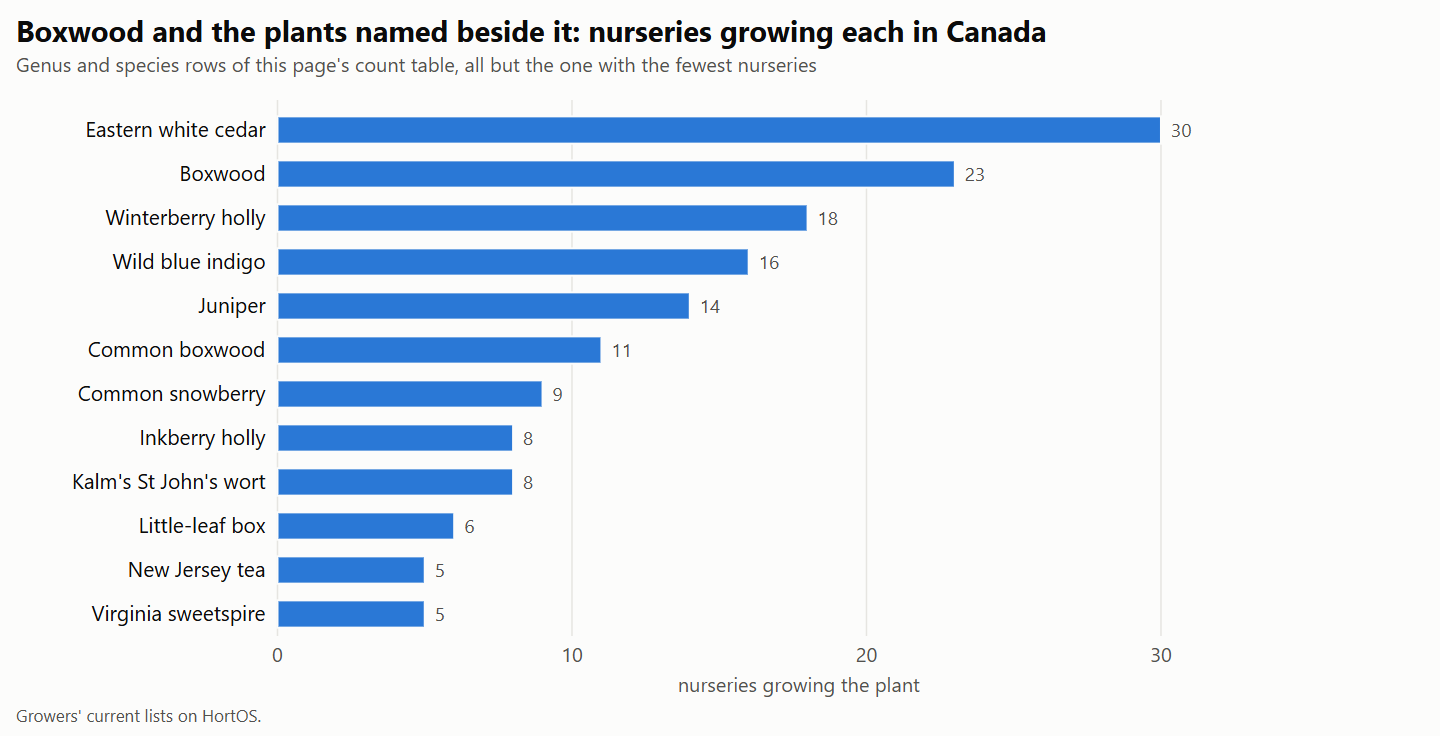
Box tree moth in Canada: boxwood rules and the plants named beside it
For landscape designers, garden clubs and stewardship groups in Canada: the provinces regulated for box tree moth, what the federal Order and directive say about moving boxwood, what Canadian bodies have published on keeping or replacing it, and how many Canadian nurseries grow boxwood and the plants two Ontario Master Gardener groups name beside it. Counts only.
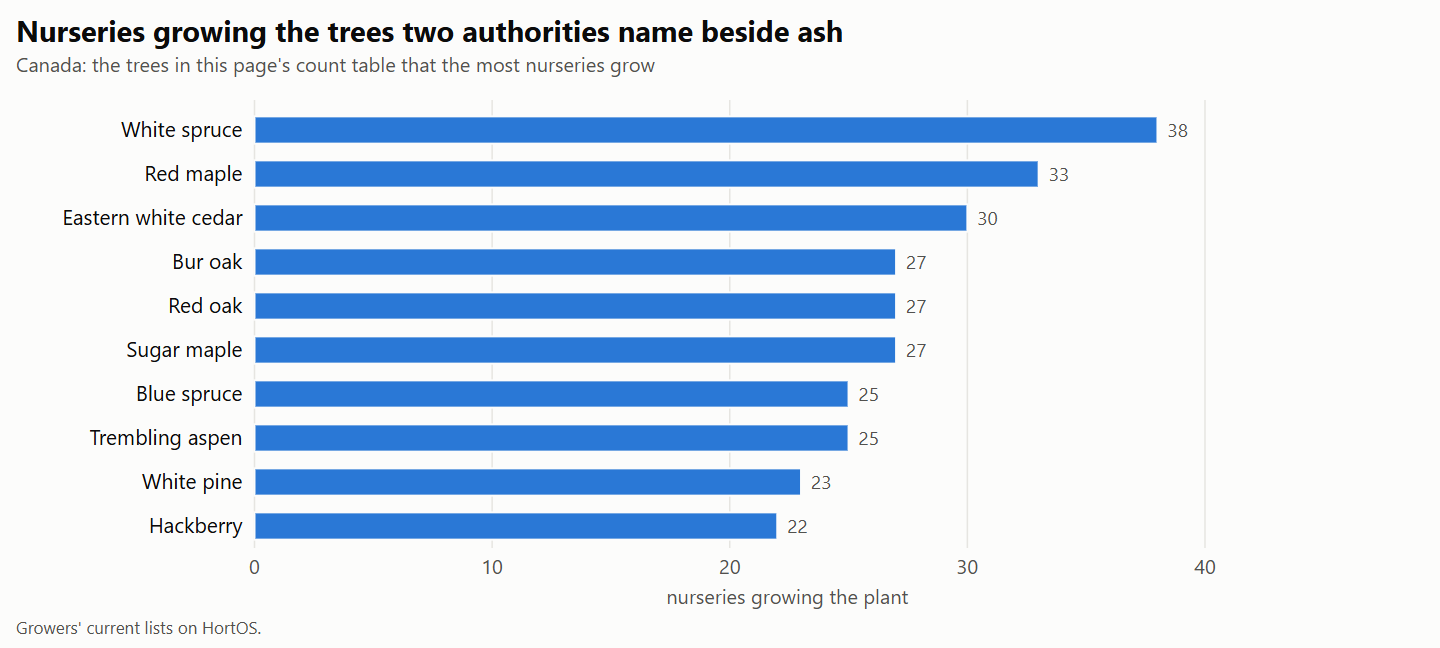
Replacing ash trees lost to emerald ash borer in Canada
For tree boards, municipal foresters and stewardship groups in Canada: what the Canadian Food Inspection Agency's pages say of regulated areas in eight provinces, the federal rule on moving ash nursery plants, what municipalities say about treating and replanting, and how many Canadian nurseries grow each tree two authorities name. Counts only, no prices.
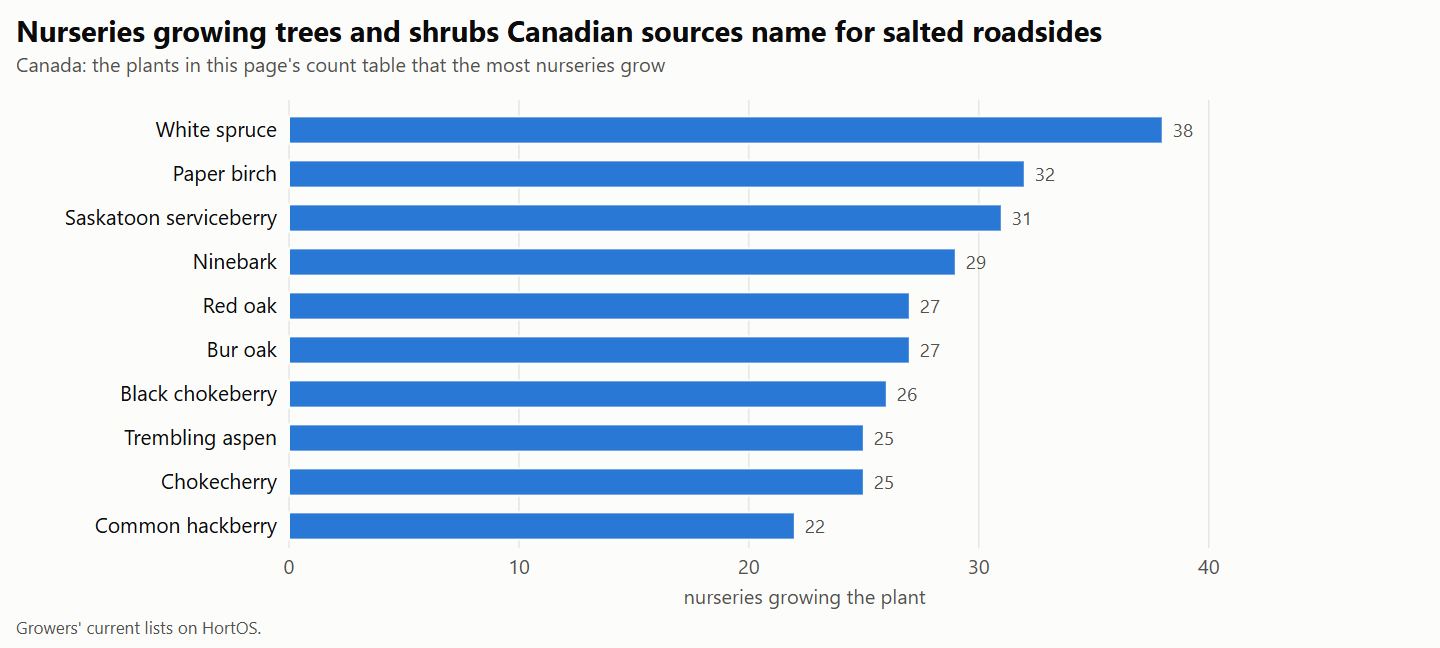
Road salt tolerant trees and shrubs for Canadian streets
For public works crews, boulevard groups and watershed groups in Canada: how road salt reaches plants by spray and through the soil, where the Transportation Association of Canada and an Ontario stormwater guide say to plant, and how many Canadian nurseries grow the trees and shrubs two Canadian sources name. Counts only, no prices.