Road salt tolerant trees and shrubs for Canadian streets
For public works crews, boulevard groups and watershed groups in Canada: how road salt reaches plants by spray and through the soil, where the Transportation Association of Canada and an Ontario stormwater guide say to plant, and how many Canadian nurseries grow the trees and shrubs two Canadian sources name. Counts only, no prices.
Updated October 24, 2026. Counts are what the live ca.hortosapp.com plant pages printed; medians are not published yet.
On this page
A public works supervisor in an Ontario town has a boulevard to replant beside an arterial road that the plows salt all winter, and a council that wants the new trees still alive years from now. Which trees and shrubs stand up to road salt, and can a nursery be found that grows them? The idea that matters most: salt tolerance is a matter of degree, so where a plant stands in relation to the spray and the meltwater matters alongside the species chosen.
The page draws on Watersheds Canada's 2024 salt tolerant native plants for Eastern Ontario and the Transportation Association of Canada's 2013 synthesis of road salt practice. It also uses the Sustainable Technologies Evaluation Program's stormwater planting guide for Ontario. For the trees and shrubs those sources name, it counts the nurseries growing each one on HortOS, a free directory of Canadian wholesale plant growers with their published availability and trade prices. It gives no rating of its own and no advice on deicers.
Quick facts
| Two routes for salt | Watersheds Canada (Ontario, 2024) says road salt reaches plants as drift thrown up by traffic and as salty water soaking into the root zone. |
|---|---|
| When damage shows | Harm done by winter salting is often not plain until spring, according to Watersheds Canada (Ontario, 2024). |
| How far spray travels | The Transportation Association of Canada (2013) says spray from low volume roads generally stays inside the right-of-way, while busy roads can send it beyond, mostly downwind. |
| The Eastern Ontario list | Watersheds Canada's resource library (2026) describes its salt tolerant list as covering 40 native species, each with its common and scientific name and its type. |
| Stormwater plantings | Ontario's stormwater planting guide from the Sustainable Technologies Evaluation Program (2026) rates plants low, medium or high for salt, and keeps low tolerance species out of any planting fed by runoff from salted pavement. |
| On HortOS | 25 trees and shrubs from the Canadian lists are counted below, as their HortOS plant pages stood. |
How road salt injures a planting
Watersheds Canada's 2024 page on salt tolerant native plants, written for Ontario, describes two ways salt does harm. Spray lifted by passing vehicles settles on twigs and works into leaf scars, where it can kill the buds that would open in spring. The same Watersheds Canada page says spray can scorch leaves, buds and small twigs outright.
The second route runs through the soil. Meltwater carries dissolved salt into the root zone, and Watersheds Canada explains that salty soil cuts the water roots can draw. The plant then behaves much as it would in a drought. The organisation also notes that the harm from winter salting is often not plain until spring.
Not every plant reacts the same way. Watersheds Canada says native species differ in how well they cope with salt-affected soil, and that only a few, called halophytes, are fully adapted to saline ground. It gives switchgrass as an example of a halophytic grass native to Ontario.
The Sustainable Technologies Evaluation Program's plant list page (Ontario, 2026) adds a note of balance. In most cases, it says, raised salt levels in soil do not last, because rain and snowmelt dilute the salt and carry it away. The Transportation Association of Canada's 2013 vegetation note takes the other side of the same question. It says salt can harm roadside vegetation and that the harm cannot be removed entirely while salt is used, only reduced.
Where Canadian practice puts the plants
The Transportation Association of Canada's 2013 note on vegetation management treats placement as part of the answer. Where spray lands, it says to plant salt tolerant species, and it says salt sensitive species should not go inside the spray zone at all. It suggests planting in groups so that the plants shelter one another, and setting landscape plantings on the far side of ditches, away from where salty runoff gathers. For newly planted conifers in urban areas, the note suggests burlap screens through the winter.
The same 2013 note names trees on both sides of the line. Its roadside list of salt tolerant trees includes honey locust, ginkgo, white oak and red oak. Among trees it rates as intolerant of salt are sugar maple, red maple, white pine and littleleaf linden.
The stormwater guide from the Sustainable Technologies Evaluation Program applies a similar logic to low impact development plantings that catch road water in Ontario. Its plant list page (2026) says species of medium tolerance can take runoff from salted roads, but should be kept out of the path of spray and should not take the bulk of the runoff. It also says woody and evergreen plants should not go in any part of such a planting that will hold piled snow in winter. Its separate tree table scores salt tolerance from 1, low, to 3, high.
Watersheds Canada's 2024 list for Eastern Ontario groups its native plants by tolerance: high, moderate, and high to moderate, with halophytes set apart. For each plant it gives the hardiness zones and whether it is a tree, a shrub, a vine, a groundcover or a tall grass. The organisation's page names staghorn sumac and red oak as species suited to roadsides that take salty runoff and spray.
The trees and shrubs, and how many nurseries grow them
The table below is a selection of trees and shrubs that have a plant page here. Each is named on Watersheds Canada's 2024 Eastern Ontario list or among the Transportation Association of Canada's 2013 tolerant and moderately tolerant species. Any plant that either source marks as intolerant is left out. Trees come first, then shrubs, in the order they were gathered. The table holds no tolerance class, because neither source's class could be tied to every row. Counts are the nurseries each plant's page on HortOS showed as growing it. Median trade prices are not published for Canada yet.
| Plant | Nurseries growing it |
|---|---|
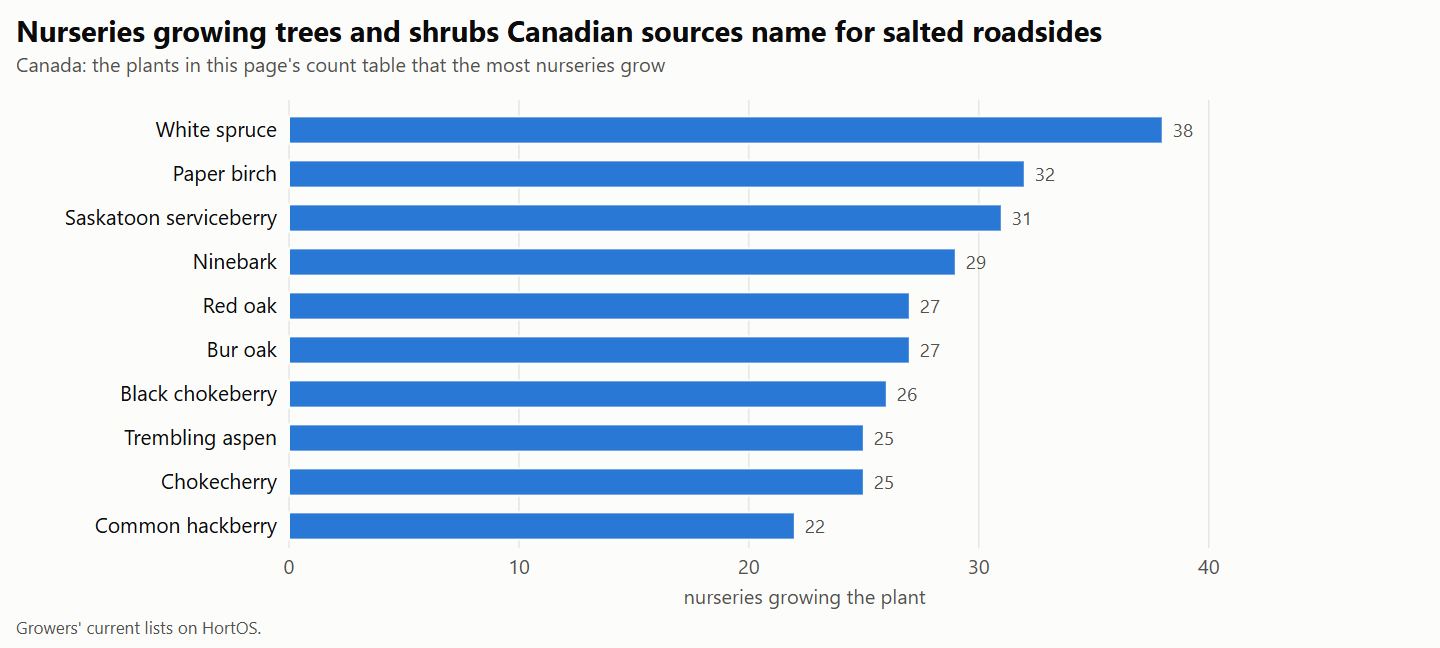
| Red oak (Quercus rubra) | 27 |
| Bur oak (Quercus macrocarpa) | 27 |
| Common hackberry (Celtis occidentalis) | 22 |
| Honey locust (Gleditsia triacanthos) | 12 |
| Ginkgo (Ginkgo biloba) | 22 |
| Japanese tree lilac (Syringa reticulata) | 15 |
| Paper birch (Betula papyrifera) | 32 |
| Trembling aspen (Populus tremuloides) | 25 |
| White spruce (Picea glauca) | 38 |
| Black cherry (Prunus serotina) | 8 |
| Serviceberry (Amelanchier canadensis) | 18 |
| Allegheny serviceberry (Amelanchier laevis) | 8 |
| Saskatoon serviceberry (Amelanchier alnifolia) | 31 |
| Staghorn sumac (Rhus typhina) | 22 |
| Fragrant sumac (Rhus aromatica) | 12 |
| Smooth sumac (Rhus glabra) | 10 |
| Ninebark (Physocarpus opulifolius) | 29 |
| Chokecherry (Prunus virginiana) | 25 |
| Winterberry (Ilex verticillata) | 18 |
| Black chokeberry (Aronia melanocarpa) | 26 |
| Nannyberry (Viburnum lentago) | 17 |
| Common juniper (Juniperus communis) | 8 |
| Kalm's St. John's wort (Hypericum kalmianum) | 8 |
| Buttonbush (Cephalanthus occidentalis) | 13 |
| Elderberry (Sambucus canadensis) | 22 |
Counts are the nurseries each plant page shows as growing the plant, with or without sizes listed.
The trees range from large shade species such as bur oak, grown by 27 nurseries, and common hackberry to smaller street trees such as Japanese tree lilac, a tree the association's 2013 list includes. Conifers are represented by white spruce, which 38 nurseries grow. Among the shrubs, black chokeberry and ninebark are each grown by more than a handful of nurseries, while common juniper shows only 8 nurseries and smooth sumac 10. A thin row means fewer nurseries to ask.
The counts cover Canada as a whole. Ontario's nurseries are on the Ontario page, which matters because the Watersheds Canada list was drawn up for the eastern part of that province. For a sense of how the trade publishes its lists and prices, the guide to buying from a wholesale grower explains how a municipality or a stewardship group can order. The guide to nursery industry statistics sets out the national survey figures for the Canadian trade.
What the counts cannot tell you
A nursery count says how widely a plant is grown in the trade. It is not a measure of how well that plant copes with salt, and a row near the top of the table is no better suited to a salted boulevard than one near the bottom. Each source sets its own scale.
The counts do not show the size, the form or the root condition of what a nursery grows, nor whether its trees were raised from local seed. Watersheds Canada's list is of native species for Eastern Ontario, so a group planting for native habitat will want to ask each grower where its seed came from and whether the plant is the straight species rather than a selection. HortOS cannot answer those questions for a grower.
Nor does the table speak to a particular site. Spray reach depends on traffic and wind, as the Transportation Association of Canada notes. Hardiness also changes across the country, and the Watersheds Canada list gives each plant's zones.
What to watch for
- Snow piles. A plant rated tolerant can still be buried in salty snow. The Ontario stormwater guide keeps woody and evergreen plants out of snow storage areas altogether.
- Judging success in March. Watersheds Canada (2024) says harm from winter salting is often not plain until spring, so a planting that looks fine in late winter may not be.
- Medium is not spray proof. The stormwater guide's medium class can take salty runoff, though not the bulk of it, and not direct spray.
- Reading the count as a rating. A plant many nurseries grow has not been tested for salt by that fact, and a thinly grown shrub is not less tolerant.
- Carrying a regional list too far. The Watersheds Canada list was made for Eastern Ontario, and its zones need checking against the planting site elsewhere.
Getting it right
- Ask the municipality's roads or public works department which side of the street takes the plowed snow and where spray settles in a normal winter.
- Have the municipal forester or the project's landscape architect choose species from the published tolerance classes, matching each plant to spray, runoff or both.
- Ask the local conservation authority whether a stormwater planting falls under its guidance before setting woody plants in a swale or rain garden.
- Ask each nursery which sizes and forms it grows, where its seed came from, and whether a native plant is the straight species.
- Agree with whoever will maintain the planting on a spring inspection, so that losses from the first winter are seen and recorded.
A word of caution
The tolerance classes behind this page belong to Watersheds Canada's 2024 Eastern Ontario list, the Transportation Association of Canada's 2013 synthesis and the Sustainable Technologies Evaluation Program's Ontario stormwater guide, and they differ in scope and date. A municipal forester or a local conservation authority can judge a particular street or swale. The nursery counts here describe the trade, not any plant's fitness for a site.
Sources
- Watersheds Canada, Salt Tolerant Native Plant List for Eastern Ontario: native plants by tolerance class.
- Watersheds Canada, Salt Tolerant Native Plants: how road salt harms plants.
- Watersheds Canada Resource Library, Salt Tolerant Native Plants collection: what the list covers.
- Transportation Association of Canada, Road Salt Management: Vegetation Management: roadside placement and tolerant trees.
- Sustainable Technologies Evaluation Program, LID SWM Planning and Design Guide: Plant lists: salt classes for stormwater plantings.
- Sustainable Technologies Evaluation Program, LID SWM Planning and Design Guide: Trees: List: tree table with salt scores.
More guides

Buying From a Wholesale Grower When You Are Not in the Trade
Naturalist clubs, conservation authorities, schools, land trusts and municipalities can buy from Canadian wholesale growers when they order like the trade: in quantity, ahead of the season, on the grower's terms. This page explains who sells to whom, business numbers and tax, minimums and pooling, how the Canadian Nursery Stock Standard sizes stock, provenance, lead times and shipping.
Nursery Industry Statistics 2026, and How to Cite HortOS
The two kinds of nursery industry number, the official survey and the live supply picture, for Canada: Statistics Canada's 2024 nursery sales, area and expenses, the number of nurseries over time, growers listed on HortOS by province and town, why no medians are published yet, and how to cite HortOS now and the Index when it publishes.
Box tree moth in Canada: boxwood rules and the plants named beside it
For landscape designers, garden clubs and stewardship groups in Canada: the provinces regulated for box tree moth, what the federal Order and directive say about moving boxwood, what Canadian bodies have published on keeping or replacing it, and how many Canadian nurseries grow boxwood and the plants two Ontario Master Gardener groups name beside it. Counts only.