Replacing ash trees lost to emerald ash borer in Canada
For tree boards, municipal foresters and stewardship groups in Canada: what the Canadian Food Inspection Agency's pages say of regulated areas in eight provinces, the federal rule on moving ash nursery plants, what municipalities say about treating and replanting, and how many Canadian nurseries grow each tree two authorities name. Counts only, no prices.
Updated October 16, 2026. Counts are what the live ca.hortosapp.com plant pages printed; medians are not published yet.
On this page
A tree board in a Canadian town that is losing its ash to emerald ash borer asks which trees authorities name for planting in its place, and how many nurseries grow each. The answer starts with the province and the municipality, because the federal page of alternatives was written for one county. The Canadian Food Inspection Agency developed that page for Essex County, Ontario, last modified it on 18 May 2012 and says its recommendations may not suit other regions.
This page reports what the Agency's Directive D-03-08 and its page of regulated areas say, with Ontario's Tree Atlas, the Government of Saskatchewan, the Invasive Species Council of BC and eight municipalities from Calgary to Halifax. For each tree those sources name, the count of nurseries growing it is taken from HortOS, a free directory of Canadian wholesale plant growers with their published availability and trade prices. The page is not advice on treating an ash, moving ash material or choosing a tree.
Quick facts
| Regulated areas | The Canadian Food Inspection Agency's page of regulated areas, modified on 12 August 2026, describes areas in British Columbia, Manitoba, Ontario, Quebec, New Brunswick and Nova Scotia. It names none in Alberta or Saskatchewan. |
|---|---|
| Detections in July 2026 | The same page of the Canadian Food Inspection Agency records a detection and a prohibition of movement in Coquitlam, British Columbia (22 July 2026), in Restigouche and Saint John counties, New Brunswick (30 July 2026) and in Colchester County, Nova Scotia (31 July 2026). |
| Ash from a nursery | Appendix 2 of Directive D-03-08 (Canadian Food Inspection Agency, sixth revision, effective 1 April 2026) covers movement from regulated to non-regulated areas. Its entry for ash nursery stock is "Prohibited". |
| First confirmed in Canada | July 2002, in Windsor, Ontario, according to the survey protocol of the Canadian Food Inspection Agency and Natural Resources Canada (revision of June 2024). |
| The federal page of alternatives | The Canadian Food Inspection Agency's page of alternatives to ash describes fifteen trees, was developed for Essex County, Ontario, and was last modified on 18 May 2012. |
| City diversity targets | Winnipeg's urban forest strategy (Manitoba, 2023) recommends no more than 10 per cent of one species and 20 per cent of one genus in the city's tree inventory. |
Where ash is regulated, from British Columbia to Nova Scotia
The Canadian Food Inspection Agency (2026) says the emerald ash borer attacks and kills every species of ash. The table below sets eight provinces side by side, as the Agency's pages stood. Its second column is the Agency's description of the regulated areas. Its third is the newest dated entry for the province on the Agency's page of regulated areas, which was modified on 12 August 2026. Its fourth is one thing an authority in that province reports.
| Province | Regulated area (Canadian Food Inspection Agency, 2026) | A dated entry on the Agency's list | What an authority there reports (authority, year) |
|---|---|---|---|
| British Columbia | Burnaby, Vancouver, the University of British Columbia, the University Endowment Lands, Surrey and New Westminster | Coquitlam: a detection and a prohibition of movement, 22 July 2026 | Presence confirmed in the City of Vancouver as of May 2024 (Invasive Species Council of BC, 2024) |
| Alberta | None on the Agency's list | None | Not yet found in Alberta (City of Calgary, 2026) |
| Saskatchewan | None on the Agency's list | None | More than a quarter of the province's urban trees are ash (Government of Saskatchewan, read October 2026) |
| Manitoba | The City of Winnipeg | Winnipeg made a regulated area, 24 January 2018 | About 30 per cent of boulevard and park trees are ash (City of Winnipeg, 2026) |
| Ontario | The southern and middle parts of the province, and the City of Thunder Bay | District of Timiskaming added, 11 March 2025 | Most or all of the 43,000 ash in the town's woodlands are dead or dying (Town of Oakville, 2026) |
| Quebec | The southern and middle parts of the province | La Tuque, Bonaventure and Charlevoix-Est added, 30 April 2026 | Nearly 50,000 ash kept alive by treatment so far (Ville de Montréal, 2021) |
| New Brunswick | Nine counties: Madawaska, Victoria, Carleton, York, Sunbury, Queens, Kings, Westmorland and Albert | Restigouche and Saint John counties: detections and prohibitions of movement, 30 July 2026 | Ash is about 12 per cent of Fredericton's street trees (City of Fredericton, 2019) |
| Nova Scotia | Halifax County and part of Hants County | Colchester County: a detection and a prohibition of movement, 31 July 2026 | A 2013 plan asks for no more than 10 per cent of any one genus in planting stock (Halifax Regional Municipality, 2013) |
"None" for Alberta and Saskatchewan means that neither the Agency's description nor its dated entries named an area there. It is not a statement that the beetle is absent. That Alberta has had no find so far is the City of Calgary's statement of 2026. The Government of Saskatchewan's page, read in October 2026, says the province has designated the beetle a pest and has regulatory controls of its own beside the federal ones.
The dated entries are of two kinds (Canadian Food Inspection Agency, 2026). A detection with a prohibition of movement bars regulated items from leaving a zone the Agency sets around the affected place. An expansion of a regulated area means regulated items may not leave that area without the Agency's written authorization. Coquitlam, Colchester County and the counties of Restigouche and Saint John are entries of the first kind. Each cell shows the newest entry for its province, not the only one.
The federal rule on moving ash, and what cities say they do
Directive D-03-08 of the Canadian Food Inspection Agency is in its sixth revision, effective 1 April 2026, and names the Plant Protection Act and the Plant Protection Regulations among its authorities. The Canadian Food Inspection Agency's page of regulated areas and items (2026) says no ash tree article may leave a regulated area, or a property under a prohibition of movement, unless the Agency consents. Its ash tree articles include whole ash trees, parts of them and ash nursery stock. The "Prohibited" entry in the directive's Appendix 2 concerns nursery plants moving from a regulated area to a non-regulated one, and this page reads no more into it.
Whether to treat, remove or replace an ash is the owner's or the city's decision, and this page reports only what each authority says of its own trees.
- Oakville, Ontario (2026). The town tells owners of ash they have two options, to treat or to remove, and says an untreated ash should be replaced with a different species.
- Fredericton, New Brunswick (2019). The city says a healthy ash need not be removed, and that managing ash on private land is at the owner's cost.
- Winnipeg, Manitoba (2026). The city first detected the beetle in 2017 and runs a program it calls "slow ash mortality", so that replacements keep pace with removals. It says it is not planting ash at this time.
- Hamilton, Ontario (2026). The city's report says ash is no longer planted, because no hybrid or cultivar is known to resist the beetle.
- Moncton, New Brunswick (read in 2026). The city's plan is to replant with a different species once an ash is removed, and to stagger removal and replanting over several years.
Three cities put a figure on how much of one kind of tree they want, and each figure is that city's own. Winnipeg's 2023 strategy (Manitoba) recommends no more than 10 per cent of one species and 20 per cent of one genus in the city's tree inventory. Hamilton's 2026 report (Ontario) gives the rating its strategy calls good as 5 per cent in one species, 10 per cent in one genus and 15 per cent in one family, city-wide. The Halifax plan of 2013 in the table above applied its genus figure to planting stock, as a near-term measure. Winnipeg's 2023 strategy also puts the city's low diversity down to climate: it plants trees hardy to Zone 3 that can grow in prairie conditions.
The trees two authorities name, with nursery counts
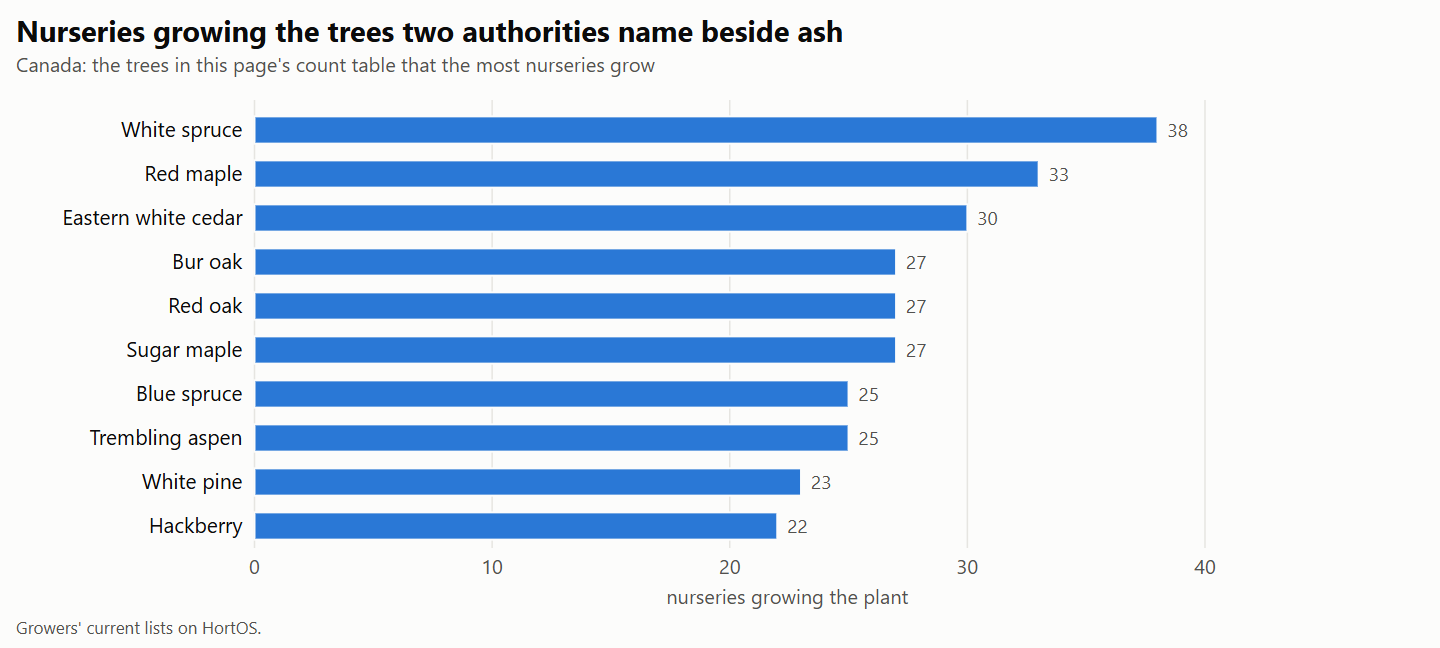
The next table is in alphabetical order. Fifteen of its rows are the trees that the Agency's 2012 page of alternatives describes. The other five are blue spruce, eastern white cedar, Japanese tree lilac, Ohio buckeye and white spruce. They are five of the species to which Winnipeg's 2023 urban forest strategy gives the mark "Use often" or "Try more". For some entries the strategy adds that the suitability of the site affects their use. Entries of the two sources that are not shown: 4. Counts are the nurseries each plant's page on HortOS showed as growing it. Median trade prices are not published for Canada yet.
Neither source is a national list of replacements for ash. The federal page was developed for Essex County's climate and environment (Canadian Food Inspection Agency, 2012). Winnipeg's table covers the most abundant species in the city's own inventory, with a recommendation on the ongoing use of each (City of Winnipeg, 2023).
| Plant | Nurseries growing it |
|---|---|
| Basswood (Tilia americana) | 15 |
| Black walnut (Juglans nigra) | 15 |
| Blue spruce (Picea pungens) | 25 |
| Bur oak (Quercus macrocarpa) | 27 |
| Eastern red cedar (Juniperus virginiana) | 6 |
| Eastern white cedar (Thuja occidentalis) | 30 |
| Hackberry (Celtis occidentalis) | 22 |
| Honeylocust (Gleditsia triacanthos) | 12 |
| Japanese tree lilac (Syringa reticulata) | 15 |
| Ohio buckeye (Aesculus glabra) | 21 |
| Pin oak (Quercus palustris) | 14 |
| Red maple (Acer rubrum) | 33 |
| Red oak (Quercus rubra) | 27 |
| Silver maple (Acer saccharinum) | 21 |
| Sugar maple (Acer saccharum) | 27 |
| Swamp white oak (Quercus bicolor) | 13 |
| Trembling aspen (Populus tremuloides) | 25 |
| Tuliptree (Liriodendron tulipifera) | 22 |
| White pine (Pinus strobus) | 23 |
| White spruce (Picea glauca) | 38 |
Counts are the nurseries each plant page shows as growing the plant, with or without sizes listed.
A count is a number of nurseries, not of trees, and says nothing of whether a tree suits a site. The smallest counts were eastern red cedar, at 6 nurseries, and pin oak, at 14.
Authorities also qualify single trees. The federal page (2012) describes trembling aspen among its alternatives, and Ontario's Tree Atlas (2024) does not recommend that tree for most residential settings.
The last table gives what the Government of Ontario's Tree Atlas says of the fifteen federal trees, on pages dated 2023 to 2025. Each cell is one fact in this page's words. The Atlas uses its own common names: its northern hackberry, honey locust, eastern redcedar, tulip tree and eastern white pine are the count table's hackberry, honeylocust, eastern red cedar, tuliptree and white pine.
| Tree (Ontario Tree Atlas name) | Height (Ontario Tree Atlas, 2023 to 2025) | Moisture (Atlas) | Shade (Atlas) | A caution or note the Atlas gives |
|---|---|---|---|---|
| Silver maple (Acer saccharinum) | 35 m | Best in moist soil | Slight shade tolerance; best in full sun | Not for planting beside city streets: fallen leaves and wide roots can block sewers |
| Sugar maple (Acer saccharum) | 35 m | Best in moist soil | Shade tolerated; better in full sun | Deep, wide roots; described as a large, strong shade tree |
| Red maple (Acer rubrum) | 25 m | Best in wet soil; some drought tolerated | Best in full sun | Can be weak, with bark that cracks; open to storm damage |
| Northern hackberry (Celtis occidentalis) | 15 m | Best in moist, drained soil; some drought and flooding tolerated | Best in full sun | Takes to many kinds of soil |
| Honey locust (Gleditsia triacanthos) | 30 m | Best in moist, drained soil; some drought and flooding tolerated | Best in full sun | Some trees bear thorns; the Atlas points to thornless kinds |
| Black walnut (Juglans nigra) | 30 m | Best in moist soil | Shade not tolerated; best in full sun | Roots give off juglone, which holds back other plants |
| Eastern redcedar (Juniperus virginiana) | 10 m | Dry to average sites | Shade not tolerated | Slow growing |
| Tulip tree (Liriodendron tulipifera) | 25 to 35 m | Needs plenty of water in summer | Full sun | Wants deep, rich, moist soil; fast, with deep and wide roots |
| Eastern white pine (Pinus strobus) | 20 to 40 m | A range of moisture levels | Best in full sun; young trees take some shade | Can grow lopsided where wind is strong |
| Trembling aspen (Populus tremuloides) | 25 m | All but the wettest sites | Shade not tolerated; full sun | The Atlas does not recommend it for most residential settings, and calls its wood weak |
| Swamp white oak (Quercus bicolor) | 22 m | Best in moist soil; seasonal flooding tolerated, drought disliked | Part shade or full sun | Oak wilt: the Atlas says to prune before April or after July |
| Bur oak (Quercus macrocarpa) | 15 to 30 m | A wide range of moisture | Best in full sun; moderate shade tolerated | Does well in cities and survives transplanting |
| Pin oak (Quercus palustris) | 20 m | Best in moist, drained soil; moderate flooding tolerated | Best in full sun | Most often on acid clay and sand, moist to wet |
| Red oak (Quercus rubra) | 20 to 30 m | A range of moisture levels | Best in full sun; some shade tolerated | Needs room; grows poorly close to other trees |
| Basswood (Tilia americana) | 35 m | Best on moist sites | Full shade to full sun | Best in rich, drained soil |
The heights are what the Atlas says each tree reaches, not sizes at sale. Eastern red cedar (Juniperus virginiana) and eastern white cedar (Thuja occidentalis) are different trees. Winnipeg's table enters the second as cedar, and eastern white cedar is the name Ontario's Tree Atlas (2023) gives it.
What the counts and the source pages leave unanswered
- Whether a tree suits the site. The source pages were written for Essex County, for Winnipeg and for Ontario. The federal page (2012) itself sends readers to the list of trees their conservation authority provides.
- Where the nurseries are. The counts are for Canada as a whole. The province pages for British Columbia, Alberta, Saskatchewan and Manitoba show the growers in each. So do those for Ontario, Quebec, New Brunswick and Nova Scotia. A grower's page gives a location, not a regulatory status.
- Container size and caliper. A count says nothing about either. Each grower answers for its own sizes.
- Species or named selection. Every row is a species page, so the buyer asks which one a grower means.
- Seed source and growing practice. The directory does not show where seed was collected or how a plant was grown. A stewardship group that needs to know asks each grower in writing.
Most of these questions end with a grower, and the guide to buying from a wholesale grower sets out how growers deal with a buyer outside the trade. Where hemlock is being lost as well as ash, the guide to hemlock woolly adelgid in Canada covers that insect's own regulated areas.
What to watch for
- Treating a July 2026 detection of the beetle as an expanded regulated area. Coquitlam, Colchester, Restigouche and Saint John each carried a detection and a prohibition of movement on the Agency's list in July 2026, which is a different kind of entry from a regulated area.
- Taking the federal page for a national list. The Canadian Food Inspection Agency developed it for Essex County, Ontario, and last modified it on 18 May 2012.
- Taking Winnipeg's table for a list of replacements. It covers the city's most abundant species and what the 2023 strategy recommends for their ongoing use.
- Reading the nursery entry as a ban on ash. Appendix 2 of Directive D-03-08 (Canadian Food Inspection Agency, 2026) concerns ash nursery stock moving from a regulated area to a non-regulated one. That Winnipeg and Hamilton are not planting ash is each city's own statement of 2026.
- Counting mountain ash as ash. The Town of Oakville, Ontario (2026) notes that mountain ash and prickly ash carry the word in their names but are not ash, and are not susceptible to the beetle.
Getting it right
- Find the municipality or county on the Canadian Food Inspection Agency's page of regulated areas. Read its dated entries as well as its description, and note the date the page was modified.
- Before an ash tree, a branch or an ash nursery plant leaves a regulated area or a property under a prohibition of movement, ask the Agency. Its 2026 page says such a movement needs its consent.
- Ask the municipality what it does with ash on public land, what it now plants, and whether it caps any one species, genus or family.
- Ask the municipality or the conservation authority for its own planting list, and set the site's moisture and light against the Tree Atlas table, which is Ontario's.
- Ask each grower in writing where the nursery is, whether the plant is the species or a named selection, which sizes it lists and where the seed was collected.
A word of caution
This page gives the regulated areas as the Canadian Food Inspection Agency's pages described them, and the Agency adds entries through the year. The Agency is the one to ask before ash moves. The source pages on trees were written for Essex County, for Winnipeg and for Ontario, so the municipality or the conservation authority is the one to ask what suits a site. The counts are what the HortOS plant pages showed, and the live pages change.
Sources
- Canadian Food Inspection Agency, Emerald ash borer: the beetle, where regulated.
- Canadian Food Inspection Agency, Regulated areas and items: Emerald ash borer: regulated areas, dated entries.
- Canadian Food Inspection Agency, Directive D-03-08: movement requirements, nursery entry.
- Canadian Food Inspection Agency, Recommended Alternatives to Ash Trees: fifteen trees, Essex County.
- Canadian Food Inspection Agency and Natural Resources Canada, Survey Protocol: Emerald Ash Borer, a copy hosted by the Invasive Species Centre: first confirmed in Canada.
- Invasive Species Council of British Columbia, Emerald ash borer: the beetle in Vancouver.
- Government of Saskatchewan, Emerald Ash Borer: ash share, provincial controls.
- City of Calgary, Emerald Ash Borer: the beetle and Alberta.
- City of Winnipeg, Emerald ash borer control: ash share, city program.
- City of Winnipeg, Comprehensive Urban Forest Strategy: diversity target, species table.
- City of Hamilton, State of the Urban Forest Report: diversity rating, ash planting.
- Halifax Regional Municipality, Urban Forest Master Plan: genus cap in planting.
- Ville de Montréal, Montréal is acting to fight the emerald ash borer: ash kept alive by treatment.
- Town of Oakville, Emerald Ash Borer: treat or remove.
- City of Fredericton, Emerald Ash Borer: Frequently Asked Questions: ash share, who pays.
- City of Moncton, Emerald Ash Borer: removal and replanting plan.
- Ontario Tree Atlas, Silver maple: height, moisture, street caution.
- Ontario Tree Atlas, Sugar maple: height, moisture, shade.
- Ontario Tree Atlas, Red maple: height, moisture, shade.
- Ontario Tree Atlas, Northern hackberry: height, moisture, shade.
- Ontario Tree Atlas, Honey locust: height, moisture, thorns.
- Ontario Tree Atlas, Black walnut: height, moisture, juglone.
- Ontario Tree Atlas, Eastern redcedar: height, moisture, shade.
- Ontario Tree Atlas, Tulip tree: height, moisture, shade.
- Ontario Tree Atlas, Eastern white pine: height, moisture, wind.
- Ontario Tree Atlas, Trembling aspen: height, moisture, residential caution.
- Ontario Tree Atlas, Swamp white oak: height, moisture, pruning dates.
- Ontario Tree Atlas, Bur oak: height, moisture, city note.
- Ontario Tree Atlas, Pin oak: height, moisture, soil.
- Ontario Tree Atlas, Red oak: height, moisture, space.
- Ontario Tree Atlas, Basswood: height, moisture, shade.
- Ontario Tree Atlas, Eastern white cedar: the tree's common name.
More guides

Buying From a Wholesale Grower When You Are Not in the Trade
Naturalist clubs, conservation authorities, schools, land trusts and municipalities can buy from Canadian wholesale growers when they order like the trade: in quantity, ahead of the season, on the grower's terms. This page explains who sells to whom, business numbers and tax, minimums and pooling, how the Canadian Nursery Stock Standard sizes stock, provenance, lead times and shipping.
Hemlock woolly adelgid in Canada: rules and stand-in evergreens
For stewardship groups, conservation authorities and arborists in Canada: the areas the federal Order regulates for hemlock woolly adelgid, the recent detections outside them, what moving hemlock requires, how the authorities describe treatment, and the conifers Ontario names for restoring some of hemlock's functions, with how many Canadian nurseries grow each. Counts only.
Box tree moth in Canada: boxwood rules and the plants named beside it
For landscape designers, garden clubs and stewardship groups in Canada: the provinces regulated for box tree moth, what the federal Order and directive say about moving boxwood, what Canadian bodies have published on keeping or replacing it, and how many Canadian nurseries grow boxwood and the plants two Ontario Master Gardener groups name beside it. Counts only.