Beech leaf disease in Ontario and native trees compared with beech
For conservation authorities, naturalist clubs and land trusts in Canada: the dated record of beech leaf disease in Ontario, what the authorities say of the disease and of a diseased beech, and a comparison of American beech with native trees from Ontario's Tree Atlas on height, shade and wildlife food, with how many Canadian nurseries grow each. Counts only.
Updated September 1, 2026. Counts are what the live ca.hortosapp.com plant pages printed; medians are not published yet.
On this page
- Quick facts
- The Ontario record, one dated statement at a time
- The disease and the outlook for a beech, authority by authority
- Fifteen native trees measured against beech
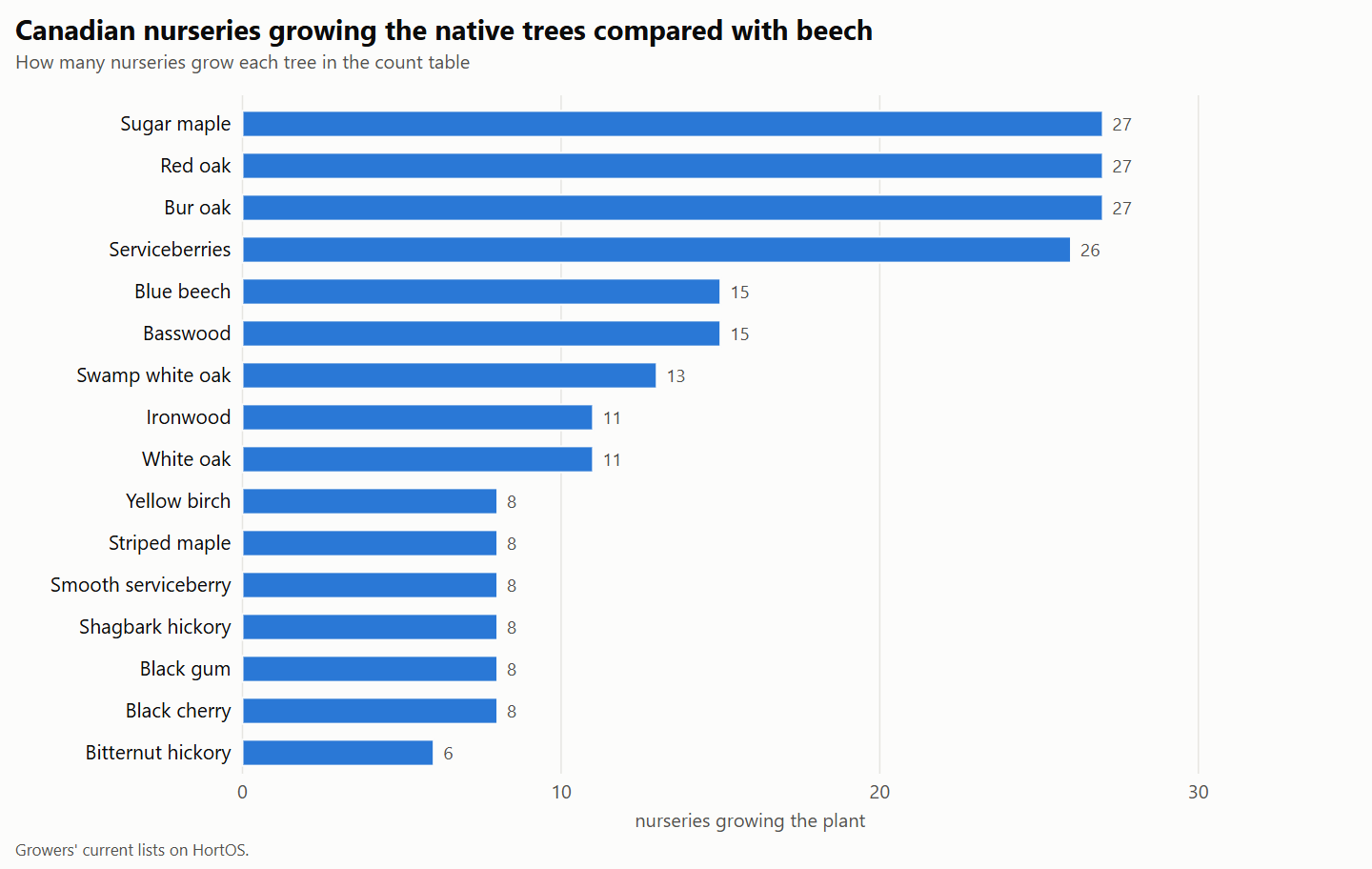
- Nurseries growing each of the fifteen
- What a count and a trait cell do not show
- What to watch for
- Getting it right
- A word of caution
- Sources
A land trust in southern Ontario finds dark-green bands between the leaf veins of its young beech, the early symptom of beech leaf disease as the Government of Ontario described it in 2025. It asks which native trees grow in the same shade or bear food for the same wildlife, and whether nurseries grow them. Every Canadian record of beech leaf disease read for this page is in Ontario, and no Canadian authority among those read publishes a list of trees to plant where beech is lost.
This page reports what the Government of Ontario, the Invasive Species Centre, Natural Resources Canada, the Forest Gene Conservation Association and a blog written by Ontario agriculture ministry staff say. Penn State Extension supplies the American origin of the disease. HortOS, a free directory of Canadian wholesale plant growers with their published availability and trade prices, adds how many nurseries grow each tree. Nothing here is advice to keep, treat, remove or replace a beech.
Quick facts
| The cause | A parasitic nematode, Litylenchus crenatae ssp. mccannii, that attacks beech trees (Government of Ontario, beech leaf disease page, 2025). |
|---|---|
| First records | Identified for the first time in 2012, in Lake County, Ohio (Penn State Extension, United States, 2024). Canada's first detection came in 2017, in Elgin County, Ontario (Invasive Species Centre, Canada, 2024). |
| Where it has been recorded | The Government of Ontario (2025) places the disease in Southern Ontario's lower half. By 23 September 2025 the Invasive Species Centre (Canada) had Ontario reports from Windsor east to Prince Edward County. |
| The trees it affects | American beech in forests, and European, Oriental and Chinese beech planted in North America (Government of Ontario, 2025). Penn State Extension (United States, 2024) describes a threat to every species of beech (Fagus). |
| The outlook for a tree | A sapling may die in two to five years and a mature tree in seven to ten (Invasive Species Centre, Canada, 2024). The Centre's 2025 profile reports research in which symptoms do not always progress. |
| Ontario on planting | The Tree Atlas (Government of Ontario, 2026) advises trees from a local source and a mix of species, so that a tree pest or disease does less harm. |
The Ontario record, one dated statement at a time
The table sets out, row by row, the dated statements of where the disease was recorded in Ontario that the sources read for this page give. Its opening row, the first identification in Ohio, is background from the United States. Each row is one authority's record in that authority's own unit of place: a district, a county, a stretch of lake shore, a municipality.
| Year | What was recorded | Authority and year |
|---|---|---|
| 2012 | The first identification anywhere: Lake County in Ohio, United States | Penn State Extension (United States), 2024 |
| 2017 | Canada's first detection, in Elgin County, Ontario | Invasive Species Centre (Canada), 2024 |
| 2020 | Symptoms found only in two districts, Aylmer and Guelph, and at a single Aurora District location | Ontario Ministry of Natural Resources, summary for 2020 |
| 2021 | Confirmed in Peterborough District; new locations in two districts, Guelph and Aylmer | Ontario Ministry of Natural Resources, summary for 2021 |
| 2022 | New areas reported inside districts where the disease was already known | Ontario Ministry of Natural Resources, summary for 2022 |
| 2023 and 2024 | Each year's summary again reports new areas inside districts already known | Ontario Ministry of Natural Resources, summaries for 2023 and 2024 |
| Late 2023 | Spread along the Lake Erie and Lake Ontario shores, from Windsor north-east to Peterborough | Invasive Species Centre (Canada), 2024 |
| June 2025 | Found in a small number of Ontario nurseries | ONnurserycrops blog, written by Ontario agriculture ministry staff, 2025 |
| September 2025 | Reports stretch from Windsor east to Prince Edward County | Invasive Species Centre (Canada), 2025 |
| 2025 | Recorded in new municipalities inside districts already reported | Ontario Ministry of Natural Resources, summary for 2025 |
Ontario's summaries for 2022 to 2025 name no place for their new records, so this page names none. The 2020 row is the position when that year's summary was written. The June 2025 row is a report on the ONnurserycrops blog, which Ontario agriculture ministry staff write, not a statement of the province. It does not say which nurseries, and no count on this page refers to them.
The Government of Ontario's page on the disease (2025) dates the province's first detection to 2017. It says the range may keep growing, and that the nematode's DNA has turned up outside the area where the disease itself is recorded. The profile kept by the Invasive Species Centre (Canada, 2025) names Ontario and several American states as the places where the disease is found. The sources behind this page name no other province, and the page does not say the disease is absent elsewhere.
The disease and the outlook for a beech, authority by authority
The Government of Ontario (2025) attributes the disease to a parasitic nematode that passes the winter in buds and leaf litter. How it travels is still under study, the same page says, with some evidence of spread by wind, rain and insects.
Ontario's 2025 page finds the disease in forests with American beech and in European, Oriental and Chinese beech planted in North America. In Canada, the Invasive Species Centre's fact sheet (2024) names American beech as the one native host known. Penn State Extension (United States, 2024) describes the disease as threatening American beech and every other species of beech (Fagus). It adds that the early signs are harder to pick out on beech with dark leaves, such as copper beech.
Ontario (2025) says beech of every age gets deformed leaves and that the disease itself kills young trees. It says a tree of sapling size may be dead in two to five years, and that older trees are slower to show effects. The Centre's fact sheet (Canada, 2024) says a mature tree may die in seven to ten years. The Centre's profile (Canada, 2025) reports newer research in which the symptoms do not always progress, so that a tree may never come to the stage where its leaves curl. The same profile says nobody has documented a tree becoming resistant or recovering in the wild, and that work on breeding beech for resistance is under way.
On movement, each authority gives guidance in its own name. Ontario (2025) asks that beech seedlings, leaf litter and firewood not be moved. The Centre's fact sheet (Canada, 2024) asks that the movement of beech saplings, wild or nursery-raised, be limited. The Forest Gene Conservation Association (Ontario, an undated handout read in 2026) asks that infected nursery plants and soil be kept out of forests the disease has not reached.
Beech bark disease is a separate disease. Ontario (2025) describes it as the joint work of a scale insect and a canker fungus, and for it tells forest managers to keep beech that shows no sign of the scale.
Fifteen native trees measured against beech
Natural Resources Canada (2024) rates American beech very tolerant of shade and names sugar maple, yellow birch and eastern hemlock as the species found with it. Eastern hemlock, a conifer, has a guide of its own, hemlock woolly adelgid in Canada; the comparison here is of broadleaf trees.
The next table sets American beech beside fifteen broadleaf entries on the list of native trees in Ontario's Tree Atlas. Each passed one test, read on its own Atlas page: the page says the tree grows in shade, as the Atlas says of beech, or bears nuts, acorns or fleshy fruit that wildlife eat. Either half is enough, so this is not a table of fifteen shade trees. The selection is this page's own, not a recommendation by Ontario or any other authority, and other trees on Ontario's list may meet the test and were not read.
Each cell is one fact from the tree's own Atlas page or from its Natural Resources Canada fact sheet, as the column heads say. No figure in the table comes from HortOS.
| Tree | Height (Ontario Tree Atlas, 2023 to 2025) | Shade (Ontario Tree Atlas) | Light tolerance (Natural Resources Canada, 2024) | What wildlife eat (Ontario Tree Atlas) |
|---|---|---|---|---|
| American beech (Fagus grandifolia), for comparison | 25 m | Tolerant of shade | Very tolerant of shade | Nuts, eaten by game birds, bears, squirrels and deer |
| Blue beech (Carpinus caroliniana) | 8 m | Full shade to full sun, with enough moisture | Very tolerant of shade | Seeds and buds, eaten by turkeys and squirrels |
| Ironwood (Ostrya virginiana) | 12 m | Deep shade to full sun | Very tolerant of shade | Twigs, catkins and seeds, eaten by deer, squirrels and grouse |
| Sugar maple (Acer saccharum) | 35 m | Tolerates shade; better in full sun | Tolerant of heavy shade for many years | The tree itself feeds squirrels, porcupines, deer and moose |
| Basswood (Tilia americana) | 35 m | Full shade or full sun | Very tolerant of shade | Berries, eaten by small mammals and birds |
| Yellow birch (Betula alleghaniensis) | Up to 25 m | Moderately tolerant of shade | Moderately tolerant of shade | Seeds and stems, eaten by many birds and mammals |
| Striped maple (Acer pensylvanicum) | 10 m | Best in full to partial shade; poor in hot summer sun | Tolerant of shade | The tree itself feeds deer, moose, rabbits and beavers |
| Serviceberries (Amelanchier species) | Up to 12 m | Partial shade to full sun | No rating; smooth serviceberry grows in the forest understory | Fruit, eaten by birds and small mammals |
| Bitternut hickory (Carya cordiformis) | 15 to 20 m | Partial shade; best in full sun | Moderately tolerant of shade | Nuts, eaten by some birds and small mammals, not a preferred food |
| Shagbark hickory (Carya ovata) | 20 to 30 m | Some shade; best in sun | Not stated | Nuts, eaten by squirrels, chipmunks and black bears |
| Red oak (Quercus rubra) | 20 to 30 m | Some shade; best in full sun | Intolerant of shade; moderately tolerant when young | Acorns, leaves and stems, eaten by deer, squirrels and black bears |
| Bur oak (Quercus macrocarpa) | 15 to 30 m | Moderate shade; best in full sun | Moderately tolerant of shade | Acorns, eaten by bears, squirrels and rabbits |
| Swamp white oak (Quercus bicolor) | 22 m | Partial shade or full sun | Moderately tolerant of shade | Acorns, eaten by squirrels and some birds |
| White oak (Quercus alba) | Usually 20 to 30 m | Prefers full sun | Moderately tolerant of shade | Acorns, eaten by birds, bears and squirrels |
| Black gum (Nyssa sylvatica) | 20 m | Best in full to part sun | Moderately tolerant of shade | Fruit, eaten by foxes, woodpeckers, ducks and wild turkeys |
| Black cherry (Prunus serotina) | Up to 22 m | Best in full sun | Intolerant of shade | Fruit, eaten by many birds and mammals |
The heights are what the Atlas says each tree reaches. The sources read give no figure for growth rate, spacing or time to maturity, so the page gives none. Where the two authorities describe a tree's shade differently, both are printed and the page does not choose. Two light tolerance cells carry no rating: the fact sheet for shagbark hickory has no such line, and the serviceberry cell is a habitat line from the fact sheet for one species, smooth serviceberry. The wildlife column is the Atlas's own account in every row, basswood berries (Ontario, 2023) and bitternuts as not a preferred food (Ontario, 2024) included.
The same Atlas pages add uses and cautions. Blue beech copes with urban sites and, once settled, takes pruning as a hedge, while ironwood does not stand pollution or road salt (Ontario Tree Atlas, 2023). The long taproot of black gum makes it hard to transplant, and swamp white oak is uncommon in Ontario (Ontario Tree Atlas, 2024). Natural Resources Canada (2024) gives black gum's range as Ontario, north of Lake Erie. The Atlas page for white oak (Ontario, 2024) says oak wilt has been found in Southern Ontario, and keeps pruning to before April and after July. Ontario's forest health summary for 2025 reports no new occurrences of oak wilt.
Nurseries growing each of the fifteen
The last table gives the same fifteen entries, with one more row for smooth serviceberry (Amelanchier laevis), which the Atlas (Ontario, 2024) names as a serviceberry of tree size. Counts are the nurseries each plant's page on HortOS showed as growing it. Median trade prices are not published for Canada yet. Ontario's list holds 64 more entries that have no row, American beech and the conifers among them. The order, most nurseries first, is not a ranking of the trees.
Counts are the nurseries each plant page shows as growing the plant, with or without sizes listed.
A count says how many nurseries across Canada grow a tree, not how many trees exist or whether the tree suits a site. Several counts are small. The Serviceberries row is the genus page, which does not show which serviceberry a nursery grows and may take in shrub-sized kinds and named selections. The smooth serviceberry row is that species' own page, and the two counts are not to be added.
Beech has pages too, and the counts are no argument for or against planting it. The page for European beech (Fagus sylvatica) showed 12 nurseries growing it. The American beech (Fagus grandifolia) page showed 7.
On what to plant, Ontario's Tree Atlas (2026) advises a mix of species, and the Centre's fact sheet (Canada, 2024) puts a wider mix of tree species among the things to do. The Forest Gene Conservation Association (Ontario, undated, read in 2026) names sugar maple and red oak as alternative species, and says beech root sprouts that follow beech bark disease can keep them from regenerating.
The Atlas describes Ontario. For other provinces this page has only the ranges on the Natural Resources Canada fact sheets (2024). They place sugar maple in southern Ontario, Quebec and the Maritime provinces, bur oak from New Brunswick west to southern Saskatchewan, and black cherry in southern Ontario, southern Quebec and Nova Scotia. Each linked name opens that province's growers, and the directory holds every grower's page.
What a count and a trait cell do not show
No price is on this page. The counts and the trait cells also leave out five things, each a question for the grower.
- Where and how a tree was grown. A plant page does not show where or how a beech or any other tree was raised, or whether the nursery lies inside the part of Ontario where the disease is recorded.
- Whether beech was checked. The directory holds no inspection record. The Centre's fact sheet (Canada, 2024) says the nematodes are in a tree before symptoms show, so detection usually trails infestation.
- Seed source. Ontario's Tree Atlas (2026) advises locally sourced trees, and the directory shows no provenance.
- Species or named selection. A count does not say whether a nursery grows the straight species or a named selection of it.
- Size at sale. No count carries a size.
The buyer asks each grower, in writing, where and how its trees were grown, what it has seen on its beech, where the seed was collected, the botanical name and the sizes it lists. A club or trust new to wholesale nurseries can read how orders, minimums and terms work in buying from a wholesale grower. A woodlot losing ash as well is the subject of the guide to emerald ash borer.
What to watch for
- Taking blue beech for a beech. Blue beech is Carpinus caroliniana, and the Tree Atlas (Ontario, 2023) says it is closer kin to the birches than to the beeches. Ironwood in these tables is Ostrya virginiana.
- Reading the comparison as fifteen shade trees. Natural Resources Canada (2024) rates black cherry intolerant of shade, and red oak intolerant though moderately tolerant when young. The Atlas page for white oak (Ontario, 2024) says it prefers full sun. Those rows are there for acorns or fruit.
- Reading the dated rows as a map or as one line of spread. The rows come from different authorities that describe place in different units, and four of Ontario's yearly summaries name no place.
- Taking a beech with no banded leaves as free of the nematode. The ONnurserycrops blog, written by Ontario agriculture ministry staff, said in June 2025 that the nematodes are also found in leaves with no symptoms.
Getting it right
- Read the current record on the Government of Ontario's beech leaf disease page and in its latest forest health summary, and note each page's date.
- Settle who decides for the property before a beech is cut or a tree is planted: the owner, or the body that manages the land.
- Shortlist trees from the comparison by the light on the site, then open each tree's Atlas page and Natural Resources Canada fact sheet, where the cautions are.
- Ask the local conservation authority whether it sells native seedlings ordered ahead, as Ontario's Tree Atlas (2026) says one may. The Atlas also names Forests Canada's 50 million tree program and Tree Canada's grants for eligible projects.
- Put the five questions to each grower in writing, and keep the answers with the planting record.
A word of caution
Where beech leaf disease is recorded changes from year to year, and the Government of Ontario's page and yearly forest health summaries are the record to check. The traits compared are descriptions by Ontario's Tree Atlas and Natural Resources Canada, not a judgment of any site. A count here is one day's reading of a HortOS plant page, and the pages change after that.
Sources
- Government of Ontario, Beech leaf disease: cause, hosts, Ontario status.
- Government of Ontario, Forest health conditions: yearly summaries, 2020 to 2025.
- Government of Ontario, Beech bark disease: the separate bark disease.
- Invasive Species Centre, Beech Leaf Disease profile: outlook, resistance, breeding research.
- Invasive Species Centre, Beech Leaf Disease fact sheet: Canadian hosts, first detection, timelines.
- Invasive Species Centre, Beech Trees Under Threat: Ontario reports, September 2025.
- ONnurserycrops blog, Beech Leaf Disease in Ontario: the disease in nurseries.
- ONnurserycrops blog, About page: who writes the blog.
- Forest Gene Conservation Association, American beech handout: alternative species, movement guidance.
- Penn State Extension, Beech Leaf Disease: origin and host range.
- Government of Ontario, The Tree Atlas: native tree list, planting tips.
- Ontario Tree Atlas, American beech: height, shade, wildlife.
- Ontario Tree Atlas, Blue beech: traits, hedge use.
- Ontario Tree Atlas, Ironwood: traits, road salt caution.
- Ontario Tree Atlas, Sugar maple: height, shade, wildlife.
- Ontario Tree Atlas, Basswood: height, shade, wildlife.
- Ontario Tree Atlas, Yellow birch: height, shade, wildlife.
- Ontario Tree Atlas, Striped maple: height, shade, wildlife.
- Ontario Tree Atlas, Serviceberries: traits, tree-sized species.
- Ontario Tree Atlas, Bitternut hickory: height, shade, wildlife.
- Ontario Tree Atlas, Shagbark hickory: height, shade, wildlife.
- Ontario Tree Atlas, Red oak: height, shade, wildlife.
- Ontario Tree Atlas, Bur oak: height, shade, wildlife.
- Ontario Tree Atlas, Swamp white oak: traits, how common.
- Ontario Tree Atlas, White oak: traits, oak wilt caution.
- Ontario Tree Atlas, Black gum: traits, taproot caution.
- Ontario Tree Atlas, Black cherry: height, shade, wildlife.
- Natural Resources Canada, American beech: light tolerance, associated species.
- Natural Resources Canada, blue-beech: light tolerance line.
- Natural Resources Canada, ironwood: light tolerance line.
- Natural Resources Canada, sugar maple: light tolerance, range.
- Natural Resources Canada, basswood: light tolerance line.
- Natural Resources Canada, yellow birch: light tolerance line.
- Natural Resources Canada, striped maple: light tolerance line.
- Natural Resources Canada, smooth serviceberry: habitat of the species.
- Natural Resources Canada, bitternut hickory: light tolerance line.
- Natural Resources Canada, shagbark hickory: site, associated species.
- Natural Resources Canada, red oak: light tolerance line.
- Natural Resources Canada, bur oak: light tolerance, range.
- Natural Resources Canada, swamp white oak: light tolerance line.
- Natural Resources Canada, white oak: light tolerance line.
- Natural Resources Canada, black-gum: light tolerance, range.
- Natural Resources Canada, black cherry: light tolerance, range.
More guides
Hemlock woolly adelgid in Canada: rules and stand-in evergreens
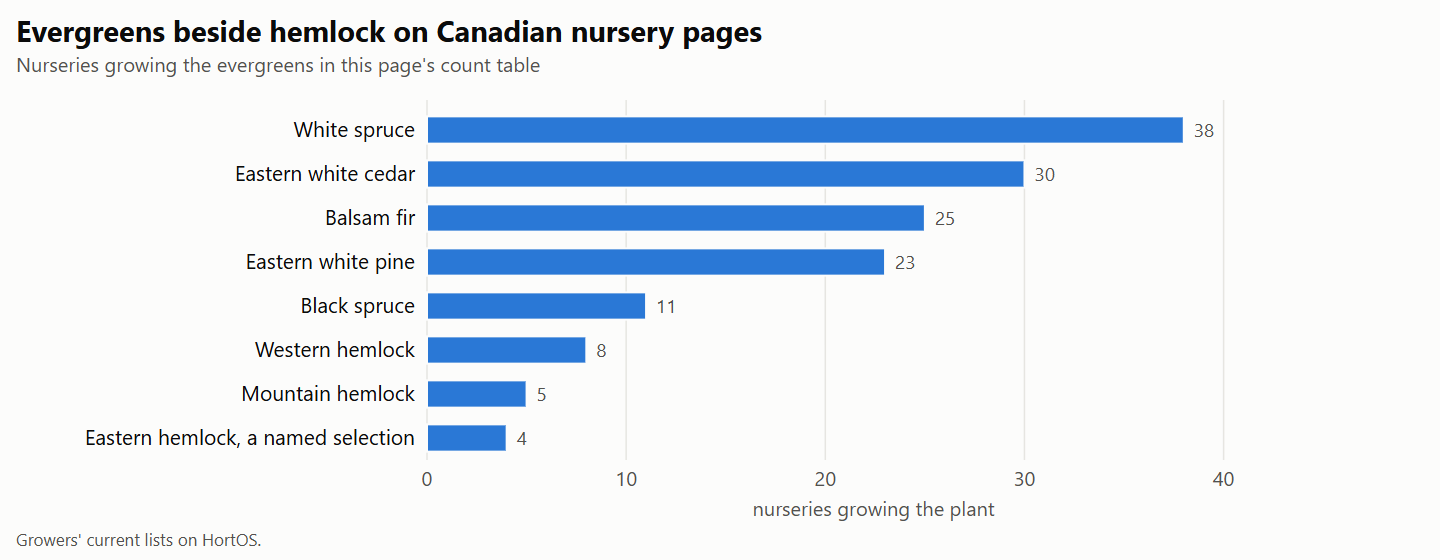
For stewardship groups, conservation authorities and arborists in Canada: the areas the federal Order regulates for hemlock woolly adelgid, the recent detections outside them, what moving hemlock requires, how the authorities describe treatment, and the conifers Ontario names for restoring some of hemlock's functions, with how many Canadian nurseries grow each. Counts only.

Buying From a Wholesale Grower When You Are Not in the Trade
Naturalist clubs, conservation authorities, schools, land trusts and municipalities can buy from Canadian wholesale growers when they order like the trade: in quantity, ahead of the season, on the grower's terms. This page explains who sells to whom, business numbers and tax, minimums and pooling, how the Canadian Nursery Stock Standard sizes stock, provenance, lead times and shipping.
Replacing ash trees lost to emerald ash borer in Canada
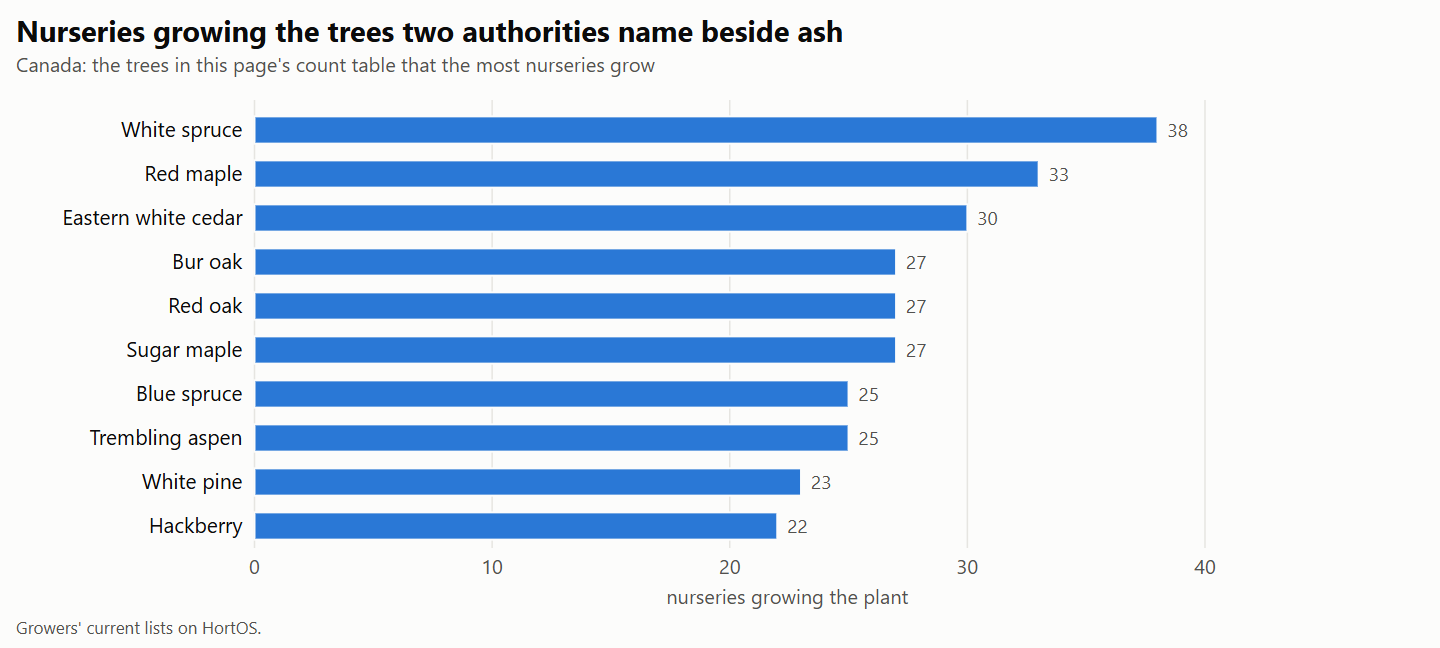
For tree boards, municipal foresters and stewardship groups in Canada: what the Canadian Food Inspection Agency's pages say of regulated areas in eight provinces, the federal rule on moving ash nursery plants, what municipalities say about treating and replanting, and how many Canadian nurseries grow each tree two authorities name. Counts only, no prices.