Where prairie farmers order shelterbelt trees after the PFRA program
For prairie farmers, acreage owners, rural municipalities and watershed districts: where shelterbelt seedlings come from since the federal program ended in 2013. SaskPower's notice of no Shand Greenhouse seedlings for spring 2027 leads, followed by a calendar of free, subsidized and cost-shared programs in three provinces with their ordering windows as read, and links to nurseries by province.
Updated October 22, 2026. Counts are what the live ca.hortosapp.com plant pages printed; medians are not published yet.
On this page
A Saskatchewan farmer who once ordered trees from the federal nursery at Indian Head now asks where shelterbelt seedlings come from, and when to order. SaskPower's Shand Greenhouse ordering site, as read on 5 October 2026, says there will be no seedlings for spring 2027 and that ordering for 2028 seedlings opens at 9 a.m. on 3 August 2027. The other programs read for this page each keep their own window, and several close in December or January for trees that arrive in May.
The page reports what SaskPower, the Saskatchewan Association of Watersheds, seven Manitoba watershed districts and seven Alberta counties and municipal districts say in their own pages, forms and notices. Manitoba's Watershed Districts Regulation gives the districts' names, and SaskAgroforestry, two encyclopedias and Mountain View County give the history. HortOS, a free directory of Canadian wholesale plant growers with their published availability and trade prices, adds how many nurseries grow white spruce and trembling aspen. This is an ordering calendar, not a shelterbelt design, and each program's own page decides.
Quick facts
| Shand Greenhouse, spring 2027 | No seedlings for spring 2027, and ordering for 2028 seedlings opens at 9 a.m. on 3 August 2027 (notice on SaskPower's ordering site, Saskatchewan, read 5 October 2026). |
|---|---|
| Shand in a usual year | Applications open on 1 August and close on 1 February or when the seedlings run out; all are typically spoken for by November (SaskPower's ordering FAQ, Saskatchewan, 2026). |
| End of the federal program | The federal government closed its Indian Head centre and all seedling production stopped in 2013 (SaskAgroforestry, University of Saskatchewan, read 2026). |
| What the federal nursery sent out | More than 570 million seedlings between 1901 and 2001 (Encyclopedia of Saskatchewan, 2006). |
| Manitoba's districts | On 1 January 2020 the province's 18 conservation districts became 14 watershed districts (Manitoba Association of Watersheds, read 2026). |
| Yearly windows in Alberta | The Municipal District of Spirit River asks for order forms by 20 December each year (notice of 22 October 2025). The Municipal District of Wainwright takes applications from 1 November to 31 January each year (application form, 2026). |
The federal nursery and its end in 2013
The Encyclopedia of Saskatchewan (2006) dates the Forest Nursery Station at Indian Head to 1901, when the Government of Canada set it up to raise trees and shrubs for prairie farmers. The same entry counts more than 570 million seedlings sent out between 1901 and 2001. SaskAgroforestry, at the University of Saskatchewan, says (2026) that the Indian Head centre sent out about 5 million seedlings a year, to some 8,000 applicants. It says the Prairie Shelterbelt Program served applicants in the three Prairie provinces and British Columbia's Peace River region.
The Canadian Encyclopedia, in an article edited in 2025, says the Prairie Farm Rehabilitation Administration (PFRA), a branch of the federal agriculture department, was wound up in 2009. It dates the cut to the shelterbelt program to 2013. SaskAgroforestry (2026) records that the federal government closed the Indian Head centre and that all seedling production stopped in 2013. Mountain View County, in Alberta, writes (2026) that counties across the province took part in the program and handed seedlings to landowners each spring. It adds that, with the 2013 closure, several wholesale sellers and local nurseries built up the shelterbelt seedlings they sell.
The Shand notice and Saskatchewan's seedling sale
SaskPower says its Shand Greenhouse raises about 500,000 seedlings a year (Saskatchewan, 2026). Its ordering FAQ (2026) describes a usual year. The seedlings carry no charge. They go to non-profit groups, service clubs and conservation groups in Saskatchewan, and to landowners who hold at least 10 acres, for non-commercial use. Applications open on 1 August and close on 1 February or when the seedlings run out. SaskPower adds that all seedlings are typically spoken for by November. Orders are filled first come, first served, so an applicant may receive only part of an order, and the greenhouse confirms at the end of March what it can send. Shipping to pickup points runs from mid-April to early May, the south of the province first.
That is the usual rule, and it does not describe the coming season. The notice on the Shand ordering site, as read on 5 October 2026, says there will be no seedlings for spring 2027. The reason it gives is construction and maintenance work at the greenhouse in 2026. It asks applicants to come back to the site at 9 a.m. on 3 August 2027 to order seedlings for 2028. Under the notice, then, no window ran in August 2026 for spring 2027.
Saskatchewan's other row is a sale. Each winter and spring the Saskatchewan Association of Watersheds holds a seedling sale, its Tree for Life program, begun in 2021. Its page, read on 5 October 2026, says the 2026 sales have closed.
The ordering calendar in three provinces
The table has one row for each seedling or shelterbelt program in Saskatchewan, Manitoba and Alberta whose own page, form or notice was read on 5 October 2026 and says what the program offers or when to order. Its 18 rows cover two Saskatchewan programs, seven Manitoba watershed districts and seven Alberta counties and municipal districts; Shand and East Interlake have two rows each. Commercial nurseries are not rows. A cell that begins "Not stated" reports one page on one day, and no more. Most dated cells give the last window a program published, not next season's.
| Province | Program and what was read | What it offers and to whom | When orders are taken | When seedlings arrive |
|---|---|---|---|---|
| Saskatchewan | SaskPower Shand Greenhouse (ordering FAQ, read October 2026) | Seedlings at no charge for Saskatchewan non-profit groups, service clubs, conservation groups and landowners holding 10 acres or more | Applications open on 1 August and close on 1 February, or sooner if the seedlings run out | Shipped to pickup points from mid-April to early May, the south of the province first |
| Saskatchewan | SaskPower Shand Greenhouse, the next two seasons (ordering site notice, read 5 October 2026) | No seedlings for spring 2027; the notice gives construction and maintenance work at the greenhouse as the reason | Ordering for 2028 seedlings opens at 9 a.m. on 3 August 2027 | Not stated in the notice |
| Saskatchewan | Tree for Life, Saskatchewan Association of Watersheds (program page, read October 2026) | Seedling sales that raise money for the association's education and outreach work on healthy watersheds | Sold each winter and spring; the 2026 sales have closed | Not stated on the page read |
| Manitoba | East Interlake Watershed District, subsidized tree program (program page, read 5 October 2026) | Subsidized seedlings for orders of up to 500, placed on the district's online form | Ordering for fall 2026 was open when the page was read | Spring orders arrive in mid-May and fall orders in mid-September |
| Manitoba | East Interlake Watershed District, free tree program (program information sheet, read October 2026) | Seedlings at no cost for shelterbelt or reforestation projects of more than 500 trees | Each project goes to the district's executive board for approval; no closing date is given | Spring planting starts near the May long weekend; fall planting follows mid-September |
| Manitoba | Assiniboine West Watershed District shelterbelt program (application form, 2025) | The district orders, delivers and plants the trees and pays 75 per cent of what an approved project costs | Tree orders are taken until 1 April | Not stated on the form |
| Manitoba | Seine Rat Roseau Watershed District shelterbelt program (program page, read October 2026) | Pays for the trees a landowner buys, up to a set average amount per tree, with a per-acre maintenance payment for the first five years; the landowner prepares the site and plants | By application; no closing date on the page read | Not stated on the page read |
| Manitoba | Redboine Watershed District (shelterbelt information page, read October 2026) | Funding for landowners, who find and order the trees themselves from a nursery of their choice | By application, with the nursery's quote attached; no closing date on the page read | Not stated on the page read |
| Manitoba | Northeast Red Watershed District (shelterbelts and buffers page, read October 2026) | The landowner buys and plants the trees; the district covers a set average amount per tree up to a ceiling | By application form; no closing date on the page read | Not stated on the page read |
| Manitoba | West Interlake Watershed District, 2 Billion Trees (program page, read October 2026) | Cost-shared tree planting with a minimum of 180 seedlings and a focus on trees over shrubs | Approval comes before any work starts, and the planting bed is prepared before trees are ordered | Not stated on the page read |
| Manitoba | Pembina Valley Watershed District (programs page, read October 2026) | Funding that goes toward what a new shelterbelt costs to establish | Through the district's program coordinators; no closing date on the page read | Not stated on the page read |
| Alberta | Municipal District of Peace shelterbelt program (program page, read October 2026) | A bulk order placed by the Agricultural Service Board at cost recovery for MD ratepayers | The 2026 season closed on 9 June 2026 | Collected from the MD's office in late May or early June |
| Alberta | County of Grande Prairie shelterbelt program, County residents only (program page, read October 2026) | A bulk order run at cost recovery, with ordering online | The 2026 program has ended | Ready for pickup in late May or early June |
| Alberta | Saddle Hills County tree seedling program (County notice, 24 June 2025) | For registered landowners in the County, one order a year, for planting inside the County | Orders opened with the notice, for trees to plant in 2026 | Not stated in the notice |
| Alberta | Municipal District of Spirit River shelterbelt program (MD notice, 22 October 2025) | Bulk-ordered seedlings at a cost-recovery rate for MD residents | Order form due by 20 December each year for the next growing season | Pickup in Spirit River, typically in May |
| Alberta | County of Northern Lights shelterbelt program (program page, read October 2026) | For County residents planting shelterbelts on their own land | Order form was due by 9 January 2026 for the 2026 season | Seedlings usually come in late May |
| Alberta | Municipal District of Wainwright shelterbelt establishment program, MD ratepayers only (application form, 2026) | Tree costs are split equally between the applicant and the MD | Applications run from 1 November to 31 January each year | Trees are expected in May |
| Alberta | Mountain View County (shelterbelts and eco-buffers page, read October 2026) | No county seedling order is described; the page points to cost-share funding for trees through the County's ALUS program on farmland and its Green Acreages program | Not stated on the page read | Not stated on the page read |
Three programs give dates and describe the window as yearly: Shand's FAQ, the Municipal District (MD) of Spirit River, whose notice says "each year", and the MD of Wainwright, whose form says "annually". The other dated rows speak for one season. The MD of Peace closed its 2026 season on 9 June 2026. The County of Grande Prairie's 2026 program has ended, and the County keeps a notification list for 2027. The County of Northern Lights set 9 January 2026 as its deadline for 2026. Saddle Hills County's notice of 24 June 2025 opened orders for planting in 2026, and the Assiniboine West date is from a 2025 form. None of these is a date for 2027.
East Interlake's two documents are reported as each stands. Its program page said ordering for fall 2026 was open when read on 5 October 2026, and its information sheet (2026) says fall orders arrive in mid-September. The district is the one to say how the two fit.
The rows differ in who buys the trees; each statement here is from that row's own source, dated as in the table. Three Manitoba rows say the landowner buys the trees. Seine Rat Roseau pays for the trees bought, up to a set average amount per tree. Northeast Red covers a set average amount per tree, up to a ceiling. Redboine funds landowners who order from a nursery of their choice, and asks for the nursery's quote with the application. Assiniboine West's 2025 form works the other way: the district orders, delivers and plants the trees. The same form puts the district's share at 75 per cent of an approved project's cost.
The Alberta rows are municipal. The six that take orders or applications are each for that municipality's own residents, ratepayers or registered landowners. The MD of Peace, the County of Grande Prairie and the MD of Spirit River each describe a bulk order at cost recovery. The MD of Wainwright's 2026 form splits what the trees cost equally between the applicant and the MD.
A Manitoba landowner who remembers a conservation district will find a watershed district in its place. The Manitoba Association of Watersheds (2026) says the province's 18 conservation districts became 14 watershed districts on 1 January 2020. Section 2 of Manitoba's Watershed Districts Regulation, M.R. 141/2019, under The Watershed Districts Act, continues each former conservation district named in its table as a watershed district. The Manitoba Laws site, read on 5 October 2026, calls its copy an unofficial version. In that table the Lake of the Prairies, Little Saskatchewan River and Upper Assiniboine River districts continue together as Assiniboine West.
Three bodies name 2 Billion Trees on pages read on 5 October 2026. East Interlake calls its free tree program, for projects of more than 500 trees, a 2 Billion Trees program. West Interlake says it has joined the federal 2 Billion Trees program, with a cost share and a minimum of 180 seedlings. The Agroforestry and Woodlot Extension Society of Alberta says current shelterbelt and ecobuffer projects qualify for funding from the 2 Billion Trees Western Coalition grant program. Each statement is that body's own, and that body is the one to ask.
When the landowner buys from a nursery
Where a program pays toward trees but does not hand them out, the order goes to a nursery. SaskAgroforestry (Saskatchewan, 2026) says bare root seedlings usually keep for 5 to 7 days, while seedlings in containers allow a longer time for storage and planting. It tells landowners to call their tree source before the planting and ask about delays and delivery dates. For the size of an order, it divides the length of the row by the spacing recommended for the species.
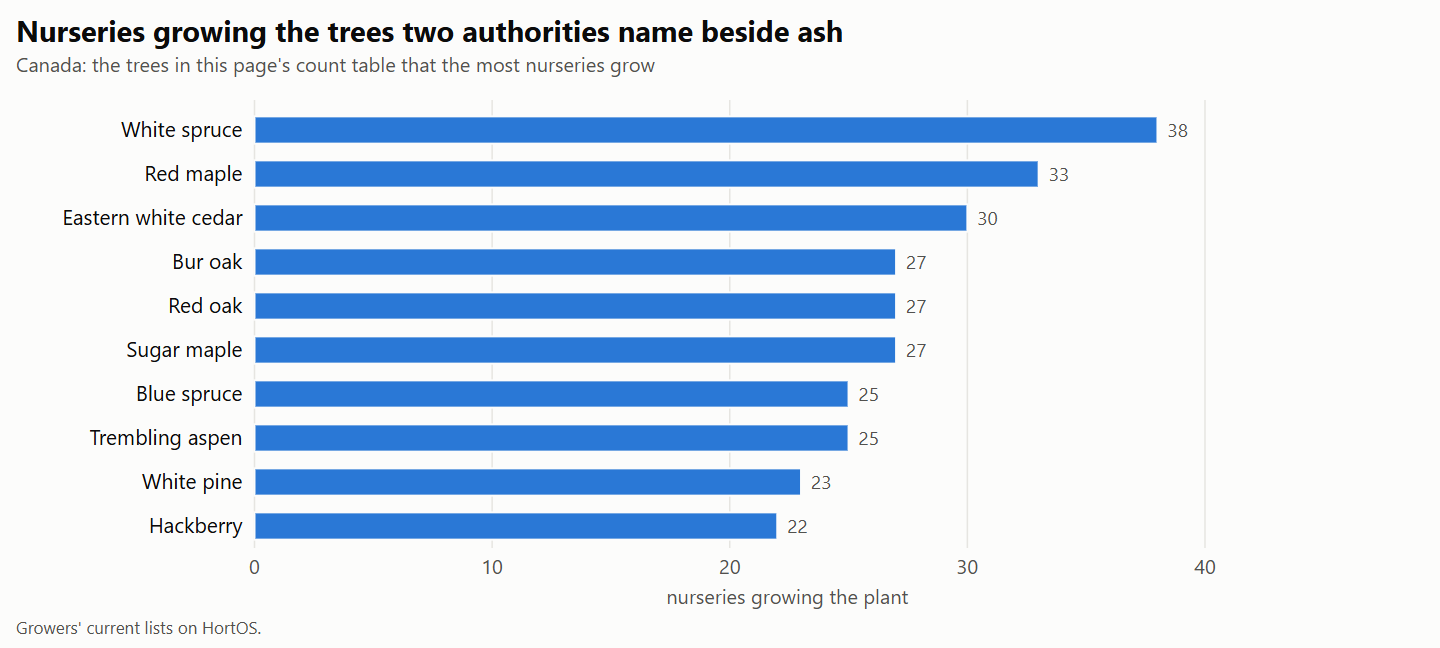
HortOS has a hub for each Prairie province, Saskatchewan, Manitoba and Alberta, within a directory of more than 2,200 growers that sell plants to the trade across Canada. Each plant has its own page. Counts are the nurseries each plant's page on HortOS showed as growing it. On that day the page for white spruce (Picea glauca) showed 38 nurseries growing it, and the page for trembling aspen (Populus tremuloides) showed 25. Both trees are named in the East Interlake Watershed District's 2024 tree catalogue. Both counts are for all of Canada, and they do not say how many of those nurseries are on the Prairies. Median trade prices are not published for Canada yet.
For a buyer who is not in the nursery trade, the guide to buying from a wholesale grower explains how such an order is placed. The official survey figures for Canada's nursery trade are in nursery industry statistics. Readers choosing trees in place of ash will find nursery counts in the guide on replacing ash trees lost to emerald ash borer.
What the calendar and the directory do not show
The table is not a census. It holds the programs whose own pages were read on one day, and other watershed districts and municipalities run tree programs that are not rows. The programs' pages are seasonal: a window read in October 2026 may belong to the season just past, and a program may change its page the next day. Caps, ceilings and seedling charges are left in words here, and each program's own page gives the current figure. This page recommends no species and gives no layout.
The directory shows which nurseries grow a plant. It cannot show whether a nursery sells seedling plugs or bare root bundles in shelterbelt quantities, where its seed came from, or whether it ships. The nursery is the one to ask: what form and size the seedlings are, where the seed came from, and how and when an order of that size would reach the farm.
What to watch for
- Reading Shand's usual window as open. The FAQ's window from 1 August to 1 February is the usual rule. The notice read on 5 October 2026 says there are no seedlings for spring 2027.
- Taking a past date for next season's. Most dated rows give a window that has closed, and a closed 2026 window is no date for 2027.
- Applying to a neighbouring municipality. The Alberta programs that take orders are for their own residents, ratepayers or registered landowners, and Saddle Hills County's notice allows planting only inside the County.
- Counting on a full order. Shand may send part of an order. East Interlake pools orders before it buys, and a species with too few requests may drop out. The County of Grande Prairie says it cannot promise to fill every order.
- Ordering trees before the district has agreed. West Interlake wants approval before any work and a prepared bed before trees are ordered. Redboine wants the nursery's quote with the application.
Getting it right
- Find the body that covers the land: SaskPower and the Saskatchewan Association of Watersheds in Saskatchewan, the watershed district in Manitoba, the county or municipal district in Alberta.
- Read that program's own page for this season. The program decides who qualifies and when its window runs, so ask it whether the window is yearly and when seedlings arrive.
- Where a district pays toward trees the landowner buys, ask the district what it needs before the order: its approval, a prepared bed, or a nursery's quote.
- SaskAgroforestry (2026) sizes an order as the row's length divided by the spacing recommended for the species.
- For trees bought from a nursery, the provincial hub lists the nurseries, and each nursery answers for its seedling form, seed source, delivery and dates.
- Pickup and planting days depend on each other. The table gives each program's arrival time where its page states one, and SaskAgroforestry (2026) puts the keeping time of bare root seedlings at 5 to 7 days.
A word of caution
Every date and rule in the table is what one program's page, form or notice said when it was read on 5 October 2026. SaskPower, each watershed district and each county or municipal district sets its own terms, and its own page decides. The statement about Manitoba's districts rests on the Watershed Districts Regulation, M.R. 141/2019, in a copy the Manitoba Laws site calls unofficial. The nursery counts are what the HortOS plant pages showed, and the nursery is the one to ask about seedlings, seed source and delivery.
Sources
- SaskPower, Shand Greenhouse seedling ordering site: the spring 2027 notice.
- SaskPower, Shand Greenhouse ordering seedlings FAQ: window, eligibility and shipping.
- SaskPower, Shand Greenhouse: seedlings grown each year.
- Saskatchewan Association of Watersheds, Saskatchewan Tree for Life Program: winter and spring seedling sales.
- SaskAgroforestry, shelterbelt planning FAQ: the federal program's closure.
- SaskAgroforestry, getting trees FAQ: calling the source ahead.
- Encyclopedia of Saskatchewan, PFRA Shelterbelt Centre: the Indian Head nursery.
- The Canadian Encyclopedia, Prairie Farm Rehabilitation Administration: the PFRA's end.
- Manitoba Association of Watersheds, Manitoba Watershed Districts: the 2020 change of districts.
- Manitoba Laws, Watershed Districts Regulation, M.R. 141/2019: former districts continued by name.
- East Interlake Watershed District, Tree Programming: its two tree programs.
- East Interlake Watershed District, tree seedling program information: arrival times, free trees.
- East Interlake Watershed District, 2024 tree catalogue: common and botanical names.
- Assiniboine West Watershed District, shelterbelt program application, 2025: deadline and cost share.
- Seine Rat Roseau Watershed District, Shelterbelt Program: funding for bought trees.
- Redboine Watershed District, Shelterbelt Information: landowners order their own trees.
- Northeast Red Watershed District, Shelterbelts and Buffers: funding per tree.
- West Interlake Watershed District, 2 Billion Trees Program: cost-shared planting terms.
- Pembina Valley Watershed District, Programs: funding for new shelterbelts.
- Municipal District of Peace No. 135, Shelterbelt Program: bulk order, 2026 closing.
- County of Grande Prairie, Shelterbelt Program: cost-recovery order for residents.
- Saddle Hills County, tree seedling program notice, 24 June 2025: who may order.
- Municipal District of Spirit River No. 133, shelterbelt program notice, 22 October 2025: yearly deadline and pickup.
- County of Northern Lights, Shelterbelt Program: the 2026 season deadline.
- Municipal District of Wainwright No. 61, shelterbelt program application, 2026: yearly window, cost share.
- Mountain View County, Shelterbelts and Eco-buffers: counties and the federal program.
- Agroforestry and Woodlot Extension Society of Alberta, Shelterbelt and Ecobuffer Project: grant funding for projects.
More guides

Buying From a Wholesale Grower When You Are Not in the Trade
Naturalist clubs, conservation authorities, schools, land trusts and municipalities can buy from Canadian wholesale growers when they order like the trade: in quantity, ahead of the season, on the grower's terms. This page explains who sells to whom, business numbers and tax, minimums and pooling, how the Canadian Nursery Stock Standard sizes stock, provenance, lead times and shipping.
Nursery Industry Statistics 2026, and How to Cite HortOS
The two kinds of nursery industry number, the official survey and the live supply picture, for Canada: Statistics Canada's 2024 nursery sales, area and expenses, the number of nurseries over time, growers listed on HortOS by province and town, why no medians are published yet, and how to cite HortOS now and the Index when it publishes.
Replacing ash trees lost to emerald ash borer in Canada
For tree boards, municipal foresters and stewardship groups in Canada: what the Canadian Food Inspection Agency's pages say of regulated areas in eight provinces, the federal rule on moving ash nursery plants, what municipalities say about treating and replanting, and how many Canadian nurseries grow each tree two authorities name. Counts only, no prices.