Farm payments for shelterbelts, buffers and wetlands in Canada
The Resilient Agricultural Landscape Program pays for shelterbelts, water buffers and wetlands on different terms in Alberta, Saskatchewan and Ontario. This page sets their caps, rates and intake status side by side as read in October 2026, with one Ontario watershed's shelterbelt terms, and says what to ask the program and the nursery.
Updated October 16, 2026. The sources are listed at the foot of the page.
On this page
A cattle and grain family beside a creek wants a windbreak on the north fence, wider willows on the bank and a wet hollow kept out of crop. They want to know whether any program will pay part of the bill. Among the programs read for this guide, payment for that work comes through cost-share programs that each province runs on its own terms. The answer depends on the province, the practice and whether an intake is open on the day of asking.
This guide draws on the program pages of the Government of Alberta, the Government of Saskatchewan, the Ontario Soil and Crop Improvement Association, Conservation Ontario and the Upper Thames River Conservation Authority. A funded windbreak still needs trees and shrubs, and HortOS, a free directory of Canadian wholesale plant growers with their published availability and trade prices, shows which nurseries grow them. This page is not an application guide and does not say who qualifies: each program decides that.
Quick facts
| Alberta's intake | The Government of Alberta's program page said that its Resilient Agricultural Landscape Program was closed to applications. |
|---|---|
| Alberta's caps | $150,000 for an active primary producer and $300,000 for grazing reserve associations, community pasture operators and approved Indigenous applicants, with a $2,000 minimum payment (Government of Alberta, 2026). |
| Alberta's farm test | An operation producing at least $25,000 of farm commodities a year, and an Environmental Farm Plan finished or under way (Government of Alberta, 2026). |
| Ontario's Marginal Lands Initiative | Shelterbelts, tree and shrub buffers beside surface water, and wetland restoration are eligible practices; the second intake was closed (Conservation Ontario, 2026). |
| One Ontario watershed's rate | Seedling shelterbelts paid at 80 per cent to a maximum of $6,000, with a 15 year land use agreement (Upper Thames River Conservation Authority, 2026). |
| Saskatchewan's riparian stream | Riparian grazing management cost shared at 60 per cent to a $20,000 cap, with pre-approval needed before a project starts (Government of Saskatchewan, 2026). |
One program name, a different deal in each province
The program behind most of the payments on this page is the Resilient Agricultural Landscape Program, usually shortened to RALP. On a page dated 2023, the Ontario Soil and Crop Improvement Association says it runs RALP in Ontario as one strand of the province's agricultural sustainability initiative, funded through the Sustainable Canadian Agricultural Partnership. The name is shared across provinces, but the pages read for this guide show each province setting what it pays for, how much and to whom.
Alberta's version names tree and wetland work outright. The Government of Alberta's 2026 program page names four activity categories: tree establishment, wetlands, pasture management and cropland conversion. It says funding may cover up to the whole of eligible expenses for projects kept up over a three year term. The same page describes a payment built around the cost of doing the work, to which an opportunity cost may be added. Alberta growers of shelterbelt trees are on the Alberta hub.
Saskatchewan's version reads differently. The Government of Saskatchewan's 2026 page sets out a funding table of forage seeding, grazing management and livestock practices, and it shows no shelterbelt or wetland practice. Of its streams, the riparian grazing management stream is the one named for land beside water. Saskatchewan's 2026 page also asks an applicant to show at least $50,000 of gross farm income in the province, either in the year they apply or in the previous year. Nurseries in the province are on the Saskatchewan hub.
Ontario's version for this kind of work is the Marginal Lands Initiative. Conservation Ontario's 2026 page says its aim is to create or improve natural features on marginal farmland, to cut greenhouse gas emissions, store carbon and add ecosystem goods and services. Its eligible practices include shelterbelts for farmyards, livestock buildings and fields, new or wider tree and shrub buffers beside surface water, and the restoration or building of wetlands. Ontario nurseries are on the Ontario hub.
The programs side by side
The table sets the programs read for this guide beside each other: who runs each, what it pays for, its rate or cap, and its status as each page stood when read. It is compiled from the five authorities' own pages. The Upper Thames rows are one conservation authority's rates under Ontario's Marginal Lands Initiative, shown as an example and not as an Ontario-wide rate.
| Program and place | Pays for | Rate or cap | Status on 5 Oct 2026 | Authority and year |
|---|---|---|---|---|
| RALP, Alberta | Tree establishment, wetlands, pasture, cropland conversion | Cap $150,000; min $2,000 | Closed to applications | Government of Alberta, 2026 |
| RALP, Alberta: grazing reserves, community pastures, approved Indigenous applicants | The same four categories | Cap $300,000 | Closed to applications | Government of Alberta, 2026 |
| RALP, Saskatchewan | Riparian grazing management | 60 per cent; cap $20,000 | Pre-approval required | Government of Saskatchewan, 2026 |
| RALP, Saskatchewan | Native forage seeding | 90 per cent; cap $30,000 | Rebates to 1 Feb 2028 | Government of Saskatchewan, 2026 |
| RALP Marginal Lands, Ontario | Shelterbelts, water buffers, wetlands, tree planting on marginal cropland | No rate on the page | Second intake closed | Conservation Ontario, 2026 |
| RALP, Upper Thames watershed, Ontario | Shelterbelts from seedlings | 80 per cent; max $6,000 | Funded for 2026 | Upper Thames River CA, 2026 |
| RALP, Upper Thames watershed, Ontario | Shelterbelts from large stock | 50 per cent; max $6,000 | Funded for 2026 | Upper Thames River CA, 2026 |
| Species at Risk Farm Incentive Program, Ontario | Native tree planting, wetland restoration, water's edge fencing | Cost share by project | Not accepting applications | OSCIA, 2026 |
A status in the table is the status on the day it was read, and intakes open and close. The Government of Alberta's page gave strong interest as the reason its intake closed. The Ontario Soil and Crop Improvement Association's page for its Species at Risk Farm Incentive Program showed that program as not taking applications on the same day.
What a watershed program asks of a shelterbelt
The Upper Thames River Conservation Authority's 2026 shelterbelt page shows how much detail sits under one row of the table. It pays 80 per cent for seedling plantings up to $6,000, and 50 per cent for larger nursery trees, with a ceiling of $50 for each hardwood and $30 for each evergreen. The same 2026 page asks for at least 300 seedlings or 50 of the larger trees in a planting.
The Upper Thames page counts trees, shrubs, rodent guards, contracted planting labour and site preparation as eligible costs, and says farmstead landscaping is not one. It asks for suitable native species, and its forestry staff must approve any species that is not native. The authority's 2026 page requires a signed land use agreement that commits the farm business to keep the project for 15 years.
Two more terms on that page reach beyond the planting itself. The Upper Thames River Conservation Authority says in 2026 that its funding can be stacked with another program up to the full cost, where the other program allows stacking. It also says a RALP project in its watershed earns no carbon credits or greenhouse gas offsets during the agreement's 10 year term.
The Species at Risk Farm Incentive Program, delivered by the Ontario Soil and Crop Improvement Association, reaches a wider range of land: crop and grass fields, stream banks, shorelines, wetlands and woodlots. Its 2026 page names native tree planting and wetland restoration among its project categories. It pays the approved cost share after the project is finished and the required paperwork has been received.
Once a program has settled the species and the count of trees, the next task is finding nurseries that grow them in the sizes it pays for. HortOS lists more than 2,200 growers that sell plants to the trade, sorted by province. The guide to buying from a wholesale grower explains how ordering by the hundred differs from buying at a garden centre, which matters for a 300 seedling order.
What this page does not show
The table shows caps, rates and statuses, not the rate for each practice, which each program sets for itself. The Upper Thames figures are one watershed's terms for 2026 and say nothing about the rates of a neighbouring conservation authority.
The statuses are a single day's reading. A program shown as closed may reopen with new terms, and one shown as funded for 2026 may fill before the year ends. Nothing here says whether a given farm, field or creek bank would qualify: the program staff decide that against their own rules.
The directory side has its own limits. A HortOS province hub shows which nurseries grow a plant, not where its seed was collected, whether it is the straight species, or how it was raised. A program that asks for native species, as the Upper Thames page does, may also care about seed origin, and only the nursery can answer that. Ask the grower for the seed source and seed zone of each line, and whether the trees were grown from seed or cuttings. This page prints no tree prices. The guide to nursery industry statistics gives the wider picture of the Canadian trade for anyone placing these plantings in context.
What to watch for
- Starting the work before approval. The Government of Alberta's 2026 page says funding is not guaranteed until an application is approved, and work begun earlier is at the applicant's own risk.
- Reading the program name as one national deal. Saskatchewan's 2026 funding table shows no shelterbelt or wetland practice, while Alberta's and Ontario's pages list both.
- Planning cash flow around an upfront payment. The Ontario Soil and Crop Improvement Association pays its species at risk cost share after the work is done and the paperwork is in.
- Forgetting the long tail. The Upper Thames River Conservation Authority asks for a 15 year commitment to keep the planting and rules out carbon credits for the agreement's 10 year period.
- Counting the farmstead garden in. The Upper Thames page rules out farmstead landscaping as a cost, so a yard planting is not a shelterbelt for the program.
Getting it right
- Ask your province's program office whether the intake for your practice is open, and what date the next one is expected.
- In Ontario, ask your conservation authority or the Ontario Soil and Crop Improvement Association which body delivers the program in your area and what its rate is for your practice.
- Ask the program staff whether an Environmental Farm Plan or an income test applies to you, and what proof they want.
- Before ordering trees, ask the program which species, sizes and minimum counts it pays for, and whether another program's funding may be stacked with it.
- Take the program's species list to nurseries on your province's hub and ask each one about seed origin, lead time and how the trees are delivered.
A word of caution
The terms on this page are what five authorities printed when their pages were read. They are the Governments of Alberta and Saskatchewan, Conservation Ontario, the Ontario Soil and Crop Improvement Association and the Upper Thames River Conservation Authority. Each of them decides who qualifies, what is paid and when an intake opens, and their pages can change without notice. The program office that serves a farm is the one that can confirm its terms.
Sources
- Government of Alberta, Resilient Agricultural Landscape Program: Alberta caps, eligibility and status.
- Government of Saskatchewan, Resilient Agricultural Landscapes Program: Saskatchewan practices, caps and deadlines.
- Ontario Soil and Crop Improvement Association, Resilient Agricultural Landscape Program: who delivers RALP in Ontario.
- Ontario Soil and Crop Improvement Association, Species at Risk Farm Incentive Program: habitat cost share and status.
- Conservation Ontario, Marginal Lands Initiative: eligible practices and intake status.
- Upper Thames River Conservation Authority, Resilient Agricultural Landscape Program: one watershed's 2026 rates.
- Upper Thames River Conservation Authority, Shelterbelt and Windbreaks: shelterbelt rates, rules and costs.
More guides

Buying From a Wholesale Grower When You Are Not in the Trade
Naturalist clubs, conservation authorities, schools, land trusts and municipalities can buy from Canadian wholesale growers when they order like the trade: in quantity, ahead of the season, on the grower's terms. This page explains who sells to whom, business numbers and tax, minimums and pooling, how the Canadian Nursery Stock Standard sizes stock, provenance, lead times and shipping.
Nursery Industry Statistics 2026, and How to Cite HortOS
The two kinds of nursery industry number, the official survey and the live supply picture, for Canada: Statistics Canada's 2024 nursery sales, area and expenses, the number of nurseries over time, growers listed on HortOS by province and town, why no medians are published yet, and how to cite HortOS now and the Index when it publishes.
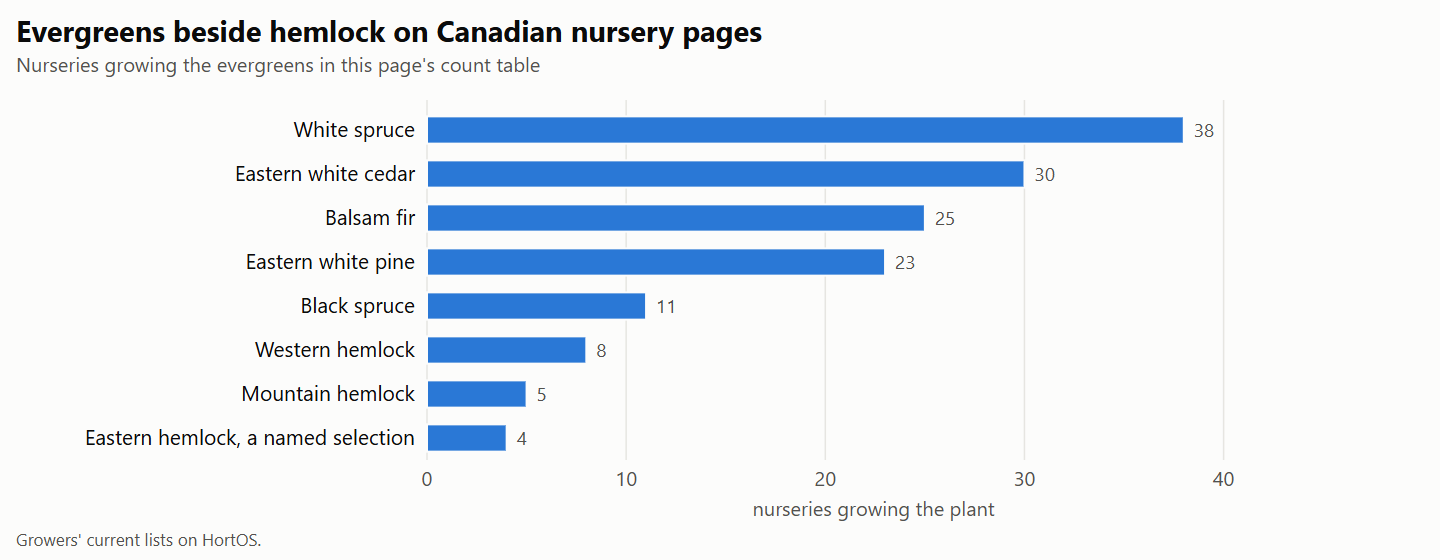
Hemlock woolly adelgid in Canada: rules and stand-in evergreens
For stewardship groups, conservation authorities and arborists in Canada: the areas the federal Order regulates for hemlock woolly adelgid, the recent detections outside them, what moving hemlock requires, how the authorities describe treatment, and the conifers Ontario names for restoring some of hemlock's functions, with how many Canadian nurseries grow each. Counts only.