Salix candida
Willow
Every Salix candida on HortOS in one place: the plain species and 2 varieties. Pick a size to see it across all of them.
Part of Salix: see them all
6 growers · 3 sizes · from $29.70 ex tax
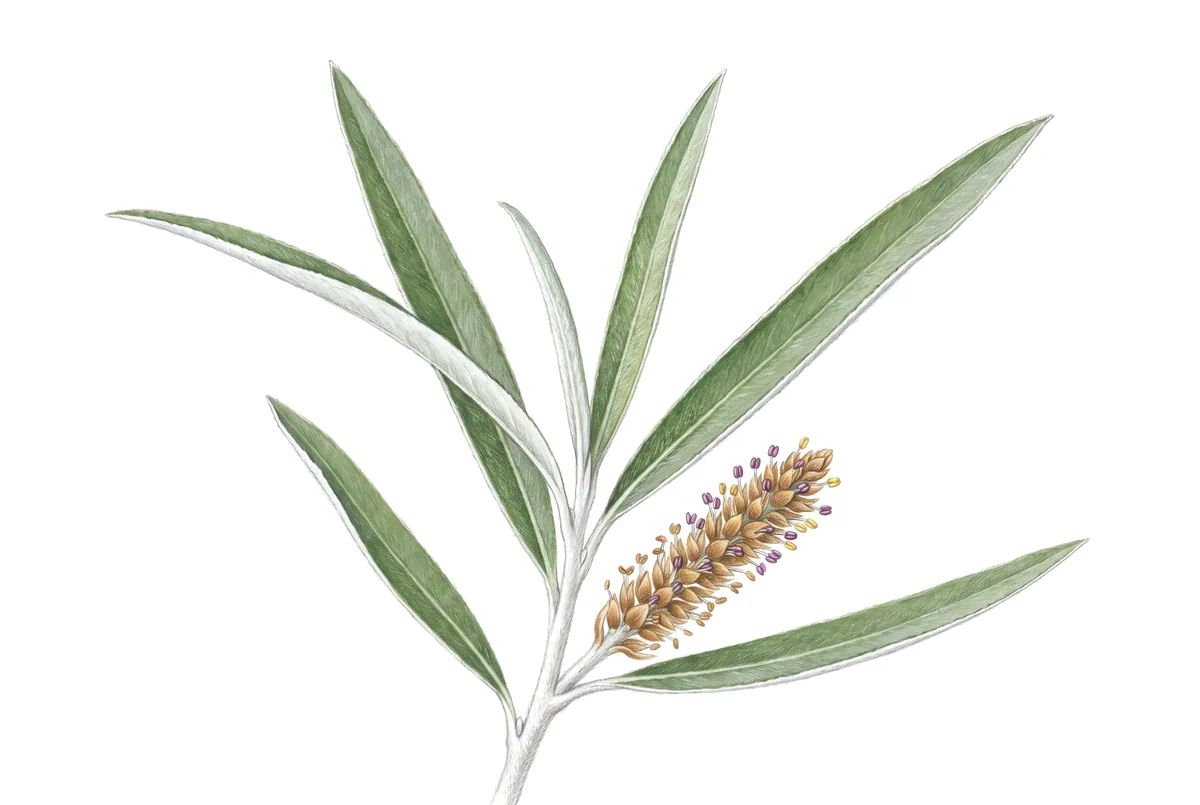
- Type
- Deciduous shrub
- Height
- 0.3 m to 2.5 m
- Flowers
- Purple, spring to early summer, as the leaves emerge
- Hardiness
- Canadian zones 0a to 7b (Natural Resources Canada, observed range)
- In Canada
- Native
Also grown by 1 nursery (no sizes or prices listed)
Enquire with them for sizes and prices.
- Verbinnen's NurseryHamilton, Ontario
Growing sage willow
Where it grows. VASCAN, the Database of Vascular Plants of Canada, records it as native in every province and territory, from British Columbia and the Yukon to Newfoundland and Labrador. The Canadian Museum of Nature's guide finds it on river floodplains, marl bogs, fens and meadows on calcareous ground, and says that for that reason it is quite local or even rare in many parts of its wide range. E-Flora BC calls it common in southern British Columbia in and east of the Coast-Cascade Mountains, on moist to wet floodplains, shores, marl bogs, thickets and meadows in the montane zone, and infrequent farther north.
Hardiness. Natural Resources Canada's plant hardiness site gives an observed zone range in Canada of 0a to 7b, an observed range rather than a rating. Trees and Shrubs Online, a British reference, calls it a distinct and hardy species.
The plant. E-Flora BC describes a shrub of 0.3 to 1 m with erect branches flexible at the base and densely hairy twigs; Trees and Shrubs Online gives up to 1.5 or 1.8 m, of stiff, erect habit. Male and female catkins are borne on separate plants and open as the leaves emerge or just before. It hybridises with many willows, by the Canadian Museum of Nature's guide, and E-Flora BC names Salix myrtillifolia and Salix petiolaris among them. No Canadian reference read gives growing advice for gardens.
Using sage willow
Trees and Shrubs Online gives 1811 as its year of introduction and calls it worth growing for the vivid whiteness of its young leaves. The Canadian Museum of Nature's guide notes that its hybrids are easily recognised and often collected, largely for the conspicuous woolly hairs they inherit. The clone sold as Iceberg Alley is the cultivar 'Jefberg' (spelt 'Jetberg' by Trees and Shrubs Online, which says it is not clear how distinct it is), and has its own page.
What to check before you buy
Hoary willow is listed as Endangered under the Endangered Species Act of Nova Scotia. Canadian growers list its selection under Salix candida 'Jefberg' and Salix candida 'Iceberg Alley'. Canadian growers name sizes by container class, #1, #2, #3, #5 and #10, as the guide to plant grades and container sizes sets out; the table above shows the sizes growers list. What to check in the roots before stock leaves the grower is in the guide to nursery plant quality.
Prices are set by each grower and shown ex tax. Availability is confirmed by the grower at order.
Common questions
- Who grows Salix candida wholesale in Canada?
- 6 wholesale growers list Salix candida on HortOS right now, each with their own pot sizes and trade prices. They are in Ontario, Alberta, British Columbia, Saskatchewan and Manitoba. The growers are named on this page.
- What pot sizes does Salix candida come in?
- Growers on HortOS list Salix candida in 2G, 3G and 5G.
- How do I order Salix candida from these growers?
- HortOS is for the trade. Add the lines you want to a list and send it: each grower gets their part of the order by email, confirms what they have and quotes freight, and nothing is bought until you approve it. Listing, searching and ordering are free.
- Is sage willow native to Canada?
- Yes. VASCAN records it as native in every province and territory, and E-Flora BC gives its range from Alaska, the Yukon and the Northwest Territories east to Newfoundland and south to Colorado, Iowa and New Jersey.
- How tall does sage willow grow?
- E-Flora BC gives 0.3 to 1 m, the Canadian Museum of Nature's guide 0.3 to 2.5 m, and Trees and Shrubs Online up to 1.5 or 1.8 m.
- Why does sage willow look white?
- The undersides of its leaves are densely covered in white woolly hairs, by E-Flora BC and the Canadian Museum of Nature's guide, and Trees and Shrubs Online says the upper surface is white with down at first, later dull green. The young twigs are densely woolly too.
- When does sage willow flower?
- The Canadian Museum of Nature's guide gives mid-April to early July, the catkins opening as the leaves emerge; Trees and Shrubs Online gives April. The male catkins have purple anthers that turn yellow.
- Is hoary willow at risk in Canada?
- Nova Scotia lists it as Endangered under its Endangered Species Act. The Canadian Museum of Nature's guide says its need for calcareous ground makes it quite local or even rare in many parts of its range.
Sources
- GBIF species match API
- VASCAN, the Database of Vascular Plants of Canada (Canadensys): Salix candida
- E-Flora BC, the Electronic Atlas of the Flora of British Columbia: Salix candida
- Canadian Museum of Nature: Guide to Salix (Willow) in the Canadian Maritime Provinces
- Trees and Shrubs Online (International Dendrology Society): Salix candida, and the genus Salix
- Natural Resources Canada, Canada's Plant Hardiness Site: Salix candida
- Government of Nova Scotia: Categorized List of Species at Risk (Endangered Species Act)
- The HortOS catalogue for Canada (the names growers list sage willow's selection under)
- The HortOS guides for Canada (plant grades and container sizes by market; nursery plant quality)
The growers, sizes and prices above are live and change as lists arrive. Cite this page: HortOS, Sage willow (Salix candida), https://ca.hortosapp.com/plants/salix-candida.
Found a fact that is wrong? Tell us and it is checked against its source.