Rubus idaeus 'Boyne'
European Red Raspberry (Edible)
One of 21 Rubus idaeus varieties: see them all
8 growers · 5 sizes · from $19.90 ex tax
- Type
- Deciduous shrub
- Height
- 1.4 m to 1.5 m
- Hardiness
- Canadian zones 0a to 8a (Natural Resources Canada)
- In Canada
- Native
| Size | Grower | PricePrice ex tax | ||
|---|---|---|---|---|
| 72 plug tray | Cityscape Plants Ltd.72 plug tray | Price on application. Sign in to ask the grower. | ||
| 1G | Eagle Lake Nurseries Ltd1G | $19.90 | ||
| 1G | Sunstar Nurseries Ltd.1G | $19.95 | ||
| 1G | Flying Creek Trees1G | Price on application. Sign in to ask the grower. | ||
| 1G | Vanstone Nurseries1G | Price on application. Sign in to ask the grower. | ||
| 2G | HC Gardens2G | $21.99 | ||
| 2G | Blue Sky Nursery Ltd2G | Price on application. Sign in to ask the grower. | ||
| 2G | Vanstone Nurseries2G | Price on application. Sign in to ask the grower. | ||
| 5G | For Trees Company5G | $45.00 | ||
| 5G | Sunstar Nurseries Ltd.5G | $51.95 | ||
| 17G | For Trees Company17G | $35.00 |
Growing boyne raspberry
Where it came from. The release account from the Canada Department of Agriculture's research station at Morden records Boyne as a cross of Chief and Indian Summer made there in 1947, first selected in 1949 and sent to cooperating growers for trial under the number M-534 in 1953. It found Boyne especially adapted to southern Manitoba, and early tests suggested it may have wider adaptation. The Fruit Varieties Journal's history of Canadian raspberry breeding gives its release as 1960 and calls it the most widely planted variety in Ontario, the Prairie provinces and the upper Midwest of the United States.
Hardiness. Alberta Agriculture calls it very hardy, and the release account found it survived low temperatures on the Canadian prairies as well as or better than Chief or Latham. Manitoba Agriculture names Boyne and Souris, both developed at Morden, as hardy raspberries for northern Manitoba. The University of Saskatchewan's fruit program says its own raspberry releases are higher yielding and more cold hardy than Boyne. No reference read gives Boyne a Canadian zone of its own; Natural Resources Canada maps the species' observations in Canada from zone 0a to 8a.
Growth and problems. The release account describes a moderately vigorous, healthy plant with plenty of canes, thick, rugose, moderately glossy leaves that stand up to strong winds, and a plant that appeared fairly drought tolerant and generally free of disease. Alberta Agriculture adds that it suckers freely and is susceptible to verticillium wilt.
Using boyne raspberry
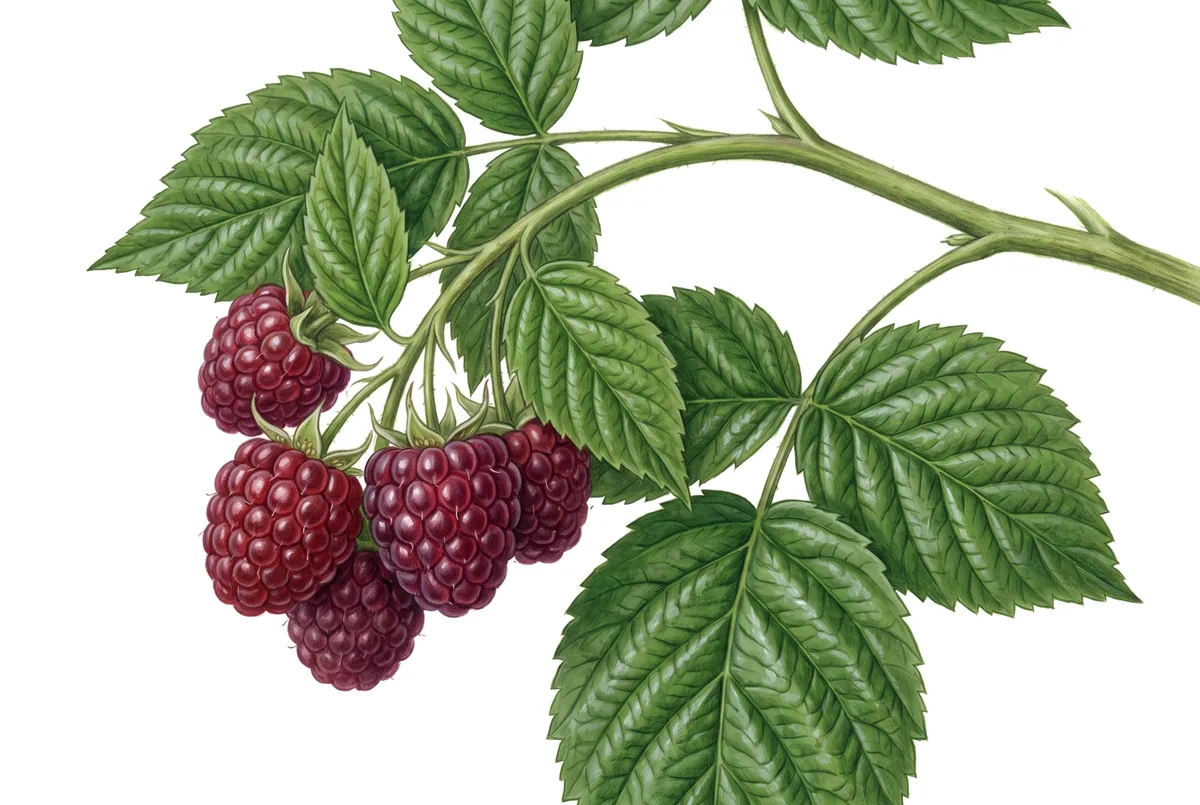
Boyne is grown for its fruit, early to mid-season by Alberta Agriculture. The release account describes medium-sized, dark red berries, ten of them weighing about 25 g, turning somewhat purplish when over-ripe, with firmly cohering drupelets that keep their shape in handling, and an aromatic, sprightly, medium-acid flavour; Alberta Agriculture finds the fruit rather tart. The account rated Boyne good to very good for eating fresh and excellent for freezing and canning, and especially suited to home gardens, local markets and processing. Over-ripe berries tend to drop, so the crop needs more frequent picking.
Planting. Alberta Agriculture sets raspberries 60 to 100 cm apart in the row with rows 3 to 4 m apart, keeping the row about 0.45 m wide. The Fruit Varieties Journal names Nova, Red River, Double Delight and Souris among later Canadian raspberries with Boyne in their ancestry.
What to check before you buy
Canadian growers list it as Boyne raspberry and as Rubus idaeus 'Boyne'. The Canadian Food Inspection Agency admits imported Rubus planting material, other than seed, only from the continental United States, the Netherlands or Germany. Canadian growers name containers by class, #1, #2, #3, #5 and #10 (plant grades and container sizes), and the root checks are in the guide to nursery plant quality. The table above shows the sizes growers list. The species, its range and its care are on the red raspberry page.
Cautions
The canes are prickly. Alberta Agriculture calls them very spiny; the release account found the prickles of young canes slender and rather weak, and those of older canes brittle and not very noticeable.
Used forediblefruit and orchard
Prices are set by each grower and shown ex tax. Availability is confirmed by the grower at order.
Common questions
- Who grows Rubus idaeus 'Boyne' wholesale in Canada?
- 8 wholesale growers list Rubus idaeus 'Boyne' on HortOS right now, each with their own pot sizes and trade prices. They are in Alberta, Ontario, British Columbia, Saskatchewan and Manitoba. The growers are named on this page.
- What pot sizes does Rubus idaeus 'Boyne' come in?
- Growers on HortOS list Rubus idaeus 'Boyne' in 72 plug tray, 1G, 2G, 5G and 17G.
- How do I order Rubus idaeus 'Boyne' from these growers?
- HortOS is for the trade. Add the lines you want to a list and send it: each grower gets their part of the order by email, confirms what they have and quotes freight, and nothing is bought until you approve it. Listing, searching and ordering are free.
- Is Boyne a summer-bearing or a fall-bearing raspberry?
- Summer-bearing. Alberta Agriculture lists it among the floricane varieties, which fruit on the canes of the year before, early to mid-season for Boyne.
- How hardy is Boyne raspberry?
- Alberta Agriculture calls it very hardy, and Manitoba Agriculture names it as a hardy raspberry for northern Manitoba. The University of Saskatchewan's own releases are, by its fruit program, more cold hardy than Boyne.
- How tall does Boyne grow?
- Its release account gives medium-tall canes of 1.4 to 1.5 m, erect, stocky and 10 to 11 mm thick.
- Where was Boyne raspberry bred?
- At the Canada Department of Agriculture's research station at Morden, Manitoba, from a 1947 cross of Chief and Indian Summer. The Fruit Varieties Journal gives its release as 1960.
- What does Boyne fruit taste like?
- The release account calls the flavour aromatic, sprightly and medium acid, probably a little strong for the best dessert quality, and rates the berries excellent for freezing and canning. Alberta Agriculture finds them rather tart.
Sources
- E-Flora BC, the Electronic Atlas of the Flora of British Columbia: Rubus idaeus
- VASCAN, the Database of Vascular Plants of Canada: Rubus idaeus
- Fruit Varieties and Horticultural Digest (American Pomological Society): Boyne raspberry, the release account from the Canada Department of Agriculture's Research Branch at Morden, Manitoba
- Fruit Varieties Journal (American Pomological Society): Raspberry breeding in Canada, 1920 to 1995
- Alberta Agriculture: Raspberries in Alberta
- University of Saskatchewan, Fruit Program: Raspberries
- University of Saskatchewan, Fruit Program: Popular fruit varieties (handout)
- Manitoba Agriculture: fruit crops
- Natural Resources Canada, Canada's Plant Hardiness Site: Rubus idaeus
- Canadian Food Inspection Agency, directive D-18-01: phytosanitary requirements for imported small fruit propagative material
- The HortOS catalogue for Canada (the names growers list Boyne raspberry under)
- The HortOS guides for Canada (plant grades and container sizes by market; nursery plant quality)
The growers, sizes and prices above are live and change as lists arrive. Cite this page: HortOS, Boyne raspberry (Rubus idaeus 'Boyne'), https://ca.hortosapp.com/plants/rubus-idaeus-boyne.
Found a fact that is wrong? Tell us and it is checked against its source.