Prunus avium
plum
Every Prunus avium on HortOS in one place: the plain species and 5 varieties. Pick a size to see it across all of them.
Part of Cherry: see them all
10 growers · 11 sizes · from $60.00 ex tax
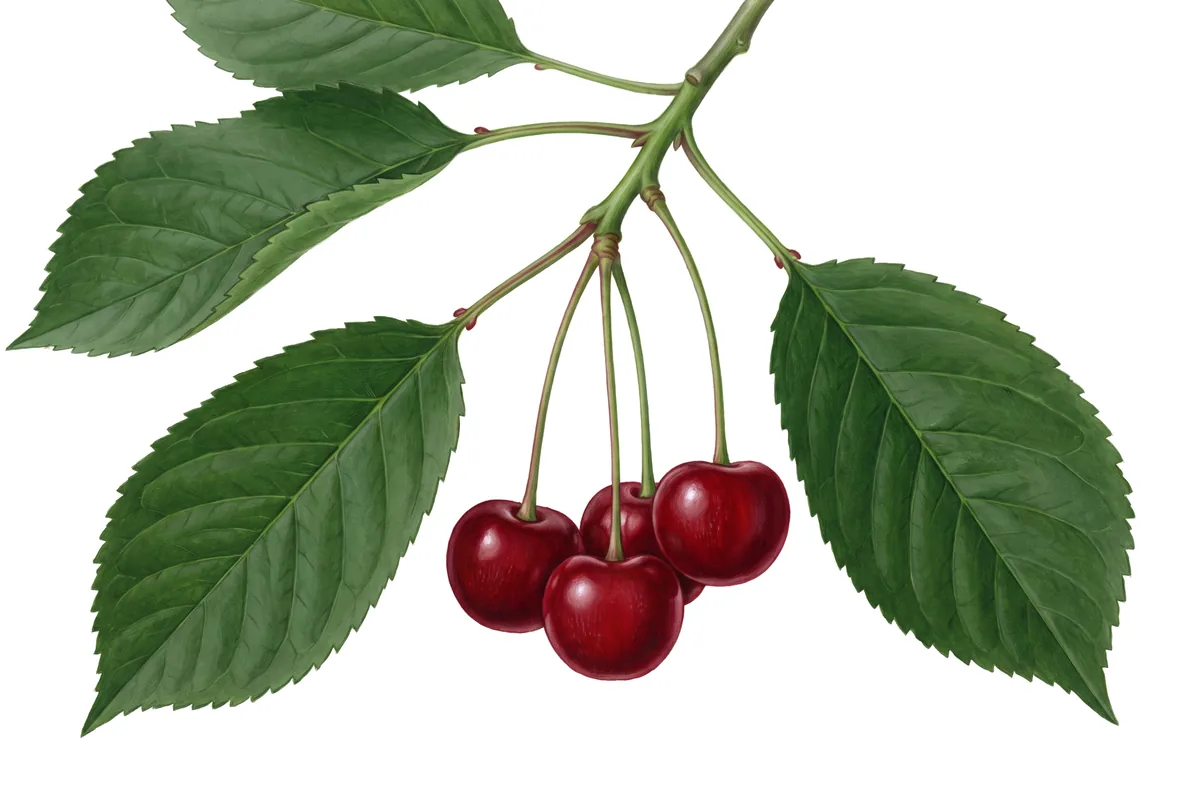
- Type
- Deciduous tree
- Height
- 4.6 m to 20 m
- Spread
- 4.6 m to 10 m
- Flowers
- White, spring, by the South Australian Plant Selector+ and NC State; late spring, by the RHS
- Sun
- Full sun, by the South Australian Plant Selector+, NC State and the RHS; full sun to part shade, by the Missouri Plant Finder
- Frost
- The fruit buds are sensitive to spring frost as the flowers open
- Hardiness
- Canadian zones 3a to 9a (Natural Resources Canada)
- In Canada
- Naturalised
Also grown by 8 nurseries (no sizes or prices listed)
Enquire with them for sizes and prices.
- Canada Green Nursery & Garden CenterSt. George, New Brunswick
- Corn Hill NurseryCornhill, New Brunswick
- Countryside Tree Farms & LandscapingDe Winton, Alberta
- Eco-SenseVictoria, British Columbia
- Green Thumb NurseriesTwillingate, Newfoundland and Labrador
- Halifax PrennialsHalifax, Nova Scotia
- JVKLincoln, Ontario
- Silver Creek Nursery Ltd.Wellesley, Ontario
Growing sweet cherry
Hardiness. Natural Resources Canada's records show sweet cherry growing in Canadian zones 3a to 9a. The American NC State and Missouri Plant Finder give USDA zones 3 to 8, which are not Canadian zones, and the British RHS rates it H6.
Site and soil. NC State and the RHS give it full sun. NC State and the Missouri Plant Finder ask for moisture-retentive soil with good drainage and say it will not tolerate wet soils. In British Columbia, E-Flora BC gives its habitat as mesic to moist forest edges and fields in the lowland zone, and calls it infrequent in the south of the province. No reference read gives a drought rating.
Pruning. The RHS says cherries are best fan-trained so they can be netted against birds, with fans trained in spring and established trees pruned while the fruit is harvested in summer.
Pests. American references list leaf spot, bacterial canker, brown rot, leaf curl, powdery mildew and shot-hole among its diseases, and aphids, fruit flies, sawflies and scale among its insects. The British RHS says it may be susceptible to cherry blackfly, winter moth caterpillar, silver leaf and blossom wilt.
Using sweet cherry
Sweet cherry is planted for its fruit and as an ornamental tree. NC State, an American reference, says it is cultivated for its edible fruit and valued for its fragrant white spring flowers and yellow autumn leaves. The Missouri Plant Finder, also American, says the species itself is generally grown as an ornamental cherry, its own fruit smaller and less sweet than the cultivars', and that birds and squirrels love the fruit.
For fruit, the variety decides the crop. The BC Tree Fruit Production Guide's table of dark sweet cherries marks some varieties self-fertile, among them Lapins, Skeena, Santina and Sandra Rose, and others not, among them Van, Regina and Sylvia. It calls Lapins the standard for mid to late season varieties. Other cherries, plums and their relatives sit under Prunus.
What to check before you buy
Read the variety on each line: Canadian growers list sweet cherry as Prunus avium followed by a variety, Lapins, Bing, Van, Stella, Sweetheart or Rainier, and as Cherry prunus avium with no variety named. Two Ontario bodies list it among invasive plants: Credit Valley Conservation ranks it as having the potential to become invasive in Ontario, and the Ontario Invasive Plant Council puts it in its Category 4, exotic species that are not a serious threat to natural areas unless competing directly with more desirable vegetation. Canadian growers name a container by its class and grade trees by calliper, as the guide to plant grades and container sizes explains, and the table above shows the sizes growers list. For trees, the guide to lead times and pre-orders says to order the year before.
Cautions
For cherries (Prunus spp.), the ASPCA lists the plant as toxic to dogs, cats and horses: its entry says the stems, leaves and seeds contain cyanide, particularly as they wilt. NC State, an American reference, gives sweet cherry medium severity poison characteristics, with the seeds and fruit stalks holding the most cyanide compounds. The Upper Thames River Conservation Authority lists sweet cherry among the invasive trees of its Ontario watershed that should not be planted.
Used forfruit and orchardedibleshade
Prices are set by each grower and shown ex tax. Availability is confirmed by the grower at order.
Common questions
- Who grows Prunus avium wholesale in Canada?
- 10 wholesale growers list Prunus avium on HortOS right now, each with their own pot sizes and trade prices. They are in Ontario, British Columbia, Alberta, Quebec and Manitoba. The growers are named on this page.
- What pot sizes does Prunus avium come in?
- Growers on HortOS list Prunus avium in 1G, 2G, 3G, 5G, 7G, 10G, 15G, 16G, 52G, 57G and 1 more sizes.
- How do I order Prunus avium from these growers?
- HortOS is for the trade. Add the lines you want to a list and send it: each grower gets their part of the order by email, confirms what they have and quotes freight, and nothing is bought until you approve it. Listing, searching and ordering are free.
- Is sweet cherry native to Canada?
- No. VASCAN gives it as introduced in British Columbia, Ontario, New Brunswick and Nova Scotia, and its record for Quebec as doubtful. E-Flora BC says it was introduced from Eurasia, and the Missouri Plant Finder says birds and squirrels have helped it spread from gardens into the wild in eastern North America.
- Where in Canada does sweet cherry grow?
- Natural Resources Canada's records show it growing in Canadian zones 3a to 9a. The USDA zones 3 to 8 that American references give are on a different scale.
- Are mazzard, gean and bird cherry the same tree?
- Yes, by the Canadian references. VASCAN and Natural Resources Canada give mazzard cherry, gean, bird cherry and wild cherry as English names of Prunus avium, with sweet cherry the name VASCAN prefers. The Ontario Invasive Plant Council lists it as bird cherry.
- Does a sweet cherry need a second tree to fruit?
- It depends on the variety. The BC Tree Fruit Production Guide marks Lapins, Skeena, Santina and Sandra Rose self-fertile, and Van, Regina and Sylvia not.
- How tall does sweet cherry grow?
- E-Flora BC gives 5 to 25 m. NC State and the Missouri Plant Finder give 4.6 to 9.1 m high and wide, Missouri 6.1 to 9.1 m in cultivation, and the RHS more than 12 m high and 8 m wide.
Sources
- GBIF species match API (Prunus avium)
- ASPCA Animal Poison Control, Toxic and Non-Toxic Plants: Cherry (Prunus spp.)
- VASCAN, the Database of Vascular Plants of Canada (Canadensys): Prunus avium, names and distribution by province
- E-Flora BC, the Electronic Atlas of the Flora of British Columbia (University of British Columbia): Prunus avium
- North Carolina State Extension Gardener Plant Toolbox: Prunus avium, sweet cherry
- Missouri Botanical Garden Plant Finder: Prunus avium
- Royal Horticultural Society, RHS Plants: Prunus avium, wild cherry, a British reference
- Natural Resources Canada, Canada's Plant Hardiness Site: Prunus avium
- BC Tree Fruit Production Guide (British Columbia Fruit Growers' Association): cherry varieties
- Upper Thames River Conservation Authority (Ontario): Invasive non-native plants in the Upper Thames River watershed
- Credit Valley Conservation (Ontario): Priority list of invasive plants
- Ontario Invasive Plant Council: A landowner's guide to managing and controlling invasive plants in Ontario, appendix
- The HortOS catalogue for Canada (the names growers list sweet cherry under)
- The HortOS guides for Canada (plant-grades-and-container-sizes-by-market; lead-times-pre-orders-and-contract-growing)
The growers, sizes and prices above are live and change as lists arrive. Cite this page: HortOS, Sweet cherry (Prunus avium), https://ca.hortosapp.com/plants/prunus-avium.
Found a fact that is wrong? Tell us and it is checked against its source.