Phalaris arundinacea
Reed Canary Grass
Every Phalaris arundinacea on HortOS in one place: the plain species and 3 varieties. Pick a size to see it across all of them.
11 growers · 8 sizes · from $1.70 ex tax
- Type
- Grass
- Height
- 0.5 m to 2 m
- Growth
- Fast
- Flowers
- Green, May to July (Nova Scotia Invasive Species Council)
- Hardiness
- Canadian zones 1b to 9a (Natural Resources Canada)
- In Canada
- Native
Growing reed canarygrass
Where it grows. VASCAN, the Database of Vascular Plants of Canada, records the typical variety as native in Alberta, British Columbia, Manitoba, New Brunswick, Newfoundland, the Northwest Territories, Nova Scotia, Ontario, Quebec, Saskatchewan and Yukon, and the striped garden form, var. picta, as introduced in ten provinces. E-Flora BC finds it in wet meadows, ditches and lakeshores, common in southern British Columbia and rare northward, and says cultivars brought in from Europe and Asia hybridize with native populations to give aggressive offspring, so its origins are debated in some regions.
Native and invasive forms. The Ontario Invasive Plant Council says only genetic analysis reliably tells them apart. Its native form grows in shallow water among rocks along lake and large river shores from Lake Superior east, is smaller, with small purple-tinged seed heads, and forms sparse stands. The invasive form is commoner in marshes, ditches and slow streams inland from the lower Great Lakes and along rivers such as the Thames, Ottawa and St. Lawrence, with larger, greenish seed heads and dense stands of nothing else.
Hardiness. Natural Resources Canada maps it from zone 1b to 9a in Canada, an observed range. E-Flora BC says it tolerates freezing and emerges early in spring.
How it spreads. The Ontario council says it reproduces by seed and by rhizome; each panicle can shed upwards of 500 seeds that float, last up to 4 years in the soil and mostly germinate within 2. The Nova Scotia Invasive Species Council says it builds a large seedbank and a permanent rhizome bed in its first year, and must be dug out, since mowing will not kill it.
Using reed canarygrass
The Ontario Invasive Plant Council says some cultivars are bred for forage and as possible biomass crops, and that the modern forage cultivars, among them 'Palaton', 'Marathon' and 'Venture', are considered non-invasive and are not as aggressive as older kinds. It lists other uses made of reed canary grasses: soil and water restoration, shoreline stabilisation, wastewater treatment, bio-energy, forage, seed mixes, pulp and paper, and the garden. E-Flora BC says it is sometimes introduced as a pasture grass and that cultivars, ribbon grass among them, are still sold in British Columbia nurseries. Metro Vancouver, with the Invasive Species Council of Metro Vancouver, advises against buying, trading or growing reed canarygrass plants or seeds for erosion control, landscaping or farming. The striped form, ribbon grass, has its own page.
What to check before you buy
On the HortOS catalogue for Canada, growers list named forms of it under the name reed canary grass: 'Picta', 'Feesey' and 'Dwarf Garters'. The Ontario Invasive Plant Council says the size, shape and height of the plants differ between its many subspecies and cultivars, and that a transparent ligule marks every strain. The City of Toronto's drought-tolerant landscaping guide puts ribbon grass, Phalaris arundinacea, on its list of invasive species not to be planted near natural ravine areas. The table above shows the sizes growers list.
Cautions
The Ontario Invasive Plant Council calls the invasive form tenacious and aggressive, displacing native species in sensitive wetland habitats, and lists var. picta among horticultural plants to be on alert for. Metro Vancouver's fact sheet says it forms dense patches in wetlands, ditches and wet meadows, and the Nova Scotia Invasive Species Council that it quickly dominates wet sites and is extremely hard to remove. The Ontario council says its shallow rhizomes can grow more than 3 m a year, and Metro Vancouver that pieces of stem and root can make new plants.
Prices are set by each grower and shown ex tax. Availability is confirmed by the grower at order.
Common questions
- Who grows Phalaris arundinacea wholesale in Canada?
- 11 wholesale growers list Phalaris arundinacea on HortOS right now, each with their own pot sizes and trade prices. They are in Alberta, British Columbia, Manitoba, Ontario and Quebec. The growers are named on this page.
- What pot sizes does Phalaris arundinacea come in?
- Growers on HortOS list Phalaris arundinacea in 32 plug tray, 150mm, 1G, 2G, 4G, 5G, 50G and 4".
- How do I order Phalaris arundinacea from these growers?
- HortOS is for the trade. Add the lines you want to a list and send it: each grower gets their part of the order by email, confirms what they have and quotes freight, and nothing is bought until you approve it. Listing, searching and ordering are free.
- Is reed canarygrass native to Canada?
- VASCAN records the typical variety as native in nine provinces, Yukon and the Northwest Territories. The Ontario Invasive Plant Council's guide says the invasive form spreading in Ontario is thought to be an escaped Eurasian cultivar.
- Is reed canarygrass invasive in Canada?
- Invasive species councils in Ontario, British Columbia and Nova Scotia treat it as invasive in wetlands, ditches and wet meadows. Metro Vancouver advises against buying, trading or growing its plants or seeds.
- How tall does reed canarygrass grow?
- E-Flora BC gives stems 50 to 150 cm tall, sometimes to 200 cm; the Ontario Invasive Plant Council gives 1 to 2 m, and the Nova Scotia Invasive Species Council up to 1.7 m.
- How do you recognise reed canarygrass?
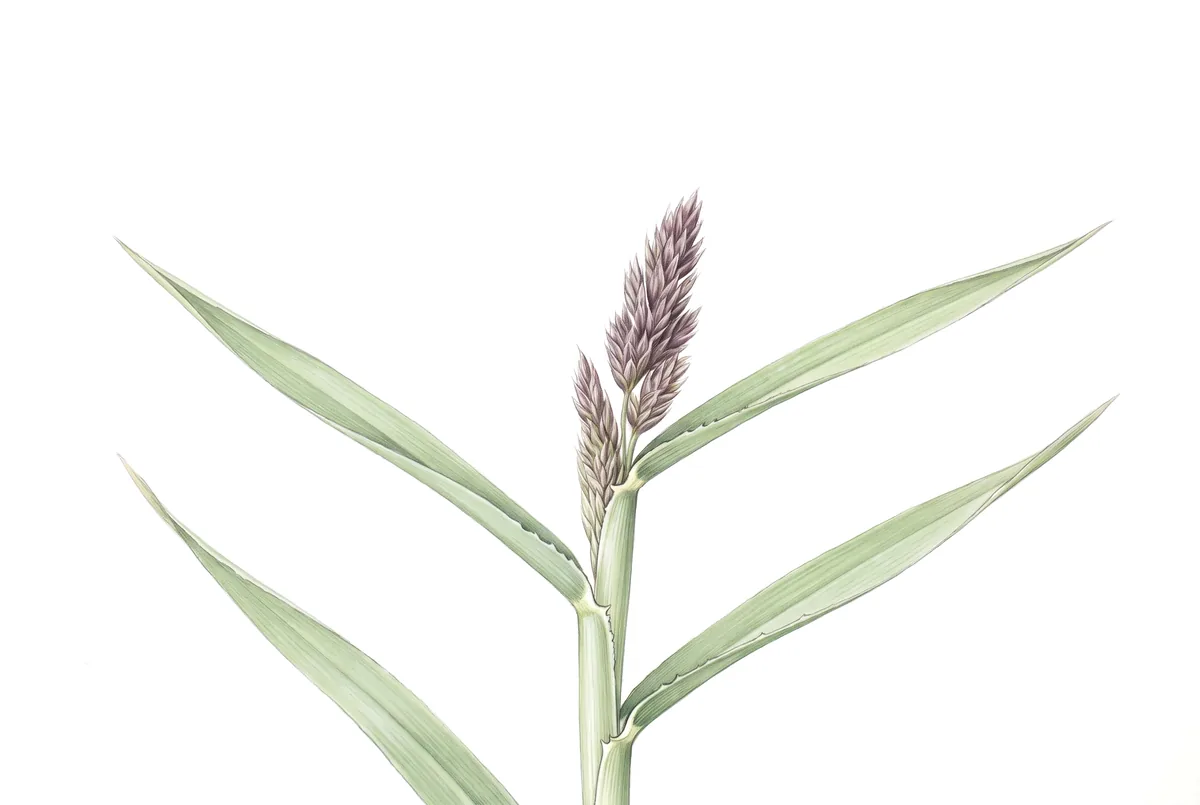
- The Ontario Invasive Plant Council names a transparent ligule as the mark of every strain, with flat, tapered leaves held at a 45 degree angle and panicles that turn from green to dark purple-brown, then straw-coloured.
- Is ribbon grass the same plant as reed canarygrass?
- Yes, a form of it. The Ontario Invasive Plant Council calls ribbon grass a cultivar of reed canary grass, with white-striped leaves, and VASCAN files it as var. picta.
Sources
- GBIF species match API: Phalaris arundinacea
- VASCAN, the Database of Vascular Plants of Canada: Phalaris arundinacea, with var. arundinacea and var. picta
- E-Flora BC, the Electronic Atlas of the Flora of British Columbia (University of British Columbia): Phalaris arundinacea
- Natural Resources Canada, Canada's Plant Hardiness Site: Phalaris arundinacea
- Ontario Invasive Plant Council: Reed Canary Grass, Best Management Practices in Ontario
- Ontario Invasive Plant Council: Grow Me Instead, a guide for southern Ontario (its alert species)
- Metro Vancouver with the Invasive Species Council of Metro Vancouver: Tackling Reed Canarygrass
- Nova Scotia Invasive Species Council: Reed Canary Grass fact sheet
- City of Toronto, City Planning: Drought Tolerant Landscaping (its invasive species list)
- The HortOS catalogue for Canada (the names growers list reed canarygrass under on ca.hortosapp.com)
The growers, sizes and prices above are live and change as lists arrive. Cite this page: HortOS, Reed canarygrass (Phalaris arundinacea), https://ca.hortosapp.com/plants/phalaris-arundinacea.
Found a fact that is wrong? Tell us and it is checked against its source.