Malus floribunda
Japanese Flowering Crap Apple
Part of Malus spp.: see them all
1 grower · 1 size · from $99.95 ex tax
- Type
- Deciduous tree
- Height
- 4.6 m to 9 m
- Spread
- 5.5 m to 9.1 m
- Flowers
- Pink, spring
- Sun
- Full sun
- Hardiness
- Canadian zones 3b to 7b (Natural Resources Canada)
- In Canada
- Not native
| Size | Grower | PricePrice ex tax | ||
|---|---|---|---|---|
| 5G | Coaldale Nurseries Ltd5G | $99.95 |
Also grown by 2 nurseries (no sizes or prices listed)
Enquire with them for sizes and prices.
- Flying Creek TreesRegina, Saskatchewan
- Stewart Tree FarmsCalgary, Alberta
Growing japanese flowering crabapple
Origin. Kwantlen, a horticulture school in British Columbia, and the Missouri Botanical Garden give its home as Japan.
Hardiness. Natural Resources Canada's plant hardiness site has recorded Japanese flowering crabapple growing in Canadian zones 3b to 7b, the zones where it has been observed, not a rating. Kwantlen gives Zone 4 (-34 to -29 °C) without naming the scale, and the Missouri Botanical Garden USDA zones 4 to 8.
Site and soil. Kwantlen gives full sun to part shade, acidic, well-drained soil and moderate water use. The Missouri Botanical Garden names a medium-moisture, well-drained, acidic loam as best and says the tree adapts to a wide range of soils.
Pruning and problems. The Missouri Botanical Garden advises pruning as needed in late winter and avoiding spring, when fresh cuts can let the fire blight bacterium in. Kwantlen lists fungal leaf spot, mites, rust, scale insects and apple scab; the Missouri Botanical Garden reports moderate disease resistance, with apple scab, leaf spot, powdery mildew and fire blight among the diseases.
Using japanese flowering crabapple
Kwantlen lists Japanese flowering crabapple as a specimen plant, for espalier, for fragrance, for woodland margins and urban agriculture, and as a tree that attracts birds and beneficial insects. The Missouri Botanical Garden calls it an old favourite with one of the best mid-spring flower displays of any crabapple, an excellent flowering lawn or street tree, effective as a specimen or in small groups, and warns that it needs room for its spread and should not be planted too close to buildings or roads.
Kwantlen gives flowers 2 to 3 cm across in May, and small, edible pomes about 9 to 13 mm across, yellow to red, in August and September; the Missouri Botanical Garden says the fruit is not very showy and seldom lasts past autumn, though birds eat it.
What to check before you buy
Growers in the HortOS catalogue for Canada list it as Malus floribunda, under the name Japanese flowering crab apple, and as Malus floribunda crab apple. Natural Resources Canada also gives the names showy crab apple and Japanese flowering crab apple. Check the botanical name on each line, not only the words crab apple. The guide to specifying and procuring trees covers writing a tree order that names a calliper, a height, a container volume and the standard they come from, and Canadian growers name container sizes by class, as the guide to plant grades and container sizes explains. The table above shows the sizes growers list.
Cautions
The ASPCA lists apple, and says the entry includes crabapples, as toxic to dogs, cats and horses, giving cyanogenic glycosides in the stems, leaves and seeds as the toxic principle.
Prices are set by each grower and shown ex tax. Availability is confirmed by the grower at order.
Common questions
- Who grows Malus floribunda wholesale in Canada?
- 1 wholesale grower lists Malus floribunda on HortOS right now, each with their own pot sizes and trade prices. They are in Alberta. The growers are named on this page.
- What pot sizes does Malus floribunda come in?
- Growers on HortOS list Malus floribunda in 5G.
- How do I order Malus floribunda from these growers?
- HortOS is for the trade. Add the lines you want to a list and send it: each grower gets their part of the order by email, confirms what they have and quotes freight, and nothing is bought until you approve it. Listing, searching and ordering are free.
- Is Japanese flowering crabapple hardy in Canada?
- Natural Resources Canada has recorded it growing in Canadian zones 3b to 7b, the zones where it has been observed. Kwantlen gives Zone 4 (-34 to -29 °C) without naming the scale.
- How big does Malus floribunda grow?
- Kwantlen gives 7 to 10 m tall and wide. The Missouri Botanical Garden gives 4.6 to 7.6 m tall and 5.5 to 9.1 m wide, and says it needs room for that spread.
- What colour is the blossom?
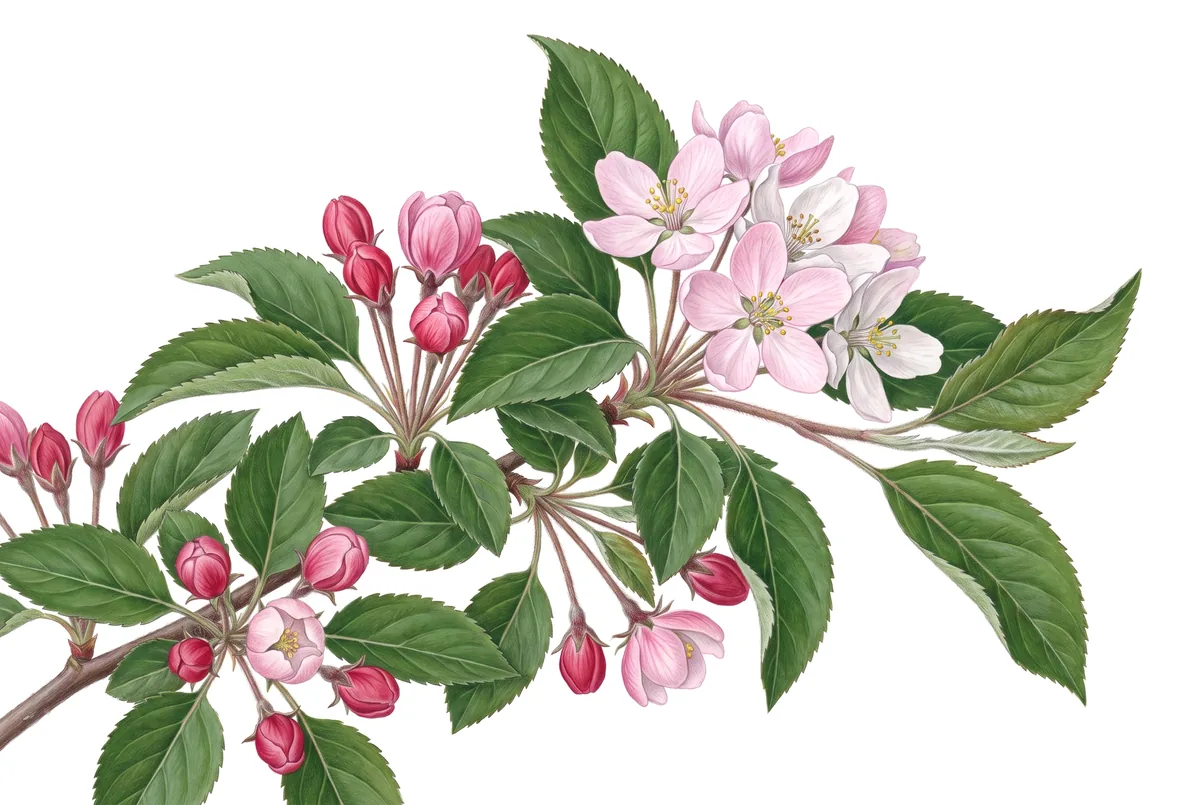
- Kwantlen gives deep pink buds that open pale pink, the petals pink to white, fragrant, in May. The Missouri Botanical Garden says the pale pink flowers mature to white.
- Is Japanese flowering crabapple native to Canada?
- No. Kwantlen and the Missouri Botanical Garden give its home as Japan.
- Is crabapple poisonous to pets?
- The ASPCA's apple entry includes crabapples and lists them as toxic to dogs, cats and horses: the stems, leaves and seeds contain cyanogenic glycosides.
Sources
- GBIF species match API (Malus floribunda)
- VASCAN, the Database of Vascular Plants of Canada (Canadensys), name search: Malus floribunda
- Missouri Botanical Garden Plant Finder: Malus floribunda
- ASPCA Animal Poison Control Center, toxic and non-toxic plants: Apple (crabapples included)
- Natural Resources Canada, Canada's Plant Hardiness Site: Malus floribunda
- Kwantlen Polytechnic University, School of Horticulture, KPU Plant Database: Malus floribunda
- The HortOS catalogue for Canada (the names growers list Japanese flowering crabapple under)
- The HortOS guides for Canada (specifying and procuring trees; plant grades and container sizes)
The growers, sizes and prices above are live and change as lists arrive. Cite this page: HortOS, Japanese flowering crabapple (Malus floribunda), https://ca.hortosapp.com/plants/malus-floribunda.
Found a fact that is wrong? Tell us and it is checked against its source.