Leucothoe fontanesiana
Drooping Leucothoe / Doghobble
Every Leucothoe fontanesiana on HortOS in one place: the plain species and 5 varieties. Pick a size to see it across all of them.
Part of Leucothoe: see them all
8 growers · 4 sizes · from $2.96 ex tax
- Type
- Evergreen shrub
- Height
- 0.6 m to 1.8 m
- Spread
- 0.6 m to 2.4 m
- Flowers
- White, spring (RHS)
- Sun
- Part shade; tolerates full shade; full sun only with consistent moisture (Missouri Botanical Garden)
- Hardiness
- Canadian zones 6b to 7b (Natural Resources Canada)
- In Canada
- Not native
Growing drooping leucothoe
In Canada. Drooping leucothoe is not native here: the Missouri Botanical Garden gives its home as moist mountain forests, thickets, stream banks and ravines from New York south to Alabama and Georgia, mainly in the Appalachians.
Hardiness. Natural Resources Canada's records show it growing in zones 6b to 7b in Canada. The Missouri Botanical Garden and NC State Extension call it hardy to USDA zone 5, a different scale, yet both advise a protected place and a good mulch: the garden a winter mulch in the St. Louis area, NC State Extension a mulch in some areas. The garden lists USDA zones 5 to 8, NC State Extension 4 to 6, and the RHS rates it H6.
Light, soil and water. The Missouri Botanical Garden grows it best in moist, acid, organically rich, cool, well-drained loams, sandy to clay, in part shade; it tolerates full shade, takes full sun only with consistent moisture, and tolerates neither drought nor wind. NC State Extension calls it sensitive to heat, and the RHS grows it in moist, acid soil in shade or partial shade.
Pruning and pests. NC State Extension says it can be severely pruned to manage its height. American references report no serious insect or disease problems, though leaf spot can damage the foliage where air circulation is poor. The RHS calls it generally pest-free and says it may be susceptible to honey fungus where that is present.
Using drooping leucothoe
The Missouri Botanical Garden suggests drooping leucothoe for woodland and shade gardens, naturalised areas, stabilising banks and hedges, and NC State Extension adds specimen and accent planting in native, pollinator and winter gardens. NC State Extension says its flowers draw bees, butterflies and other pollinators, that it gives good cover in winter, and that it is highly resistant to deer damage.
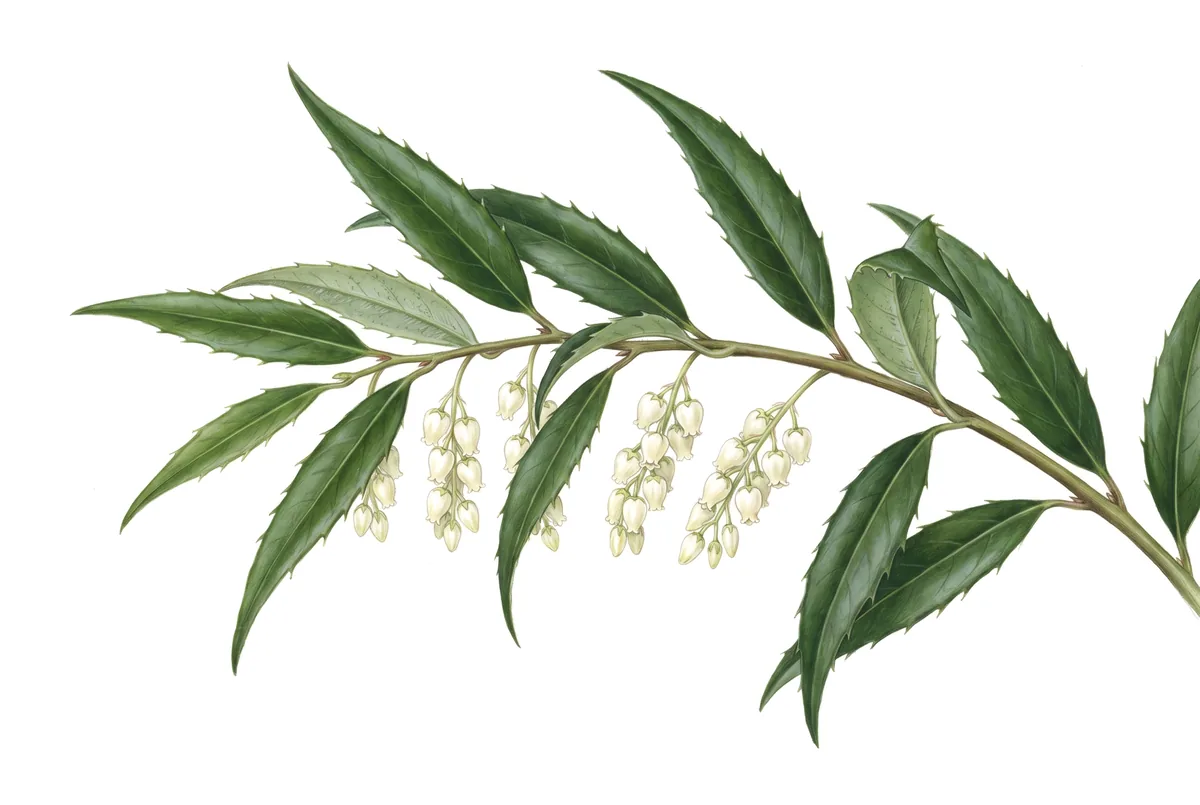
Trees and Shrubs Online shows it in a wood in North Yorkshire as a very dense thicket covering the ground, and notes that because the flowers are all borne on the lower side of the branches, a branch often needs lifting for the full display to be seen. The leaves change with the seasons: the RHS says they are often tinged purple in winter, and NC State Extension that plants in autumn and winter sun show good colour and that the new growth is red. The variegated Rainbow has its own page, and the other leucothoes are on the genus page.
What to check before you buy
The Canadian Food Inspection Agency names drooping leucothoe in Appendix 1 of its directive D-01-01 among the plants regulated for Phytophthora ramorum, the cause of sudden oak death, so its rules on moving nursery stock bear on this plant. Canadian growers list it mostly as named selections, 'Rainbow', Nana and Scarletta among them, under the common names drooping leucothoe and doghobble; read the full name on each line. Canadian growers name containers by class, as the guide to plant grades and container sizes explains, and the guide to nursery plant quality sets out the root and pest checks. The table above shows the sizes growers list.
Cautions
The ASPCA lists the genus Leucothoe as toxic to dogs, cats and horses, naming grayanotoxins, and says that eating a few leaves can cause serious problems. NC State Extension gives drooping leucothoe a high poison severity for people, in the leaves and flowers. The Canadian Food Inspection Agency regulates it for Phytophthora ramorum.
Named (as Leocothoe fontanesiana, drooping leucothoe) in Appendix 1 of the CFIA directive D-01-01 among the plants regulated for Phytophthora ramorum (sudden oak death): its plants and plant parts are regulated. (Canadian Food Inspection Agency, directive D-01-01, Appendix 1)
Used forhedging and screeningspecimen
Prices are set by each grower and shown ex tax. Availability is confirmed by the grower at order.
Common questions
- Who grows Leucothoe fontanesiana wholesale in Canada?
- 8 wholesale growers list Leucothoe fontanesiana on HortOS right now, each with their own pot sizes and trade prices. They are in British Columbia and Ontario. The growers are named on this page.
- What pot sizes does Leucothoe fontanesiana come in?
- Growers on HortOS list Leucothoe fontanesiana in Quart, 1G, 2G and 3G.
- How do I order Leucothoe fontanesiana from these growers?
- HortOS is for the trade. Add the lines you want to a list and send it: each grower gets their part of the order by email, confirms what they have and quotes freight, and nothing is bought until you approve it. Listing, searching and ordering are free.
- Is drooping leucothoe native to Canada?
- No. The Missouri Botanical Garden gives its native range as the south-eastern United States, from New York south to Alabama and Georgia, mainly in the Appalachian Mountains. Trees and Shrubs Online says it was introduced to cultivation in 1793.
- How hardy is drooping leucothoe in Canada?
- Natural Resources Canada's records show it growing in zones 6b to 7b in Canada. American references call it hardy to USDA zone 5 but advise a protected place and a good mulch.
- Is Leucothoe fontanesiana the same as Leucothoe axillaris or L. walteri?
- GBIF and World Flora Online accept Leucothoe fontanesiana as the name. The RHS lists Leucothoe axillaris var. editorum and Leucothoe walteri as synonyms of it, and Trees and Shrubs Online gives L. walteri as a synonym too. Canadian growers list Leucothoe axillaris as a separate line.
- How big does drooping leucothoe get?
- Trees and Shrubs Online gives 0.6 to 1.8 m high, and the Missouri Botanical Garden a mound 0.9 to 1.8 m tall and as wide. NC State Extension gives 0.6 to 1.8 m tall and 1.2 to 2.4 m wide, and the RHS puts it in its 1 to 1.5 m height class and its 1.5 to 2.5 m spread class.
- Is drooping leucothoe poisonous?
- Yes, by the ASPCA, which lists the genus as toxic to dogs, cats and horses. NC State Extension gives drooping leucothoe a high poison severity for people, in the leaves and the flowers.
- What are the flowers like?
- Trees and Shrubs Online describes white, slenderly pitcher-shaped flowers 6.4 mm long, crowded on racemes 2.5 to 5.1 cm long in the leaf axils, all on the lower side of the arching branches. NC State Extension gives late April into June and calls them fragrant to ill-scented.
Sources
- GBIF species match API: Leucothoe fontanesiana
- World Flora Online, name matching: Leucothoe fontanesiana
- VASCAN, the Database of Vascular Plants of Canada (Canadensys): name search for Leucothoe fontanesiana
- ASPCA Animal Poison Control, Toxic and Non-Toxic Plants: Dog Hobble (Leucothoe)
- Trees and Shrubs Online (International Dendrology Society): Leucothoe fontanesiana; the genus Leucothoe
- Missouri Botanical Garden Plant Finder: Leucothoe fontanesiana
- North Carolina State Extension Gardener Plant Toolbox: Leucothoe fontanesiana
- Royal Horticultural Society, RHS Plants: Leucothoe fontanesiana
- Natural Resources Canada, Canada's Plant Hardiness Site: Leucothoe fontanesiana
- Canadian Food Inspection Agency, directive D-01-01, Appendix 1: plants regulated for Phytophthora ramorum
- The HortOS catalogue for Canada: the listing rows for Leucothoe
- The HortOS guides for Canada: plant grades and container sizes by market; nursery plant quality
The growers, sizes and prices above are live and change as lists arrive. Cite this page: HortOS, Drooping leucothoe (Leucothoe fontanesiana), https://ca.hortosapp.com/plants/leucothoe-fontanesiana.
Found a fact that is wrong? Tell us and it is checked against its source.