Buddleja davidii
Butterfly Bush
Every Buddleja davidii on HortOS in one place: the plain species and 6 varieties. Pick a size to see it across all of them.
Part of Buddleia: see them all
9 growers · 3 sizes · from $5.00 ex tax
- Type
- Deciduous shrub
- Height
- 1 m to 3.7 m
- Spread
- 1 m to 4.6 m
- Growth
- Fast
- Flowers
- Lilac, spring to summer by PlantNET; summer to autumn by HortFlora
- Sun
- Full sun
- Drought
- Tolerant
- Hardiness
- Canadian zones 3b to 9a (Natural Resources Canada)
- In Canada
- Naturalised
Also grown by 2 nurseries (no sizes or prices listed)
Enquire with them for sizes and prices.
- Foxglove Wholesale NurseryKelowna, British Columbia
- Pépinière LocasLaval, Quebec
Growing butterfly bush
In Canada. VASCAN, the Database of Vascular Plants of Canada, gives it as introduced in British Columbia and Ontario. E-Flora BC calls it frequent in south-western British Columbia, on south-eastern Vancouver Island and in the lower Fraser Valley, on mesic to dry disturbed ground and rocky slopes in the lowland zone. Natural Resources Canada maps its observations in Canada from zone 3b to 9a, an observed range, not a rating, with nearly all its records outside the country.
Position and size. The KPU Plant Database, from Kwantlen Polytechnic University's School of Horticulture in British Columbia, gives full sun to part shade, well-drained soil and moderate, summer-dry water use, and a mature size of 2 to 3 m tall and 3 to 4 m across. The Invasive Species Council of BC gives up to 5 m. The Missouri Botanical Garden, an American reference, says it does poorly in wet, poorly drained ground.
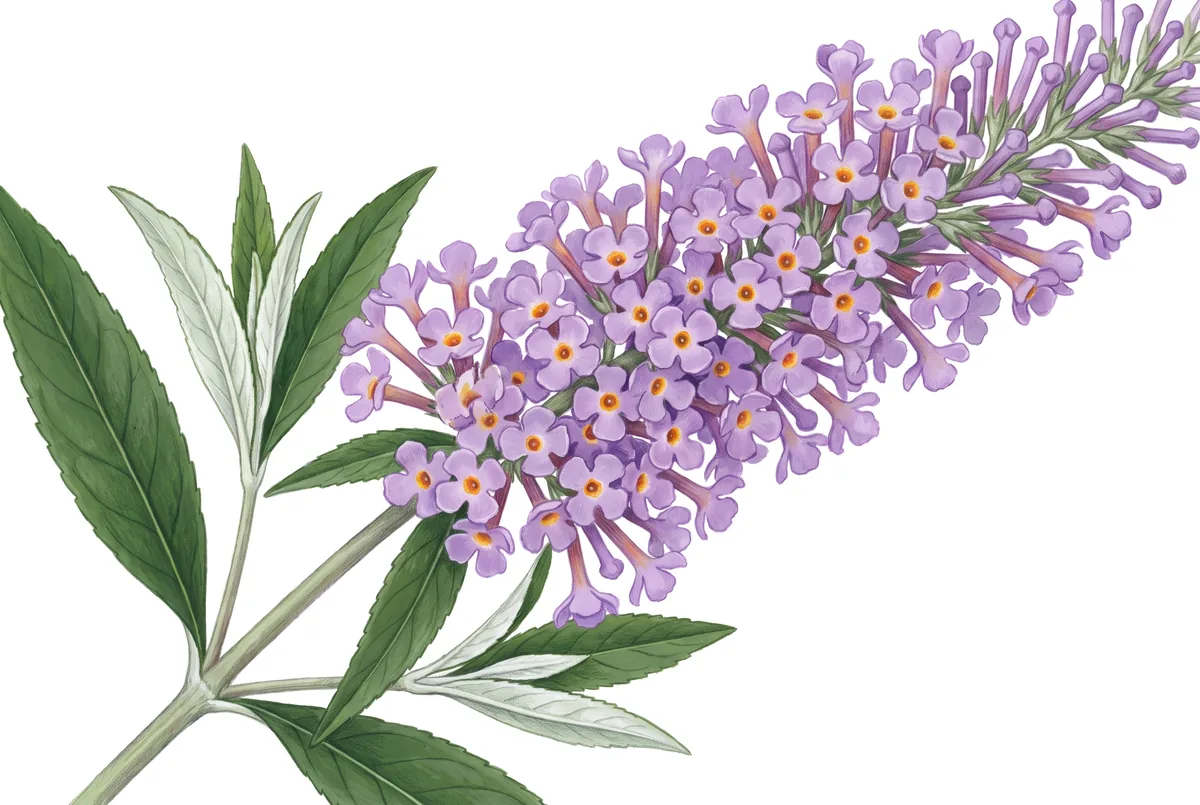
Leaves and flowers. By the KPU Plant Database the leaves are opposite and lance-shaped, mostly 8 to 25 cm long, green to grey-green above and white and downy beneath, and the flowering peak runs from June to September. E-Flora BC gives each flower four spreading lobes, purplish with an orange eye, in clusters 15 to 25 cm long, followed by sharp-pointed two-part capsules.
Pruning and pests. North Carolina State Extension says it flowers on new growth and is best pruned in early spring. American references report spider mites.
Using butterfly bush
The KPU Plant Database lists it for attracting butterflies, for fragrance and for summer interest. Metro Vancouver, the regional district, says adult butterflies drink its nectar but that it gives no habitat or food to butterfly eggs and larvae, and that native flowering shrubs are the best host plants for every stage of native butterflies. For British Columbia, the Invasive Species Council of BC suggests blue elderberry, California lilac, Lewis's mock orange, Meyer lilac or red-flowering currant in its place. Canadian growers also list it by cultivar: Black Knight has its own page, and the buddleia page covers the genus as growers list it.
What to check before you buy
The Invasive Species Council of BC says a single flower cluster can produce tens of thousands of seeds, spread by wind and water and able to grow after many years in the soil. Metro Vancouver advises against buying, trading or growing butterfly bush, cultivars and varieties included, and says that even cultivars advertised as sterile can still produce seeds. The table above shows the sizes growers list, and the guide to plant grades and container sizes explains the Canadian container classes.
Cautions
Metro Vancouver says that on BC's southwest coast butterfly bush can form dense thickets, displace native plants and hold back tree growth, and that its seeds may stay viable in the soil for up to 5 years. E-Flora BC notes that the Greater Vancouver Invasive Plant Council has called it an emerging invasive species in its region.
Prices are set by each grower and shown ex tax. Availability is confirmed by the grower at order.
Common questions
- Who grows Buddleja davidii wholesale in Canada?
- 9 wholesale growers list Buddleja davidii on HortOS right now, each with their own pot sizes and trade prices. They are in British Columbia and Ontario. The growers are named on this page.
- What pot sizes does Buddleja davidii come in?
- Growers on HortOS list Buddleja davidii in 1G, 2G and 3G.
- How do I order Buddleja davidii from these growers?
- HortOS is for the trade. Add the lines you want to a list and send it: each grower gets their part of the order by email, confirms what they have and quotes freight, and nothing is bought until you approve it. Listing, searching and ordering are free.
- Is butterfly bush invasive in Canada?
- The Invasive Species Council of BC treats it as an invasive plant in British Columbia, spreading into disturbed open ground, coastal forest edges, roadsides and sunny stream banks, where it replaces native plants. VASCAN records it as introduced in British Columbia and Ontario.
- Are sterile butterfly bush cultivars safe to plant?
- Metro Vancouver says even cultivars advertised as sterile can still produce seeds, and advises against buying, trading or growing butterfly bush, cultivars and varieties included.
- What can be planted instead of butterfly bush?
- For British Columbia, the Invasive Species Council of BC names blue elderberry, California lilac, Lewis's mock orange, Meyer lilac and red-flowering currant as non-invasive alternatives.
- How big does butterfly bush grow?
- E-Flora BC gives 1 to 5 m tall. The KPU Plant Database gives 2 to 3 m tall and 3 to 4 m across.
- Does butterfly bush help butterflies?
- Metro Vancouver says adult butterflies drink the nectar but the plant offers no habitat or food for their eggs and larvae, and names native flowering shrubs as the best host plants.
Sources
- GBIF species match API
- VASCAN, the Database of Vascular Plants of Canada: Buddleja davidii
- Missouri Botanical Garden Plant Finder: Buddleja davidii
- North Carolina State Extension Gardener Plant Toolbox: Buddleja davidii
- Natural Resources Canada, Canada's Plant Hardiness Site: Buddleja davidii
- E-Flora BC, the Electronic Atlas of the Flora of British Columbia (University of British Columbia): Buddleja davidii
- KPU Plant Database (Kwantlen Polytechnic University, School of Horticulture): Buddleja davidii
- Invasive Species Council of British Columbia: Butterfly bush
- Metro Vancouver, Tackling Butterfly Bush (invasive species fact sheet)
- The HortOS catalogue for Canada (the listing names)
- The HortOS guides for Canada (plant grades and container sizes by market)
The growers, sizes and prices above are live and change as lists arrive. Cite this page: HortOS, butterfly bush (Buddleja davidii), https://ca.hortosapp.com/plants/buddleja-davidii.
Found a fact that is wrong? Tell us and it is checked against its source.